
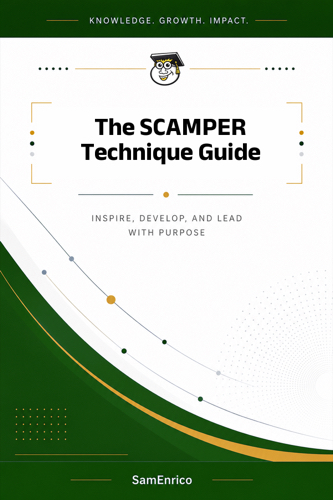
The SCAMPER Technique Guide eBook
Substitute, combine, adapt, modify, put to other u
by Cecil Hee
Substitute, combine, adapt, modify, put to other use, eliminate, reverse.
Formats
Free sample
Chapter 1: The Seven Locks--–- The conference room smelled of stale coffee and faded ambition. Fourteen people sat around a polished table that had witnessed thousands of meetings and produced perhaps three good ideas. A whiteboard stretched across one wall, pristine and waiting. The facilitator, a well-meaning director named Priya, had written one word at the top: “IDEAS.”“Okay everyone,” she said, capping her marker with a theatrical click. “We need to solve the customer retention problem.
No wrong answers. Just be creative.”Silence. Then the same three people spoke.“What if we lowered prices?” said Mark, the finance lead, who had suggested this at every meeting for eighteen months.“What if we added more features?” said Elena from product, who had suggested this at every meeting for twelve months.“What if we sent a monthly newsletter?” said James from marketing, who had suggested this at every meeting for six months, which was how long he had worked there.Priya wrote the three ideas on the whiteboard. Then she stood back, nodded encouragingly, and waited for more. The silence stretched like cold taffy.
Someone checked their phone. Someone else doodled a sailboat. The clock on the wall ticked so loudly it seemed to be mocking them.After forty-five minutes, they had generated exactly zero new ideas. The three suggestions had been rewritten, rephrased, and recombined into seven variations that were functionally identical to the original three. Priya drew a box around “lower prices” and declared it the winner.
Everyone nodded. Everyone knew nothing would change.That meeting happened somewhere in the world in the last hour. It is happening right now as you read this sentence. And it will happen again before you finish this chapter.The myth of open-ended brainstorming is one of the most expensive lies in business. We have been taught that creativity is a faucet: turn the handle, and ideas flow.
But the faucet is rusted shut. The human brain, left to its own devices, does not generate novel solutions. It generates familiar ones. It reaches for the nearest memory, the most recent success, the safest bet. This is not a flaw.
It is a survival mechanism.This chapter will show you why your brain hides your best ideas from you, how structured thinking cracks open those hidden vaults, and why seven seemingly simple questions—the SCAMPER triggers—have produced more breakthrough innovations than any brainstorming session in history. By the end, you will understand why Priya’s meeting was doomed before it started and, more importantly, what to do instead.The Pattern Machine Your brain contains approximately 86 billion neurons. Each of these neurons can form thousands of connections. The possible number of neural pathways in a single human brain exceeds the number of atoms in the known universe. And yet, when someone asks you to “be creative,” your brain does the equivalent of ordering the same sandwich from the same deli for the thousandth time.This is because the brain is not designed to be creative.
It is designed to be efficient.Efficiency, in evolutionary terms, means survival. Your ancient ancestors did not need novel solutions to escape predators. They needed fast, reliable, repeatable solutions. Run from the thing with big teeth. Eat the sweet berries, not the bitter ones.
Trust the path you walked yesterday because the path you walked yesterday did not kill you. These patterns became neural highways—well-lit, four-lane roads that your thoughts travel automatically.Psychologists call these cognitive fluency and availability heuristics. In plain English: your brain prefers the first idea that comes to mind because that idea has been used before. It is a mental shortcut. It saves energy.
And it is absolutely lethal to innovation.Consider a famous study from Stanford University. Researchers gave groups of students a classic creativity problem: generate as many uses as possible for a paperclip. One group was told to “be creative” and brainstorm freely. The other group was given a structured set of prompts—essentially a crude version of what this book will teach you. The results were not close.
The structured group generated 7 times more highly novel ideas than the free-form group. But here is the detail that haunts every open-ended brainstorming session: the free-form group produced roughly the same number of ideas as the structured group. The difference was in quality, not quantity. The free-form group repeated variations of the same three or four concepts (hold papers together, pick a lock, make a hook). The structured group generated ideas that were genuinely unexpected (a miniature conductor for electricity, a tool for resetting tiny circuit breakers, a bookmark that clips to the page, a device for cleaning between keyboard keys).The free-form group worked just as hard.
They filled just as many pages. They left just as tired. But their brains had defaulted to the nearest neural highway every single time.This is the first truth you must accept: You are not bad at creativity. You are using the wrong method.The Paradox of the Empty Page Open-ended brainstorming feels productive because it is democratic and low-pressure. Anyone can participate.
There are no wrong answers. The facilitator smiles and writes everything down. But this apparent freedom creates a hidden problem: choice paralysis combined with pattern matching.When you are told to generate ideas about “anything,” your brain must simultaneously:Search your entire memory for relevant concepts (too broad)Evaluate each concept for appropriateness (too slow)Discard concepts that feel risky or stupid (too safe)Present something before the silence becomes awkward (too rushed)The result is what creativity researchers call the first-thought effect. In study after study, the first three ideas generated in any brainstorming session are the most common, most obvious, and most likely to have been suggested before. The fourth idea is slightly less obvious.
The fifth is rarer. By the tenth idea, participants are scraping the bottom of their mental barrel. But here is the paradox: the tenth idea is statistically more likely to be novel and valuable than the first three combined.Why? Because the first three ideas are pulled from the most accessible neural pathways. They are the brain’s default settings.
The fourth, fifth, and sixth ideas require effort. The seventh, eighth, and ninth require struggle. By the tenth, the brain has exhausted its obvious answers and must resort to unusual connections, forgotten memories, and unlikely associations. This is where breakthrough ideas live.But most brainstorming sessions never reach the tenth idea. They stop at three.
They write them on the whiteboard. They declare victory. And they never know what they missed.The SCAMPER technique solves this problem by providing seven specific mental locks to pick. Instead of searching the entire universe for ideas (“be creative”), you search a carefully restricted territory (“substitute one material for another”). This restriction sounds counterintuitive.
Shouldn’t creativity be unlimited? No. Unlimited search space is paralyzing. Limited search space is liberating.Think of it this way: if you needed to find a specific book in a library, would you rather search the entire building at once (open-ended brainstorming) or be told the book is in the third aisle, second shelf, between 7:00 PM and 8:00 PM (structured prompt)? The second option…
This is the end of the free sample. Get the eBook to keep going. Buy now
About this book
Details
- Author
- Cecil Hee
- Publisher
- SamEnrico
- Language
- English
- Genre
- Non-Fiction, Self-Help, SCAMPER
- Released
- 2026-06-05
- Pages (approx.)
- 156
- Available as
- eBook, Audiobook

Read better in the ZLOADR app
Your eBooks on your phone or tablet. Sign in with your SamEnrico account and start reading.
More by Cecil Hee
 Blue Zone Altitude Benefits GuideCecil Hee$11.99
 Voice Actor Family BusinessCecil Hee$11.99
 Low Carb Diet for Food AddictionCecil Hee$11.99
 Nurse Patient ConversationCecil Hee$11.99
 Gold Rush Fever: The Untold Story of the Klondike’s Forgotten TycoonCecil Hee$11.99
 30 Day CAC SprintCecil Hee$12.99
 Founder Depression and AlcoholCecil Hee$12.99
 How to Start a Photocopying Machinery Business (Beginners Guide)Cecil Hee$11.99
 Understanding Winter–shortland–temple SyndromeCecil Hee$17.99
 Zoho CRM Business AutomationCecil Hee$11.99
You may also like
 Hong Kong Handover 1997Dunn Johnnie$11.99
 Zumba For Postnatal Recovery CourseNeal Christian$11.99
 Zumba for BeginnersLadner Nikia$11.99
 YouTube Comment Mining GuideHumes Pandora$12.99
 Worry Box MeditationCarlin Rudy$11.99
 Workplace Stress MeditationNguyen Lynn$11.99
 Workplace Stress and Sleep RepairHawley Ivory$11.99
 Workplace Perfectionism CureDelaney Jeffry$11.99
 Workplace Injustice Anger GuideWallen Isabelle$11.99
 Work Addiction and Burnout LinkGreenwood Ester$11.99
 Women in Yoga and WellnessBeattie Galina$11.99
 Women in Stand Up ComedyChun Evangeline$11.99