
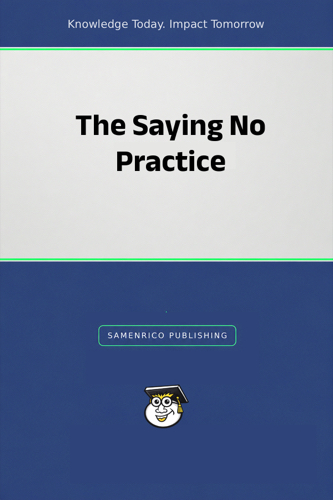
The Saying No Practice eBook
Teaches declining requests without explanation or
by Dugan Elton
Teaches declining requests without explanation or apology.
Formats
Free sample
Chapter 1: The Apology Epidemic--–- You are walking down a crowded sidewalk. Someone rounds the corner too fast, their shoulder slamming into yours. They stumble. You say, “I’m sorry.”This is not a hypothetical. This is a reflex.
You have done it thousands of times. Someone else bumps into you—literally makes contact with your body through their own inattention—and you apologize. You say sorry for existing in their path. You say sorry for having shoulders. You say sorry for being solid enough to stop their momentum.The word comes out before you can stop it.
It is automatic. It is conditioned. And it is the single most reliable predictor of whether you will spend your life saying “yes” to things you despise.This book is called The Saying No Practice. But before you can learn to say no, you must understand why you say sorry so much. Because the sorry reflex and the yes reflex are the same muscle.
You apologize for taking up space. You apologize for having needs. You apologize for the crime of being a person with limits. And then, because you have already established yourself as someone who owes the world an apology, you say yes to every request that follows. The apology is the down payment.
The yes is the debt coming due.The Hidden Cost of “Sorry”Let us begin with a simple experiment you can conduct in the next hour. Go to your email inbox or your text message history. Search for the word “sorry.” Count how many times you have used it in the last seven days. Now ask yourself: how many of those apologies were for things that were actually your fault?If you are like 94 percent of the people who have taken this exercise in workshops, the answer is “very few.” You apologized for responding slowly to a message that did not require urgency. You apologized for canceling plans because you had the flu.
You apologized for asking a question in a meeting. You apologized for asking for help. You apologized for not knowing something you were never taught.None of these are transgressions. None of these require forgiveness. And yet you offered an apology as if you had committed a sin.This matters because apologies are not neutral.
When you say “I’m sorry” to someone, you are performing a specific social transaction. You are admitting fault. You are lowering your status relative to the other person. You are handing them the power to grant or withhold forgiveness. And most importantly for the purposes of this book, you are establishing a pattern: you are the kind of person who owes the world something.Let me be clear.
There are legitimate apologies. If you break a promise, you should apologize. If you hurt someone through negligence, you should apologize. If you betray a trust, you should apologize. These are not the apologies we are discussing.
We are discussing the reflexive, habitual, unnecessary apologies that have become verbal tics. The “sorry” you say when you have done nothing wrong. The “sorry” that has become a filler word, like “um” or “like.” The “sorry” that pre-emptively announces to the world that you are a burden.The research on this is unambiguous. A study published in the Journal of Social Psychology found that people who over-apologize are perceived as less competent, less trustworthy, and lower in social status than those who apologize only when actually at fault. Another study tracking workplace dynamics found that employees who apologized for asking questions were less likely to receive help than those who asked the same questions without apology.
The apology did not make them seem polite. It made them seem needy.Here is what happens inside the brain of the person receiving your unnecessary apology. They hear “I’m sorry” and they subconsciously register: “This person believes they have done something wrong. I am now in a position of judgment. I can choose to forgive them or not.” You have created a power dynamic that did not previously exist.
You were just a person making a request or declining an invitation. Now you are a supplicant seeking absolution.The most damaging unnecessary apology is the one attached to a refusal.The Apology-No Trap Consider the following common exchange:Coworker: “Can you stay late tonight to finish the report?”You: “I’m sorry, I can’t. I have plans.”What just happened? You said no, yes. But you said no wrapped in an apology.
The word “sorry” signals that you are in the wrong. It signals that your inability to stay late is a failure on your part. It signals that the default state of affairs is you saying yes, and your no requires an exception, a justification, and an apology.Now watch what happens next. Because you apologized, the coworker feels entitled to negotiate. After all, you admitted fault.
You said you were sorry. That implies you wish you could say yes. And if you wish you could say yes, maybe you can be convinced.Coworker: “Oh, what kind of plans?”You: “Dinner with my partner.”Coworker: “Can you push it an hour? We really need this tonight.”You see the trap. The apology invited the follow-up questions.
The apology signaled that your no was negotiable. The apology suggested that you are the one with the problem, and the coworker is simply trying to help you solve it.Now compare this to the same refusal without apology:Coworker: “Can you stay late tonight to finish the report?”You: “No.”That is it. One word. No apology. No explanation.
No justification. No opening for negotiation. The coworker now has a choice: accept the no or ask for more information. If they ask for more information, you are not obligated to provide it. But here is what usually happens: they do not ask.
Because the flat no, delivered without apology, signals that the conversation is over. It signals that you are not unsure. It signals that you are not asking for permission. It signals that you have made a decision and you are not seeking absolution.The difference between the two responses is not politeness. The difference is status and clarity.
The apology version is lower status and less clear. The no-apology version is higher status and completely clear. The apology version invites negotiation. The no-apology version ends it.If you want to master the art of saying no, you must first master the art of not apologizing for it. The apology is the enemy of the boundary.
Every time you say “sorry” before a no, you have already lost half the battle.The JADE Trap: Why Explanations Are Weapons Against You The apology is the first layer of the problem. The second layer is what comes after the apology: the explanation. And the explanation is where most people truly destroy their own boundaries.Let me introduce you to a framework that will appear throughout this book. It is called JADE. It stands for Justifying, Arguing, Defending, and Explaining.
These are the four horsemen of poor boundaries. Every time you engage in any of these four behaviors after saying no, you are handing the other…
This is the end of the free sample. Get the eBook to keep going. Buy now
About this book
Details
- Author
- Dugan Elton
- Publisher
- SamEnrico
- Language
- English
- Genre
- Non-Fiction, Self-Help, Saying No
- Released
- 2026-06-08
- Pages (approx.)
- 130
- Available as
- eBook, Audiobook

Read better in the ZLOADR app
Your eBooks on your phone or tablet. Sign in with your SamEnrico account and start reading.
More by Dugan Elton
 The Stress Free Divorce Co ParentingDugan Elton$11.99
 Listening In Supply Chain GuideDugan Elton$11.99
 Bedtime Breath for InsomniaDugan Elton$11.99
 Two Minute RuleDugan Elton$11.99
 Gratitude for Nature ConnectionDugan Elton$11.99
 The Songbird's ReturnDugan Elton$11.99
 Movement Therapy AccessDugan Elton$11.99
 Jesse Owens RaceDugan Elton$11.99
 The Unseen Champions: Latin America's Women's Football Revolution (1980-2000)Dugan Elton$11.99
 The Silent Hunter: Simon Lake and the Birth of the Modern SubmarineDugan Elton$11.99
 The Last Broadcast: The Mysterious Fate of Flight MH370Dugan Elton$11.99
 The Mineral Guide to LizarditeDugan Elton$11.99
You may also like
 Hong Kong Handover 1997Dunn Johnnie$11.99
 Zumba For Postnatal Recovery CourseNeal Christian$11.99
 Zumba for BeginnersLadner Nikia$11.99
 YouTube Comment Mining GuideHumes Pandora$12.99
 Worry Box MeditationCarlin Rudy$11.99
 Workplace Stress MeditationNguyen Lynn$11.99
 Workplace Stress and Sleep RepairHawley Ivory$11.99
 Workplace Perfectionism CureDelaney Jeffry$11.99
 Workplace Injustice Anger GuideWallen Isabelle$11.99
 Work Addiction and Burnout LinkGreenwood Ester$11.99
 Women in Yoga and WellnessBeattie Galina$11.99
 Women in Stand Up ComedyChun Evangeline$11.99