
Non-FictionHealth & WellnessMediterranean
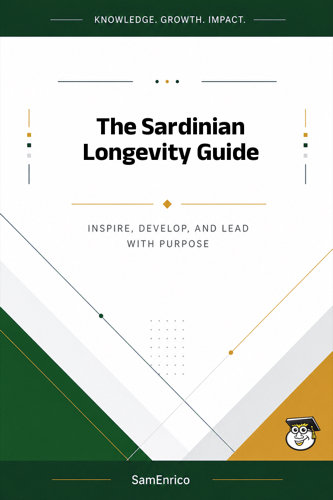
The Sardinian Longevity Guide eBook
Mountain village lifestyle, pecorino cheese, and c
Mountain village lifestyle, pecorino cheese, and centenarian men.
Formats
Free sample
Chapter 1: The Mountain's Laboratory--–- The road to Villagrande Strisaili is not a road that wants to be found. It narrows from two lanes to one, then to a gravel track that clings to the edge of a limestone canyon. On one side, vertigo. On the other, sheep—hundreds of them, blocking the way with the casual authority of creatures who have never seen a deadline. The driver, a young researcher from the University of Sassari named Dr.
Gianni Pes, checks his watch for the tenth time. He is running late. But the shepherd guiding the flock does not run. He moves at a pace that seems almost deliberately slow, his staff tapping the asphalt in a rhythm older than Rome. Pes will remember this moment years later, when the data changes everything.
The shepherd, he will learn, is ninety-seven years old. And he is not unusual here.This is how the discovery began: not in a laboratory, not with a grant proposal, but with a man in a dusty cap who refused to hurry. In the early 1990s, Pes and a demographer named Michel Poulain were validating birth records in the mountains of Sardinia's Nuoro province. They had come to confirm a hunch—that something unusual was happening to the men in this forgotten corner of the Mediterranean. What they found would rewrite the science of aging and force the world to reconsider everything it thought it knew about how to live.The men of these mountains do not merely grow old.
They grow old differently. In the rest of the world, the ratio of female to male centenarians is roughly five to one. In Villagrande, that ratio falls to two to one. In some villages, it is one to one. Men live as long as women—a statistical impossibility, according to conventional demography.
The researchers coined a term for the region: the Blue Zone. It was the first of five such zones they would eventually identify, but it remains the most mysterious. Because unlike the others—Okinawa, Ikaria, Nicoya, Loma Linda—Sardinia's longevity is not evenly distributed between sexes. It is overwhelmingly a male phenomenon. And that meant the explanation could not be diet alone.
Women in Sardinia eat the same food as men. Something else was protecting the men.The answer, as it turned out, was not hidden in a gene or a single habit. It was embedded in the landscape itself—a landscape that had been quietly engineering human longevity for thousands of years, long before anyone thought to measure it.The Accidental Laboratory The Gennargentu mountain range is not dramatic by Alpine standards. Its peaks rise to only about six thousand feet. But what it lacks in height, it makes up in inaccessibility.
This is not a range of gentle hills; it is a series of limestone ridges carved by rivers into deep, narrow canyons called codulas. For most of history, the only way in or out was by foot or mule. The Romans built roads across Sardinia, but they bypassed this region. The Phoenicians established trading posts on the coast and never ventured inland. The Byzantines, the Arabs, the Spanish—each wave of conquerors circled the mountains like water around a stone.This isolation had two profound effects.
First, it preserved a genetic lineage that had been diluted elsewhere. The mountain populations intermarried for centuries, creating a relatively homogeneous gene pool. When researchers later analyzed Y-chromosome markers, they found that the men of this region carry a distinct haplotype—labeled M26—that is rare in the rest of Italy and virtually absent in mainland Europe. This marker is associated with resilience to age-related diseases, though the precise mechanisms remain under study.But—and this is crucial—the M26 marker is not a magic wand. It does not guarantee longevity any more than owning a gym membership guarantees fitness.
The proof lies in what happens when Sardinians leave the mountains. Studies tracking migrants from Villagrande to the industrial cities of northern Italy found that the longevity advantage disappears within a single generation. The grandchildren of centenarians, raised on processed food and sedentary jobs, die at the same age as everyone else. The gene loads the gun, as the saying goes. The lifestyle pulls the trigger.The second effect of isolation was environmental.
The mountains forced a way of life that was, by accident, optimized for human healthspan. Consider the daily experience of a traditional shepherd in the 1950s, before paved roads and automobiles reached the high valleys. He woke before dawn. His first task was to walk—not for exercise, but because the sheep were two kilometers up the slope. He carried water from the village fountain, fifty pounds on each shoulder, because there was no indoor plumbing.
He built stone walls, harvested hay, milked the animals in a squatting position that maintained hip and ankle mobility. He ate what the land provided: beans from the garden, cheese from the sheep, bread from the communal oven, wine from the hillside vines. He slept when the sun set because there was no electricity.None of this was chosen for its health benefits. It was simply survival. But survival, in this specific environment, produced bodies that aged with extraordinary grace.The Shepherd's Day To understand how this works, it is helpful to walk through a single day in the life of a traditional mountain shepherd—not as nostalgia, but as a physiological case study.The shepherd rises at 5:00 AM.
This is not a choice; the sheep must be moved to pasture before the sun heats the rocks. His first activity is a walk of approximately two kilometers uphill on uneven terrain. Every step requires micro-adjustments from the ankles, knees, and hips—what biomechanists call "proprioceptive loading." This type of movement strengthens the stabilizer muscles that atrophy in people who walk only on flat, predictable surfaces. It also trains the vestibular system, reducing the risk of falls decades later.By 6:00 AM, he has reached the pasture. Now the work begins in earnest.
He squats to inspect the sheep's hooves—a position that requires full range of motion in the hips and knees. He lifts fifty-pound bags of grain from the storage hut to the feeding trough, a movement pattern known as a "loaded carry." He walks the perimeter of the enclosure to check for broken fencing, adding another kilometer of uneven terrain. By 9:00 AM, he has already accumulated three hours of low-intensity, high-duration physical activity. His heart rate has remained in what exercise physiologists call Zone 1 or Zone 2—elevated but conversational. This is the fat-burning zone, where the body preferentially oxidizes fatty acids for fuel rather than drawing on glycogen or breaking down muscle.Contrast this with the typical Western exercise protocol.
A desk worker sits for nine hours, drives home, changes into gym clothes, and spends forty-five minutes on a treadmill at high intensity. This pattern produces a brief spike in heart rate followed by prolonged sitting. The metabolic benefits of the workout are partially negated by the sedentary hours that surround it. More importantly, high-intensity exercise—while beneficial for cardiovascular fitness—can spike cortisol, the stress hormone that, when chronically elevated, accelerates aging. The shepherd never spikes his…
This is the end of the free sample. Get the eBook to keep going. Buy now
About this book
Details
- Author
- Masterson Buster
- Publisher
- SamEnrico
- Language
- English
- Genre
- Non-Fiction, Health & Wellness, Mediterranean
- Released
- 2026-06-06
- Pages (approx.)
- 116
- Available as
- eBook, Audiobook

Read better in the ZLOADR app
Your eBooks on your phone or tablet. Sign in with your SamEnrico account and start reading.
More by Masterson Buster
 Anger for Event PlannersMasterson Buster$11.99
 Workaholism in Law EnforcementMasterson Buster$11.99
 Food Intolerance Success StoriesMasterson Buster$11.99
 Submarine War Naval DoctrineMasterson Buster$11.99
 The Sky Fire of Baekje: Korea's First Aerial Gambit (660 AD)Masterson Buster$11.99
 Three Way Match OptimizationMasterson Buster$12.99
 Expense Categorization AIMasterson Buster$12.99
 Understanding Staphylococcus Epidermidis InfectionMasterson Buster$17.99
 How to Start a Petro-chemical Industry Products Business (Beginners Guide)Masterson Buster$11.99
 Blueprint ReproductionMasterson Buster$11.99
You may also like
 Hong Kong Handover 1997Dunn Johnnie$11.99
 Zumba For Postnatal Recovery CourseNeal Christian$11.99
 Zumba for BeginnersLadner Nikia$11.99
 YouTube Comment Mining GuideHumes Pandora$12.99
 Worry Box MeditationCarlin Rudy$11.99
 Workplace Stress MeditationNguyen Lynn$11.99
 Workplace Stress and Sleep RepairHawley Ivory$11.99
 Workplace Perfectionism CureDelaney Jeffry$11.99
 Workplace Injustice Anger GuideWallen Isabelle$11.99
 Work Addiction and Burnout LinkGreenwood Ester$11.99
 Women in Yoga and WellnessBeattie Galina$11.99
 Women in Stand Up ComedyChun Evangeline$11.99