
Non-FictionBiographyWest Africa
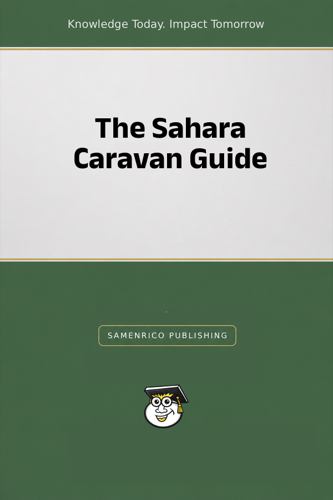
The Sahara Caravan Guide
Leads a salt caravan from Timbuktu to Taoudenni ac
Leads a salt caravan from Timbuktu to Taoudenni across Mali.
Formats
About this book
Free sample
Chapter 1: The Salt That Built Empires...--The dry wind that blows across the Sahara carries no memory, but the men who walk beneath it do. They remember a time when the white slabs cut from the earth of Taoudenni were not merely salt but currency, not merely mineral but destiny. To understand why the Azalai still moves from Timbuktu to the northern mines, you must first understand that this route was never just about seasoning food. It was about power, survival, and the quiet geometry of empires that rose and fell on the back of a camel.Before the first gasoline engine sputtered across the Sahel, before the French drew colonial borders across maps that Tuareg elders had never seen, before Timbuktu became a synonym for mystery rather than commerce, the salt caravan was the circulatory system of West Africa. The salt from Taghaza and later Taoudenni flowed south.
Gold, slaves, grain, and textiles flowed north. And between these two currents walked generations of men whose names were never recorded but whose knowledge built the wealth of the Mali and Songhai empires. This chapter traces that history not as a romantic elegy but as a practical foundation. You cannot lead a caravan unless you know why the route exists, who died to find the wells, and how the geography of salt shaped the politics of survival.The Geography of White Gold The geological story begins 100,000 years ago, when the Sahara was not a desert but a savannah dotted with lakes. The Taoudenni basin, a vast depression in the rock floor of what is now northern Mali, was once a shallow inland sea fed by rivers that have long since dried to dust.
As the climate shifted and the waters evaporated, they left behind layers of sodium chloride—rock salt—sometimes thirty meters thick, buried beneath sand and silt. In the medieval period, the most accessible deposits lay at Taghaza, a site roughly 150 kilometers south of Taoudenni. The salt there was softer, easier to cut, and lay close to the surface. For three centuries, Taghaza was the undisputed capital of Saharan salt.But…
This is the end of the free sample. Get the eBook to keep going. Buy now
Contents
- Chapter 1
- Chapter 2
- Chapter 3
- Chapter 4
- Chapter 5
- Chapter 6
- Chapter 7
- Chapter 8
- Chapter 9
- Chapter 10
- Chapter 11
- Chapter 12
Details
- Author
- Robison Sharda
- Publisher
- SamEnrico
- Language
- English
- Genre
- Non-Fiction, Biography, West Africa
- Released
- 2026-06-11
- Pages (approx.)
- 122
- Available as
- eBook, Audiobook

Read better in the ZLOADR app
Your eBooks on your phone or tablet. Sign in with your SamEnrico account and start reading.
More by Robison Sharda
 Test Performance Anxiety WorkbookRobison Sharda$11.99
 School Environmental Toxin AuditRobison Sharda$11.99
 Stress and Trembling Hands GuideRobison Sharda$11.99
 Antwerp Heist Belgian Justice SystemRobison Sharda$11.99
 The Phantom Fleet: The Vanishing Armada of 1745Robison Sharda$11.99
 The Whispering Bones of the Lamassu: Guardians of Ancient GatesRobison Sharda$11.99
 A Beginners Guide to Campdrafting (Volume 1)Robison Sharda$11.99
 Social Commerce Business SetupRobison Sharda$11.99
 Founder Led Dilution ManualRobison Sharda$12.99
 Remote Manager Conflict GuideRobison Sharda$12.99
 Understanding Fetal Enterovirus SyndromeRobison Sharda$17.99
You may also like
 Hong Kong Handover 1997Dunn Johnnie$11.99
 Zumba For Postnatal Recovery CourseNeal Christian$11.99
 Zumba for BeginnersLadner Nikia$11.99
 YouTube Comment Mining GuideHumes Pandora$12.99
 Worry Box MeditationCarlin Rudy$11.99
 Workplace Stress MeditationNguyen Lynn$11.99
 Workplace Stress and Sleep RepairHawley Ivory$11.99
 Workplace Perfectionism CureDelaney Jeffry$11.99
 Workplace Injustice Anger GuideWallen Isabelle$11.99
 Work Addiction and Burnout LinkGreenwood Ester$11.99
 Women in Yoga and WellnessBeattie Galina$11.99
 Women in Stand Up ComedyChun Evangeline$11.99