
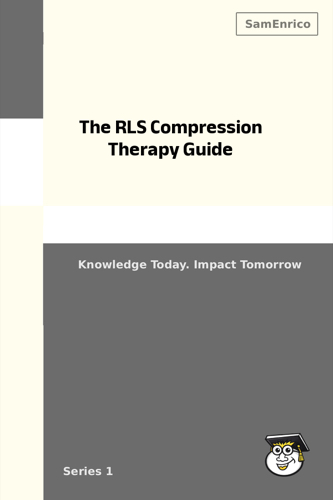
Non-FictionHealth & WellnessMedical Devices
The RLS Compression Therapy Guide Audiobook
Evaluates compression stockings and pneumatic devi
Evaluates compression stockings and pneumatic devices for symptom relief.
Formats
Free sample
Chapter 1: The Second Heart...--For eleven years, I believed my brain was broken. Every night, as the clock crept toward midnight, an electric restlessness would ignite deep within my calves—not pain, not exactly, but a desperate, crawling urgency that made stillness feel like suffocation. I would toss, turn, kick, get up, walk ten laps around the living room, lie down again, and repeat the cycle until dawn painted the windows gray. My wife moved to the guest room in year three. My career stalled from chronic exhaustion in year five.
By year eight, I was taking three different dopamine agonists, and my symptoms had spread from my legs to my arms. The drugs were making me worse. My neurologist called it augmentation. I called it a slow death of the spirit.Then, on a humid Tuesday in July, a vascular surgeon named Dr. Hamid looked at my legs—really looked at them—and asked a question no one had ever asked me: "Have you ever had your leg veins evaluated?"I said no.
Why would I? RLS is a neurological disorder. Everyone knew that. My brain was the problem. But Dr.
Hamid pointed to the faint blue ropes tracing beneath the skin of my left calf. "Those are varicose veins," he said. "Not severe enough for surgery, but enough to cause venous pooling when you sit or lie down. Your legs are filling with blood that can't return to your heart. Your brain detects the stagnation and screams at you to move.
Your legs aren't restless because your dopamine is low. They're restless because they're drowning."That conversation changed everything. It will change everything for you, too.This chapter challenges the most fundamental assumption about Restless Legs Syndrome: that it is primarily a disorder of brain chemistry. For decades, the medical establishment has treated RLS as a neurological disease requiring neurological solutions—dopamine agonists, gabapentin, benzodiazepines. These drugs help some people, sometimes, for a while.
But they also fail spectacularly for many others. Up to seventy percent of long-term dopamine agonist users experience augmentation, where the medication paradoxically worsens the condition, causing symptoms to start earlier in the day, spread to new body parts, and become more severe than before treatment began.What if the problem isn't in your brain at all? What if the problem is in your veins?The Vascular Congestion Hypothesis: A New Way of Seeing The central…
This is the end of the free sample. Get the Audiobook to keep going. Buy now
About this book
Details
- Author
- Baumgartner Matha
- Publisher
- SamEnrico
- Language
- English
- Genre
- Non-Fiction, Health & Wellness, Medical Devices
- Released
- 2026-06-06
- Pages (approx.)
- 133
- Available as
- eBook, Audiobook

Listen in the VoxFlicks app
Audiobooks and audio dramas wherever you go. Sign in with your SamEnrico account and press play.
More by Baumgartner Matha
 Strategic Silence PersuasionBaumgartner Matha$11.99
 Raisin Eating Mindfulness ExerciseBaumgartner Matha$11.99
 Earle's TED Prize WishBaumgartner Matha$11.99
 Workplace Stress and Substance UseBaumgartner Matha$11.99
 The Jade Dragon’s Oath: A Knight’s Quest in the Celestial KingdomBaumgartner Matha$11.99
 Store MerchandisingBaumgartner Matha$11.99
 How to Start a Bus Service Business (Beginners Guide)Baumgartner Matha$11.99
 Requirements Elicitation Prompt GuideBaumgartner Matha$12.99
 Return Migration Trends GuideBaumgartner Matha$12.99
 Understanding Keratoderma Palmoplantar DeafnessBaumgartner Matha$17.99
You may also like
 Hong Kong Handover 1997Dunn Johnnie$11.99
 Zumba For Postnatal Recovery CourseNeal Christian$11.99
 Zumba for BeginnersLadner Nikia$11.99
 YouTube Comment Mining GuideHumes Pandora$12.99
 Worry Box MeditationCarlin Rudy$11.99
 Workplace Stress MeditationNguyen Lynn$11.99
 Workplace Stress and Sleep RepairHawley Ivory$11.99
 Workplace Perfectionism CureDelaney Jeffry$11.99
 Workplace Injustice Anger GuideWallen Isabelle$11.99
 Work Addiction and Burnout LinkGreenwood Ester$11.99
 Women in Yoga and WellnessBeattie Galina$11.99
 Women in Stand Up ComedyChun Evangeline$11.99