
Non-FictionSelf-HelpTransition
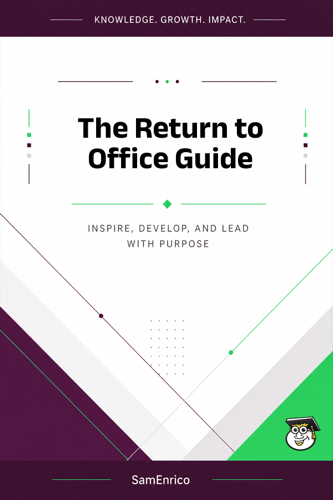
The Return to Office Guide eBook
Transition back to in person work with less stress
Transition back to in person work with less stress after remote period.
Formats
Free sample
Chapter 1: The Stolen Hours--–- It begins as a low-grade hum, barely noticeable at first. You pour your coffee, glance at the clock, and do the mental math. If you leave by 7:45 AM, you might beat the worst of it. But if there’s an accident on the highway—and there’s always an accident—you’ll sit in standstill traffic for forty-five minutes, arrive late, and spend the first hour of your workday apologizing for something that wasn’t your fault. Then you do the math again, this time in reverse.
If you leave the office at 5:15 PM, you’ll hit rush hour. If you leave at 6:00 PM, you’ll miss dinner with your kids. If you leave at 4:30 PM, your boss might notice and file it away under “not committed.” So you stay until 5:45 PM, sit in traffic anyway, and arrive home exhausted, resentful, and incapable of being fully present with the people you love.This is not a traffic problem. This is not a time management problem. This is a grief problem, and it has a name: lost time syndrome.Over the past several years, millions of workers experienced something unprecedented in the history of modern labor.
They woke up, walked a few feet to their desks, and began working without the ritual of the commute. For many, this was not merely a convenience; it was a liberation. Those one to two hours previously swallowed by traffic, trains, buses, and parking garages were suddenly returned. Some used that time to sleep longer, reducing their chronic sleep debt. Others used it to exercise, cook breakfast with their children, or simply sit in silence before the demands of the day began.
A 2022 study from the National Bureau of Economic Research found that the average American commuter saved fifty-four minutes per day during the remote work period—the equivalent of an entire extra weekend every month.Then the mandates came. And the hours were stolen back.This chapter is not a polemic against returning to the office. The decision to return, for most workers, is not theirs to make. This chapter is an acknowledgment that the commute is not neutral. It is not merely “transportation time.” It is a psychological battleground where your energy, patience, and sense of agency go to die—unless you learn to fight back.
You will learn to reframe the commute as a third space, not a lost space. You will discover the Bookend Rituals that transform chaotic transitions into deliberate ones. And you will arm yourself against Commute Theater—the exhausting performance of productivity that fools no one and drains everyone.By the end of this chapter, you will not love your commute. But you will stop letting it ruin your day before it begins.The Hidden Cost of the Commute Let us name what you have lost. Not in abstract terms, but in concrete, measurable units of human life.According to the United States Census Bureau, the average one-way commute in America is 27.6 minutes.
Round trip, that is 55.2 minutes per day. Over a standard 260-day work year, that amounts to 239 hours—or nearly ten full days—spent in transit. These are not restful hours. They are not productive hours. They are liminal hours: neither home nor work, neither rest nor labor, neither personal nor professional.
The brain remains in a state of heightened alertness, scanning for threats (the car braking ahead, the delayed train announcement), unable to fully relax or fully engage.The psychological literature calls this “commuter’s misery,” and it is remarkably consistent across cultures and transit modes. A 2014 study published in the Journal of Transport Geography found that every additional ten minutes of commuting was associated with a measurable decrease in job satisfaction, leisure time satisfaction, and overall life satisfaction. The effect was not linear; it was exponential. The difference between a ten-minute commute and a twenty-minute commute was noticeable. The difference between a twenty-minute commute and a forty-minute commute was devastating.But here is what the studies do not capture: the accumulated grief of having known something better.Before the remote work experiment, the commute was simply a fact of life.
You accepted it the way you accepted gravity. But then, for a few years, you experienced what it felt like to wake up and simply be where you needed to be. Your body was not hurled through space twice a day in a metal box. You did not arrive at work already depleted. You did not return home already resentful.
You had time—precious, unstructured, yours—and then it was taken away.That feeling is not weakness. That feeling is the natural human response to loss. And the first step toward reclaiming your equilibrium is to stop pretending the commute doesn’t bother you. It bothers you because it should.Why the Commute Feels Worse Than It Used To Three factors have conspired to make the post-remote commute uniquely painful. Understanding them is essential to overcoming them.Factor One: The Loss of Novelty.
Before the pandemic, your brain had habituated to the commute. It was a predictable, if unpleasant, routine. But after years away, that habituation has dissolved. Your brain now experiences the commute as a new stressor, and novel stressors trigger a stronger physiological response than familiar ones. Your cortisol spikes.
Your heart rate elevates. You are not just commuting; you are reacting to commuting as if it were a threat.Factor Two: The Comparison Point. Human beings evaluate their experiences relative to what they have recently known. During the remote period, your comparison point was waking up and walking to your desk. Now your comparison point is the same—but your reality is traffic.
The gap between expectation and experience creates what psychologists call “negative contrast effects.” The same commute that felt tolerable in 2019 feels unbearable in 2025 because you have tasted something better.Factor Three: The Erosion of Transitional Space. Before remote work, the commute served an unacknowledged psychological function: it was a transition zone between home and work. You listened to music, drank coffee, slowly shifted mental gears. When you worked from home, that transition disappeared—but so did the need for it. Now that you are returning to the office, the transition is back, but your brain has lost the muscle memory of how to use it.
You are trying to shift gears without a clutch.These three factors explain why the commute now feels like a violation rather than an inconvenience. You are not imagining it. You are not being dramatic. You are experiencing a predictable psychological response to a sudden environmental shift. And predictable problems have predictable solutions.Reframing the Commute: From Lost Time to Third Space The most common mistake people make when trying to fix their commute is fighting it.
They leave earlier, take alternate routes, listen to productivity podcasts, answer work emails, try to “make up” the lost time. This approach fails because it treats the commute as a problem to be solved rather than a condition to be managed.The alternative is reframing. Instead of asking, “How do I make this commute shorter or more productive?” ask, “What can this commute be for?”The answer is something urban planners and psychologists…
This is the end of the free sample. Get the eBook to keep going. Buy now
About this book
Details
- Author
- Novak Verlene
- Publisher
- SamEnrico
- Language
- English
- Genre
- Non-Fiction, Self-Help, Transition
- Released
- 2026-06-11
- Pages (approx.)
- 138
- Available as
- eBook, Audiobook

Read better in the ZLOADR app
Your eBooks on your phone or tablet. Sign in with your SamEnrico account and start reading.
More by Novak Verlene
 Values And Mission Alignment Investor Relations GuideNovak Verlene$11.99
 The Learning Zone GuideNovak Verlene$11.99
 The Burnout Creative BlockNovak Verlene$11.99
 Forgiving Your Father GuideNovak Verlene$11.99
 Merlin's Lost Canticles: The Enchanted Ballads of CamelotNovak Verlene$11.99
 How to Start a Cigarette Making Machinery Business (Beginners Guide)Novak Verlene$11.99
 International Franchise EnforcementNovak Verlene$12.99
 ClickUp Business Plan GuideNovak Verlene$12.99
 Beauty Guide ManagerNovak Verlene$11.99
 Understanding Trichostasis SpinulosaNovak Verlene$17.99
You may also like
 Hong Kong Handover 1997Dunn Johnnie$11.99
 Zumba For Postnatal Recovery CourseNeal Christian$11.99
 Zumba for BeginnersLadner Nikia$11.99
 YouTube Comment Mining GuideHumes Pandora$12.99
 Worry Box MeditationCarlin Rudy$11.99
 Workplace Stress MeditationNguyen Lynn$11.99
 Workplace Stress and Sleep RepairHawley Ivory$11.99
 Workplace Perfectionism CureDelaney Jeffry$11.99
 Workplace Injustice Anger GuideWallen Isabelle$11.99
 Work Addiction and Burnout LinkGreenwood Ester$11.99
 Women in Yoga and WellnessBeattie Galina$11.99
 Women in Stand Up ComedyChun Evangeline$11.99