
Non-FictionHistoryRetributive Justice
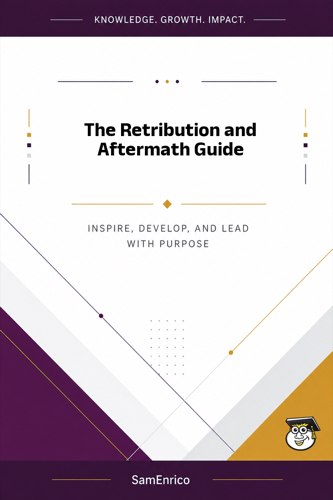
The Retribution and Aftermath Guide
Details British reprisals, execution methods, and
by Wayne Hilde
Details British reprisals, execution methods, and punitive expeditions.
Formats
About this book
Free sample
Chapter 1: The Cannon’s Lesson...--–- The morning heat over Delhi had already turned the dust to gold when the first prisoner was brought out. He was a sepoy—a soldier of the East India Company’s own army—and until six weeks earlier, he had guarded British officers, saluted the Union Jack, and believed, as his contract stated, that he served the Crown as a free man. Now he knelt in the open ground before the Kashmir Gate, stripped of his uniform, his wrists bound with hemp rope. Behind him stood a twelve-pounder cannon, its muzzle gaping like a second mouth. A British artilleryman rammed a charge home, then stepped back.
The officer in command raised his hand, then dropped it. The cannon roared. The sepoy did not die instantly—no one ever did—but what remained of him flew backward in an arc of red mist and scattered bone, painting the wall behind in a pattern that the regimental diarist would later describe as “a necessary geometry.”This was not murder, in the official account. This was pedagogy. This was civilization.I.
The Mughal Inheritance The practice of binding a prisoner to the mouth of a cannon and firing him into oblivion did not originate with the British. It was a Mughal method—sankal—used by emperors to execute rebels, traitors, and sometimes merely those who had fallen out of favor. The British East India Company, which began as a trading enterprise and metastasized into a territorial power, absorbed local customs the way water absorbs soil. But the Company did more than adopt sankal; it industrialized it. Where the Mughals had used cannon execution sparingly, as a spectacular warning reserved for high crimes, the British deployed it with the bureaucratic regularity of a railway timetable.The first recorded British use of cannon execution dates to 1764, after the Battle of Buxar, when the Company defeated the combined armies of three Indian rulers.
But the practice remained episodic until the cataclysm of 1857. By then, the Company had spent decades convincing itself of a simple, brutal proposition: Indians understood…
This is the end of the free sample. Get the eBook to keep going. Buy now
Contents
- Chapter 1
- Chapter 2
- Chapter 3
- Chapter 4
- Chapter 5
- Chapter 6
- Chapter 7
- Chapter 8
- Chapter 9
- Chapter 10
- Chapter 11
- Chapter 12
Details
- Author
- Wayne Hilde
- Publisher
- SamEnrico
- Language
- English
- Genre
- Non-Fiction, History, Retributive Justice
- Released
- 2026-06-05
- Pages (approx.)
- 132
- Available as
- eBook, Audiobook

Read better in the ZLOADR app
Your eBooks on your phone or tablet. Sign in with your SamEnrico account and start reading.
More by Wayne Hilde
 Walking Meditation For Dementia GuideWayne Hilde$11.99
 Brain Health Annual ChecklistWayne Hilde$11.99
 Relationship Anger Cognitive GuideWayne Hilde$11.99
 Forgiveness for Cultural BetrayalWayne Hilde$11.99
 The Golden Hands of Cuba: How a Gymnast Defied the Odds at the 1968 OlympicsWayne Hilde$11.99
 Understanding Ocular Motility DisordersWayne Hilde$17.99
 Seasonal Production LevelingWayne Hilde$12.99
 German University for Vietnamese StudentsWayne Hilde$12.99
 How to Become a Order ClerkWayne Hilde$11.99
 Validation EngineerWayne Hilde$11.99
You may also like
 Hong Kong Handover 1997Dunn Johnnie$11.99
 Zumba For Postnatal Recovery CourseNeal Christian$11.99
 Zumba for BeginnersLadner Nikia$11.99
 YouTube Comment Mining GuideHumes Pandora$12.99
 Worry Box MeditationCarlin Rudy$11.99
 Workplace Stress MeditationNguyen Lynn$11.99
 Workplace Stress and Sleep RepairHawley Ivory$11.99
 Workplace Perfectionism CureDelaney Jeffry$11.99
 Workplace Injustice Anger GuideWallen Isabelle$11.99
 Work Addiction and Burnout LinkGreenwood Ester$11.99
 Women in Yoga and WellnessBeattie Galina$11.99
 Women in Stand Up ComedyChun Evangeline$11.99