
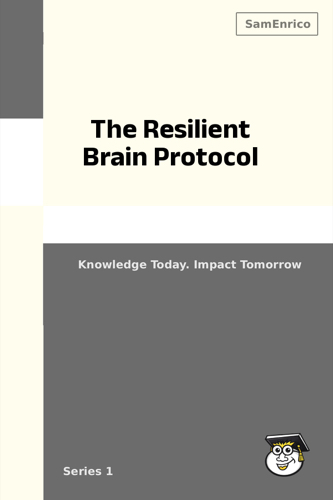
Non-FictionHealth & WellnessNeuroplasticity
The Resilient Brain Protocol eBook
Uses neuroplasticity exercises to build cognitive
by Rauch Pierre
Uses neuroplasticity exercises to build cognitive reserve against mental illness.
Formats
Free sample
Chapter 1: The Lie You Were Told--–- You have been lied to about your brain. Not out of malice, but out of outdated science that refused to die. For over a century, the dominant story in medicine was this: the adult brain is fixed, hardwired, and unchangeable. After a critical window in childhood, you were told, your brain became static—like concrete that had finally set. From that point forward, you could only lose function.
You could not grow new neurons. You could not rewire old circuits. And if you developed a mental illness, the best you could hope for was management, not recovery.That story is wrong.It was wrong when it was first proposed. It was wrong when it was taught in medical schools. And it is dangerously wrong today, because it has convinced millions of people that their anxiety, their depression, their trauma responses, and their cognitive decline are permanent features of who they are—rather than plastic patterns that can be reshaped.This book exists to hand you a different story.
One that is not based on wishful thinking or pop psychology, but on three decades of revolutionary neuroscience. The story of neuroplasticity: the brain's lifelong ability to reorganize itself by forming new neural connections throughout life. The story of cognitive reserve: the hidden buffer that allows some people to weather stress, trauma, and even brain disease without collapsing. And the story of a single molecule—a protein you have probably never heard of—that acts as your brain's own "Miracle-Gro," capable of growing new neurons and strengthening the ones you already have.But before we get to the science, we need to talk about the lie. Because you cannot build a resilient brain until you understand exactly what you are building it against.The Prison of the Fixed Mind Imagine you are a patient sitting in a psychiatrist's office in the year 1995.
You have just described months of persistent sadness, loss of pleasure in activities you once loved, and a crushing fatigue that makes getting out of bed feel like climbing a mountain. The psychiatrist nods sympathetically, writes a prescription for an antidepressant, and says something like this: "You have a chemical imbalance. Your brain doesn't produce enough serotonin. This medication will help correct that, but you will likely need to take it for the rest of your life."Now imagine you are the same patient, twenty-five years later, sitting in a different doctor's office. You have the same symptoms.
But this time, the psychiatrist says: "Your brain has fallen into a pattern. The neural circuits that regulate mood and motivation have become less connected. The good news is that the brain can change. We are going to use a combination of targeted exercises, lifestyle adjustments, and—if appropriate—medication to help you rewire those circuits. This is not a life sentence.
This is a renovation project."Same symptoms. Same patient. Radically different prognosis. The difference is not new drugs or better technology. The difference is a paradigm shift—a fundamental change in how scientists and clinicians understand the brain itself.The old paradigm, which held sway for roughly one hundred years, is called the doctrine of the static brain.
Its roots trace back to the late nineteenth century and the work of Santiago Ramón y Cajal, the father of modern neuroscience. Cajal was a brilliant Spanish histologist who used a staining technique developed by Camillo Golgi to reveal the intricate structure of neurons—the brain's basic building blocks. What Cajal saw under his microscope were individual nerve cells that did not touch each other but instead communicated across tiny gaps called synapses. He proposed what became known as the "neuron doctrine": the brain is made up of discrete, individual cells.So far, so good.But Cajal also made a second claim—one that was more speculation than observation. He argued that in the adult brain, these neural circuits were fixed and permanent.
You could lose neurons, he believed, but you could not grow new ones. And while the strength of connections might change slightly with learning, the overall architecture was immutable. This idea, later dubbed the "no new neurons" doctrine, became gospel. It was repeated in textbooks, taught in medical schools, and internalized by generations of doctors and patients.The consequences of this belief were profound and damaging. If the adult brain could not change, then recovery from brain injury was impossible beyond spontaneous healing.
If neurons could not be replaced, then cognitive decline with age was inevitable and unstoppable. And if the brain's emotional circuitry was fixed, then mental illness was essentially a hardware defect—something you managed but never truly healed.This is the lie that shaped modern mental health treatment. And it is still quietly influencing how many doctors think today, even though the evidence against it has become overwhelming.The Patient Who Should Not Have Spoken In 1997, a neuroscientist named Dr. Edward Taub made a discovery that should have been impossible under the old paradigm. He was working with stroke patients who had lost the use of one arm—in some cases, for decades.
Standard medical wisdom held that if a stroke patient had not regained function within six to twelve months, that function was gone forever. The neural circuits that controlled that arm had died, and because the adult brain could not rewire itself, there was no hope of recovery.Taub did not accept this. He had been studying neuroplasticity in animals for years, and he had seen monkeys learn to use deafferented limbs after being forced to stop using their good arms. He wondered: could the same principle work in humans?He developed a technique called Constraint-Induced Movement Therapy, or CIMT. The protocol was brutal in its simplicity.
He took patients who had been paralyzed on one side for years—patients who had given up hope—and he restrained their functional arm in a sling or a mitt. Then he made them try to use their "dead" arm for six hours a day, every day, for two weeks.The results were astonishing. Patients who had not moved their affected arm in a decade began to reach, grasp, and lift. Brain scans showed why. The areas of the brain that had been dormant—the regions that once controlled the paralyzed arm—were coming back online.
But here is the truly remarkable part: in some patients, completely different areas of the brain had taken over the job. The brain had not simply repaired old circuits. It had built entirely new ones.One patient, a woman who had suffered a stroke at age fifty-seven and lost all function in her left arm for nearly twenty years, regained the ability to brush her own hair, eat with a fork, and carry groceries. She was seventy-six years old when Taub published his study. Her brain had changed long after the "critical window" had supposedly closed.This was not a miracle.
It was neuroplasticity in action. And it should have been impossible.The story of Taub's patients is not an isolated case. It is one of thousands of examples that have forced neuroscientists to abandon the static brain model. Stroke patients learning to speak…
This is the end of the free sample. Get the eBook to keep going. Buy now
About this book
Details
- Author
- Rauch Pierre
- Publisher
- SamEnrico
- Language
- English
- Genre
- Non-Fiction, Health & Wellness, Neuroplasticity
- Released
- 2026-06-06
- Pages (approx.)
- 151
- Available as
- eBook, Audiobook

Read better in the ZLOADR app
Your eBooks on your phone or tablet. Sign in with your SamEnrico account and start reading.
More by Rauch Pierre
 Major Depressive Disorder in Children ExplainedRauch Pierre$11.99
 Net Carbs Calculation GuideRauch Pierre$11.99
 Interbrand Top 100 Value Ranking ReviewRauch Pierre$11.99
 Bullet Journal Daily ReviewRauch Pierre$11.99
 Russian Mafia in DubaiRauch Pierre$11.99
 Pat DodsonRauch Pierre$11.99
 Legacy of InnovationRauch Pierre$11.99
 The Timbuktu Scholars: Guardians of Knowledge in the Golden Age of SonghaiRauch Pierre$11.99
 The Spice King: The Rise of the Portuguese Trade MonopolyRauch Pierre$11.99
 Service Providers Guide to Public Relations SpecialistsRauch Pierre$11.99
 A Collector's Handbook to the Mini Mki CountrymanRauch Pierre$11.99
 Mailchimp Social Media Integration HandbookRauch Pierre$12.99
You may also like
 Hong Kong Handover 1997Dunn Johnnie$11.99
 Zumba For Postnatal Recovery CourseNeal Christian$11.99
 Zumba for BeginnersLadner Nikia$11.99
 YouTube Comment Mining GuideHumes Pandora$12.99
 Worry Box MeditationCarlin Rudy$11.99
 Workplace Stress MeditationNguyen Lynn$11.99
 Workplace Stress and Sleep RepairHawley Ivory$11.99
 Workplace Perfectionism CureDelaney Jeffry$11.99
 Workplace Injustice Anger GuideWallen Isabelle$11.99
 Work Addiction and Burnout LinkGreenwood Ester$11.99
 Women in Yoga and WellnessBeattie Galina$11.99
 Women in Stand Up ComedyChun Evangeline$11.99