
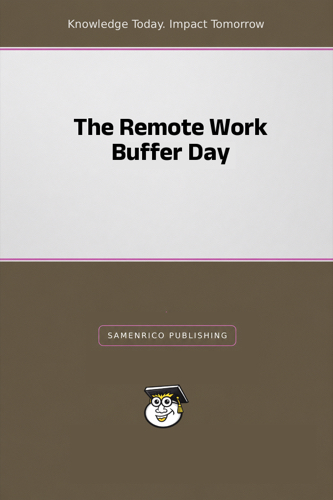
The Remote Work Buffer Day eBook
Reserves one day weekly for catch up and planning.
by Ali Ninfa
Reserves one day weekly for catch up and planning.
Formats
Free sample
Chapter 1: The Five-Day Lie--–- The email arrived at 7:14 AM. By 7:22, you had answered it, plus two Slack messages, plus a text from your manager asking if you had “a quick five minutes.” By 7:45, you had joined a Zoom call that could have been an email. By 9:00 AM, you were exhausted. And you had not yet done a single thing that actually mattered.If this sounds familiar, you are not lazy. You are not undisciplined.
You are not failing at remote work. You are, however, caught in a trap that nearly every remote worker falls into—a trap so subtle and so pervasive that most people never even see it, let alone escape it. The trap is this: you are trying to do two completely different jobs at the exact same time, every single day, and your brain was never designed for that.Let me name those two jobs. The first is the Maker. The Maker produces.
The Maker writes reports, builds spreadsheets, designs systems, solves problems, creates value. The Maker requires long, uninterrupted stretches of focus. The Maker hates context switching. The Maker’s best work happens in two-to-four-hour blocks where the outside world disappears.The second is the Manager. The Manager organizes.
The Manager plans, prioritizes, delegates, reviews, and strategizes. The Manager answers emails, triages requests, schedules meetings, and keeps the machine running. The Manager’s work is fragmented by nature—quick decisions, small actions, constant triage.In a traditional office, these two roles are at least partially separated by the structure of the day. Meetings happen in the morning. Deep work happens after lunch.
The commute provides a buffer. The physical separation of spaces—your desk versus the conference room—creates subconscious boundaries.Remote work destroyed those boundaries overnight. Now your inbox is always open. Now Slack never sleeps. Now the meeting that could have been an email is a calendar invite at 4:00 PM.
Now you answer a client question, update a spreadsheet, respond to your boss, write a proposal, join a video call, and eat lunch—all in the same ninety-minute window. You are simultaneously the Maker and the Manager, every hour of every day.And you are burning out because of it.The Invention of “Half-Work”There is a name for what happens when you try to be both Maker and Manager at the same time. It is called half-work. Half-work is when you are technically doing something—answering an email, joining a call, moving a file—but you are not making meaningful progress on anything that actually moves your life or career forward. Half-work is the sensation of being busy all day but accomplished at nothing.
Half-work is what happens when you spend eight hours switching contexts and then cannot remember a single thing you finished.The data on half-work is staggering. A 2021 study by the University of California, Irvine, found that after a single interruption—a notification, a chat message, a quick question—it takes an average of twenty-three minutes to return to the original task with the same level of focus. Twenty-three minutes. And the average remote worker is interrupted every eleven minutes. Do the math.
You are spending most of your waking work hours in the shallow end of the pool, paddling furiously but never swimming anywhere.Here is what half-work looks like in real life. You sit down at 9:00 AM to write a proposal. It is important. It is due Friday. It requires deep thinking.
You open the document, write two sentences, and a Slack notification pops up: “Quick question about the Smith file?” You answer. Three minutes later, an email arrives: “Can you review this by noon?” You flag it. You return to the proposal. You write one more sentence. Your phone buzzes—a text from your partner asking what you want for dinner.
You reply. You return to the proposal. You realize you have forgotten what you were writing. You scroll up to re-read. Thirty minutes have passed.
You have written three sentences. You feel exhausted. It is 9:30 AM.This is not a failure of willpower. This is a failure of system design. Your brain has a finite amount of attentional resources, and every time you switch contexts—from the proposal to Slack to email to text and back—you burn a little bit of that fuel.
By noon, the tank is empty. By 2:00 PM, you are running on fumes. By 5:00 PM, you are staring at your screen, unable to remember what you accomplished, feeling vaguely guilty and deeply tired.The tragedy is that you did not fail. The system failed you. And the system is not your boss, your company, or your technology.
The system is the belief that you can—and should—be both Maker and Manager, every single day, five days a week.The Puritan Work Ethic and Its Quiet Destruction This belief did not appear out of nowhere. It has deep cultural roots. The Puritan work ethic—the idea that hard work is a moral duty and that rest is suspicious—has shaped Western productivity culture for centuries. In its original form, it was about salvation through labor. In its modern form, it is about worth through busyness.The Puritan work ethic whispers three dangerous lies into the ear of every remote worker.The first lie: If you are not working, you are wasting time.
This lie makes rest feel like theft. It turns lunch breaks into guilt trips. It makes you answer emails at 10:00 PM because the laptop is right there and the notification is right there and surely one more message won’t hurt. But it does hurt. Every hour you spend in half-work is an hour you could have spent in deep recovery—or in actual, focused, meaningful work.
The Puritan work ethic confuses motion with progress.The second lie: More hours equal more output. This lie ignores the basic biology of the human brain. Cognitive performance is not linear. After about four to five hours of focused work per day, diminishing returns set in sharply. After six hours, you are mostly pretending to work.
After eight hours, you are actively harming your ability to think clearly. The most productive remote workers do not work more hours. They work better hours.The third lie: Strategic pauses are luxuries, not necessities. This lie is the most damaging of all because it directly contradicts the science of elite performance. Every high-performing system—from Olympic athletes to symphony orchestras—builds rest into its schedule.
Sprinters do not sprint every day. Violinists do not practice for twelve hours straight. They alternate intense effort with deliberate recovery. The Puritan work ethic calls this laziness. The science calls it optimization.The Buffer Day is a direct rebellion against all three lies.
It says: I will work fewer hours, but I will work better hours. It says: I will stop pretending that busyness is productivity. It says: I will build a strategic pause into every week because that pause is not a weakness—it is my competitive advantage.Introducing the Buffer Day: A Definition Let me define the Buffer Day clearly, because this book will use the term hundreds of times, and I want no confusion about what it means.The…
This is the end of the free sample. Get the eBook to keep going. Buy now
About this book
Details
- Author
- Ali Ninfa
- Publisher
- SamEnrico
- Language
- English
- Genre
- Non-Fiction, Self-Help, Buffer
- Released
- 2026-06-09
- Pages (approx.)
- 148
- Available as
- eBook, Audiobook

Read better in the ZLOADR app
Your eBooks on your phone or tablet. Sign in with your SamEnrico account and start reading.
More by Ali Ninfa
 Plant Based Glycemic Index WorkbookAli Ninfa$11.99
 The Foam Roller CompanionAli Ninfa$11.99
 Grover Cleveland Two NonconsecutiveAli Ninfa$11.99
 Email Filter Setup GuideAli Ninfa$11.99
 The Songlines of the Dreaming: Deciphering Australia's Ancient Linguistic LabyrinthAli Ninfa$11.99
 Gridlocked: The Unseen Battle for New York's Subway ExpansionAli Ninfa$11.99
 Understanding Cutaneous VascularitisAli Ninfa$17.99
 Sales Scripts for FreelancersAli Ninfa$12.99
 Germany Green Investment GuideAli Ninfa$12.99
 AntiquingAli Ninfa$11.99
 How to Become a Spiral Spring WinderAli Ninfa$11.99
You may also like
 Hong Kong Handover 1997Dunn Johnnie$11.99
 Zumba For Postnatal Recovery CourseNeal Christian$11.99
 Zumba for BeginnersLadner Nikia$11.99
 YouTube Comment Mining GuideHumes Pandora$12.99
 Worry Box MeditationCarlin Rudy$11.99
 Workplace Stress MeditationNguyen Lynn$11.99
 Workplace Stress and Sleep RepairHawley Ivory$11.99
 Workplace Perfectionism CureDelaney Jeffry$11.99
 Workplace Injustice Anger GuideWallen Isabelle$11.99
 Work Addiction and Burnout LinkGreenwood Ester$11.99
 Women in Yoga and WellnessBeattie Galina$11.99
 Women in Stand Up ComedyChun Evangeline$11.99