
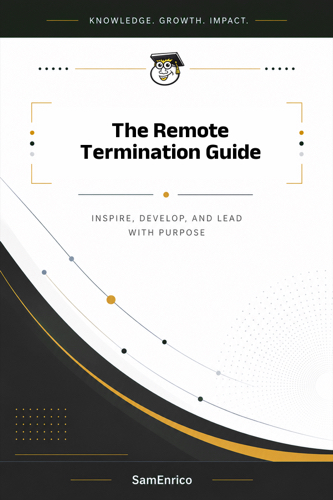
The Remote Termination Guide eBook
Handle difficult conversations and layoffs with co
by Henley Suzi
Handle difficult conversations and layoffs with compassion and compliance.
Formats
Free sample
Chapter 1: The Unseen Chasm--–- The video call connects with a soft chime. Two faces appear in rectangles. Between them, sixty milliseconds of latency, two thousand miles of fiber optic cable, and a chasm that no amount of carefully chosen words can fully bridge. The manager smiles a small, tight smile. The employee smiles back, unaware that this smile will be their last as colleagues.
In the space between those two smiles—in the silence before the first word is spoken—everything that can go wrong already has.This is the unseen chasm. It is the distance not measured in miles but in empathy. It is the gap between what a manager intends to communicate and what an employee actually hears. It is the void where body language goes to die, where tone flattens, where the warmth of human presence evaporates into pixels and compression algorithms.Welcome to the geography of goodbye in the age of remote work.For decades, the script for terminating an employee was written in conference rooms with beige walls and uncomfortable chairs. The manager would walk to the employee's desk—a physical journey that required courage—and say the words that would change a life.
The employee would gather their things. Security would escort them out. The ritual, painful as it was, had a beginning, a middle, and an end that everyone understood, even if they dreaded it.That world is gone. It is never coming back.Today, the termination conversation happens on the same platform used for birthday parties, team stand-ups, and virtual happy hours. The employee sits in their home—the place where they sleep, raise their children, grieve their losses, and feel safest in an unsafe world.
The manager sits in their own home, or perhaps a home office, staring at a camera lens that captures only a fraction of what a human face communicates. The HR representative joins as a third rectangle, muted until needed, their expression frozen in a half-smile that could mean anything or nothing.And in this sterile digital theater, someone is told they no longer have a job. Their career changes direction. Their family's financial future shifts. Their sense of identity—"I am an engineer at this company," "I am a manager at that firm," "I am a valuable contributor"—shatters against the hard wall of a decision delivered through a screen.This book exists because that moment is fundamentally different from anything that came before it.
The rules that guided managers in the era of physical offices—rules about body language, timing, follow-up, and compassion—do not translate directly to the remote environment. Some do not translate at all. And the cost of getting it wrong, measured in lawsuits, reputational damage, and human suffering, has never been higher.The Illusion of Familiarity Managers often make a fatal assumption: that a remote termination is simply an in-person termination conducted over video. Just use the same words. Just be professional.
Just get through it. How different can it really be?This assumption is wrong, and it is dangerously wrong. It is the kind of wrong that gets companies sued and managers fired.In-person termination benefits from what psychologists call embodied presence. When a manager sits across a table from an employee, both parties share the same physical space. They breathe the same air.
They feel the same ambient temperature. They observe each other's posture, hand movements, and the micro-expressions that flash across a human face in a quarter of a second—a twitch of the eyebrow that signals confusion, a tightening of the jaw that signals anger, a slight parting of the lips that signals the desire to speak.The manager can lean forward to convey sincerity. The employee can see that lean. The brain processes these signals automatically, below the level of conscious thought, and they matter enormously. In fact, research in interpersonal communication suggests that up to seventy percent of meaning is conveyed non-verbally.
Only thirty percent comes from the words themselves.Remote termination strips away that seventy percent. It leaves only the words, and sometimes not even all of them.Consider what a camera does not capture: the way an employee's hands tremble beneath the desk, out of frame. The way their breathing quickens as the manager says the word "unfortunately." The way they grip their own forearm to steady themselves against the shock. Consider what a manager cannot convey through a lens: the slight tilt of the head that signals genuine listening, the leaning back that gives the employee space to process, the leaning forward that offers silent solidarity. These are not decorations on the conversation.
They are the grammar of human connection. Without them, the sentence is incomplete.Worse, the remote environment introduces distortions that did not exist before. A frozen video feed can make a manager look indifferent just as the employee begins to cry. A delayed audio signal can make a thoughtful pause feel like an awkward silence—or worse, like the manager has hung up. The employee may see their own face on the screen, watching themselves receive the worst news of their professional life, and that self-surveillance amplifies every emotion.
They become both the person receiving the news and the person watching themselves receive it, a split experience that is uniquely disorienting.This is the Empathy Gap: the measurable, experienced, gut-level difference between delivering difficult news in person and delivering it through a screen. It is the central challenge of remote termination, and every chapter of this book is designed to help you bridge it.The Ghosting Epidemic Before we go further, we must name the practice that represents the absolute bottom of the barrel. We must call it what it is, and we must condemn it without qualification.Ghosting is when an employer terminates a remote employee by simply locking them out of their accounts, deactivating their email, and never speaking to them again. No call. No video.
No message beyond the automated notification that "your access has been removed." The employee logs into Slack on Monday morning and finds their account disabled. They call their manager. The manager does not answer. They email HR. The email bounces back.If you have ever done this, stop reading this book and resign from your management position.
You are not ready to lead people.Ghosting is not a termination method. It is an act of cowardice dressed up as efficiency. It tells the employee that they were never a person to you—just a login credential, a Slack handle, a line item on a spreadsheet, a cost to be cut. It tells the world that your company has no moral compass, no basic decency, no understanding of what it means to treat people as people. And it is legally reckless, as courts increasingly view ghosting as evidence of bad faith in wrongful termination lawsuits, punitive damages, and even intentional infliction of emotional distress claims.Yet ghosting persists in remote work culture.
Managers convince themselves that a termination conversation would be "too awkward" over video. They tell themselves the employee "probably saw it coming" or "wasn't a good fit anyway." They delegate the task to IT, who flips a switch, and…
This is the end of the free sample. Get the eBook to keep going. Buy now
About this book
Details
- Author
- Henley Suzi
- Publisher
- SamEnrico
- Language
- English
- Genre
- Non-Fiction, Business Brief, HR
- Released
- 2026-06-07
- Pages (approx.)
- 146
- Available as
- eBook, Audiobook

Read better in the ZLOADR app
Your eBooks on your phone or tablet. Sign in with your SamEnrico account and start reading.
More by Henley Suzi
 Step Two Finding SanityHenley Suzi$11.99
 Alopecia Areata GuideHenley Suzi$11.99
 Public Access AED LawsHenley Suzi$11.99
 The Bloodied Badlands: Canada's First Prison Gang War (1920s)Henley Suzi$11.99
 Behavioral Health TechnicianHenley Suzi$11.99
 UK Business Credit Builder LoanHenley Suzi$12.99
 How to Produce Blood Pressure Monitor CuffsHenley Suzi$11.99
 How to Become a Machine SetterHenley Suzi$11.99
You may also like
 Hong Kong Handover 1997Dunn Johnnie$11.99
 Zumba For Postnatal Recovery CourseNeal Christian$11.99
 Zumba for BeginnersLadner Nikia$11.99
 YouTube Comment Mining GuideHumes Pandora$12.99
 Worry Box MeditationCarlin Rudy$11.99
 Workplace Stress MeditationNguyen Lynn$11.99
 Workplace Stress and Sleep RepairHawley Ivory$11.99
 Workplace Perfectionism CureDelaney Jeffry$11.99
 Workplace Injustice Anger GuideWallen Isabelle$11.99
 Work Addiction and Burnout LinkGreenwood Ester$11.99
 Women in Yoga and WellnessBeattie Galina$11.99
 Women in Stand Up ComedyChun Evangeline$11.99