
Non-FictionSelf-HelpProcrastination
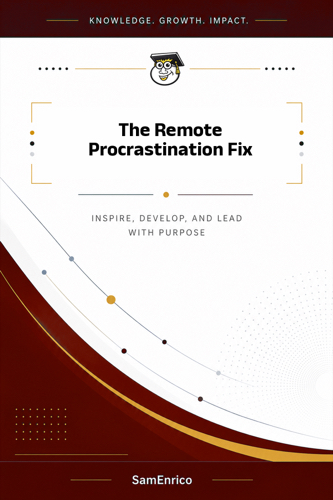
The Remote Procrastination Fix eBook
Overcome delay and distraction when working alone.
Overcome delay and distraction when working alone.
Formats
Free sample
Chapter 1: The Shame Spiral--–- The email arrived at 9:14 AM on a Tuesday. It was short, polite, and utterly devastating. "Hi Alex, just checking in on the Davidson report. Haven't seen a draft yet. Everything okay?" Alex had been staring at that report for eleven days.
Eleven days of opening the document, reading the first paragraph, closing it, and opening Twitter. Eleven days of telling himself "I'll do it tomorrow." Eleven days of watching his stomach tighten every time his laptop buzzed with a new message. The email was not angry. It was not accusatory. It was simply...
curious. And that curiosity was a mirror, reflecting back everything Alex had been trying not to see: he was failing. Not because he was incapable. Not because the report was impossible. But because he was working alone, in his apartment, with no one watching, and something inside him had quietly, systematically broken.If you are reading this book, you have felt what Alex felt.
You have sat at your home desk—or your kitchen table, or your bedroom—with a task that should take forty-five minutes, and you have somehow stretched it into three hours of "research" that was actually just scrolling. You have missed a deadline and blamed "technical difficulties." You have closed your laptop at 6 PM, exhausted, and realized you accomplished almost nothing. And then, in the quiet of your own head, you have asked yourself the question that remote workers everywhere whisper alone: What is wrong with me?The answer, which this entire book exists to prove, is nothing. Nothing is wrong with you. You are not lazy.
You are not undisciplined. You are not secretly unsuited for remote work. You are, however, trapped in a system that was designed for a different world—an office world, a visible world, a world where other people could see your screen and your boss could glance at your desk and the simple pressure of being watched kept you moving. That world is gone. And no one gave you a manual for what comes next.This chapter is that manual's first page.
It will dismantle the single most damaging belief in remote work: that procrastination is a character flaw. It will introduce you to the two real types of procrastination that plague remote workers, and it will teach you why your willpower was never the problem. By the end, you will have completed your first self-audit, and you will understand something that most remote workers never learn: procrastination is not a sign that you are broken. It is a signal that something in your environment is broken. And signals, once read correctly, can be fixed.The Myth You Have Been Taught to Believe Let us name the lie directly.
You have been told, explicitly or implicitly, that procrastination is a moral failure. That people who delay are "lazy." That if you just had more self-discipline, you would sit down and do the work. This belief is so deeply embedded in our culture that it feels like common sense. But common sense, in this case, is wrong.Dr. Piers Steel, one of the world's leading researchers on procrastination, spent decades studying why people delay.
His meta-analysis of over 700 studies found something striking: procrastination is not correlated with laziness. In fact, procrastination is more strongly correlated with impulsivity and task aversion. Simply put, humans procrastinate when a task feels unpleasant or when a more immediately rewarding option is available. This is not a character defect. It is how the mammalian brain evolved.
Your brain is designed to prioritize immediate rewards over delayed ones. It is designed to avoid pain, including the psychological pain of a difficult task. When you procrastinate, your brain is doing exactly what evolution programmed it to do. The problem is not your brain. The problem is that remote work has stripped away the external structures that evolution assumed would be present.Consider what an office provides without you even noticing.
There is the simple fact of visibility: other humans can see your screen. Your brain, a social organ that evolved in tribes, interprets being watched as a signal to perform. There is the rhythm of the commute, which bookends your workday and tells your brain when to switch modes. There is ambient noise and movement, which provide low-level stimulation that keeps you alert. There is the water cooler—a real or metaphorical space where you can offload confusion, ask a quick question, or simply feel connected to other humans.Remote work removes all of this.
It replaces visibility with invisibility. It replaces rhythm with flexibility, which often becomes formlessness. It replaces ambient stimulation with the deafening silence of your own living room. It replaces the water cooler with... nothing, unless you intentionally build something new.
When you procrastinate at home, you are not failing at self-discipline. You are experiencing the logical consequence of an environment stripped of the cues your brain needs to function. The shame you feel is not a motivational tool. It is a side effect of blaming yourself for a problem you did not create.The Two Types of Remote Procrastination If procrastination is not a single monster but a signal, then the first step is learning to read the signal. Through years of working with remote employees, freelancers, and distributed teams, I have identified two distinct types of remote procrastination.
They look similar from the outside—delayed work, guilty feelings, wasted time—but they have different causes and therefore require different solutions.Logistical Procrastination occurs when you delay because you lack information, a reply, or a necessary file. You are waiting for an email that has not arrived. You are stuck on a question that requires input from a colleague who is offline. You have a partial puzzle and cannot see the full picture, so you do nothing. Logistical procrastination feels like being trapped.
You want to work. You are not avoiding the task out of fear. But you genuinely cannot proceed, and the waiting creates a kind of paralysis. The key signature of logistical procrastination is that you feel ready to work but blocked by something outside your control.Emotional Procrastination occurs when you delay because the task itself triggers anxiety, boredom, or fear of failure. You are not blocked.
You have everything you need. But the thought of starting produces a physical sensation—a tight chest, a churning stomach, an overwhelming urge to check your phone. Emotional procrastination feels like resistance. Your brain has labeled the task as painful, and it is trying to protect you by steering you toward literally anything else. The key signature of emotional procrastination is that you feel avoidant.
You could start, but you do not want to.These two types often masquerade as each other. You might tell yourself you are waiting for information (logistical) when really you are afraid of doing a bad job (emotional). You might tell yourself you are too anxious to start (emotional) when really you are missing a key document (logistical). This is why the self-audit at the end of this chapter is so important. You cannot fix what you cannot name.The Visibility Trap: What the Office Gave You That Home Takes Away To…
This is the end of the free sample. Get the eBook to keep going. Buy now
About this book
Details
- Author
- Obryan Janina
- Publisher
- SamEnrico
- Language
- English
- Genre
- Non-Fiction, Self-Help, Procrastination
- Released
- 2026-06-10
- Pages (approx.)
- 138
- Available as
- eBook, Audiobook

Read better in the ZLOADR app
Your eBooks on your phone or tablet. Sign in with your SamEnrico account and start reading.
More by Obryan Janina
 IFS Trigger MappingObryan Janina$11.99
 Neurodivergent Love EsteemObryan Janina$11.99
 Alcohol Detox Sweating GuideObryan Janina$11.99
 Personal Brand TestimonialsObryan Janina$11.99
 Waiver of SubrogationObryan Janina$11.99
 Perspective Taking GuideObryan Janina$11.99
 GOS PrebioticObryan Janina$11.99
 Voltage Visions: The Forgotten Race to Power the FutureObryan Janina$11.99
 The Great Escape of the Bengal Tigers: How a Circus Heist Exposed Mumbai’s UnderworldObryan Janina$11.99
 How to Produce Safety PinsObryan Janina$11.99
 How to Produce Fireplace ScreensObryan Janina$11.99
 A Collector's Handbook to the Aston Martin VolanteObryan Janina$11.99
You may also like
 Hong Kong Handover 1997Dunn Johnnie$11.99
 Zumba For Postnatal Recovery CourseNeal Christian$11.99
 Zumba for BeginnersLadner Nikia$11.99
 YouTube Comment Mining GuideHumes Pandora$12.99
 Worry Box MeditationCarlin Rudy$11.99
 Workplace Stress MeditationNguyen Lynn$11.99
 Workplace Stress and Sleep RepairHawley Ivory$11.99
 Workplace Perfectionism CureDelaney Jeffry$11.99
 Workplace Injustice Anger GuideWallen Isabelle$11.99
 Work Addiction and Burnout LinkGreenwood Ester$11.99
 Women in Yoga and WellnessBeattie Galina$11.99
 Women in Stand Up ComedyChun Evangeline$11.99