
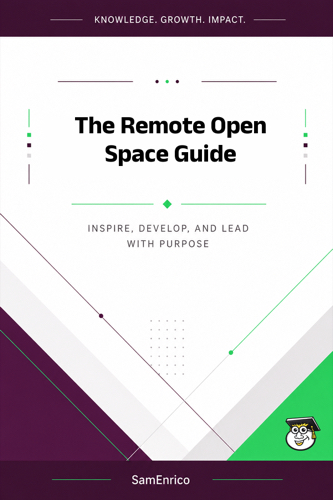
Non-FictionSelf-HelpUnconference
The Remote Open Space Guide eBook
Run participant driven agendas in virtual unconfer
Run participant driven agendas in virtual unconferences.
Formats
Free sample
Chapter 1: Why Nobody Listens--It is 2:47 PM on a Tuesday, and you are watching thirty-seven squares of human beings pretend to pay attention. Some have their cameras on but their eyes are elsewhere, drifting to second screens, to phones hidden below desks, to the laundry that needs folding. Some have their cameras off entirely, their avatars reduced to initials in circles, present in body only. You have prepared for weeks. The slides are beautiful.
The content is important. The speakers are experts. And yet, as you scan the gallery view, you feel what you have felt a hundred times before: the sinking recognition that nobody is really listening. The meeting is a hollow shell. The conference is a performance of attendance.
The conversation is happening somewhere else, in side chats and private messages, in the spaces you cannot see. And you are beginning to suspect that the problem is not your slides, not your speakers, not your platform. The problem is the format itself.The Great Unlearning The pandemic forced an experiment that no one would have chosen voluntarily. Millions of workers, students, and community members were pushed onto virtual platforms overnight, with no training, no preparation, and no time to redesign how they would interact. The default was simple and catastrophic: take the in-person meeting and put it on a screen.
The same agenda. The same presenter. The same passive audience. The results were predictable. Engagement plummeted.
Fatigue soared. And three years later, most organizations are still running the same failed experiment, wondering why it is not working.This is not a technology problem. Zoom works. Teams works. Meet works.
The platforms are not perfect, but they are not the source of the disengagement. The source is the format. Passive listening at scale is inherently disengaging, regardless of how charismatic the presenter or how beautiful the slides. The human brain is not designed to receive information passively for extended periods. It is designed to seek, to question, to discuss, to create.
When you force it into passive mode, it rebels. It drifts. It multitasks. It checks email. It scrolls social media.
It does anything except absorb the content you have so carefully prepared.I have facilitated hundreds of virtual events over the past five years. I have watched the patterns emerge and solidify. The first ten minutes of any traditional virtual conference are tolerable. The next ten are difficult. By thirty minutes, half the audience has mentally checked out.
By sixty minutes, you are speaking to a ghost town, populated by people who have learned to keep their cameras on while their attention wanders anywhere else. The format is not failing because you are a bad presenter. The format is failing because it is designed to fail.The Research We Cannot Ignore The evidence is overwhelming and consistent. Adult learning research has shown for decades that passive listening produces retention rates below 10 percent after 48 hours. Active discussion, by contrast, drives retention rates above 70 percent.
This is not a small difference. It is the difference between a conference that changes behavior and a conference that is forgotten before the closing slide.The reason is neurological. When you listen passively, your brain activates regions associated with receiving information but not with integrating it. The information passes through working memory and is rapidly discarded unless reinforced. When you discuss actively, your brain activates regions associated with processing, evaluating, and connecting new information to existing knowledge.
The information is encoded more deeply. It is more likely to be remembered. It is more likely to be applied.The "backchannel phenomenon" is the canary in the coal mine. At almost every traditional conference, the most valuable conversations happen in the hallways, in the margins, and in side chats—not in the main room. Participants learn more from the person next to them than from the person on stage.
They ask their most important questions in whispers, not in microphones. They build relationships in the spaces between sessions, not during the sessions themselves. This is not a bug. It is a feature of how humans learn. And traditional virtual formats eliminate these hallways entirely, forcing all conversation through a single, heavily mediated channel that is optimized for broadcasting, not for dialogue.The research on autonomy and motivation is equally damning.
When participants have no control over what they learn or discuss, they mentally check out within minutes. Self-determination theory, developed by psychologists Edward Deci and Richard Ryan, identifies autonomy as one of three fundamental psychological needs (along with competence and relatedness). When autonomy is absent, motivation collapses. Traditional conferences are autonomy deserts. The agenda is set months in advance by people who do not know what participants want to discuss today.
The sessions are locked in place. The topics are fixed. The participant's role is to sit, listen, and absorb. It is a model designed for compliance, not for engagement.The Illusion of the Compelling Keynote I want to address a belief that I encounter constantly, especially among experienced event organizers. The belief is that the problem is not the format but the execution.
If only you could find more charismatic speakers, more compelling stories, more beautiful slides, then the audience would stay engaged. The keynote would land. The magic would happen.This belief is an illusion. It persists because we have all experienced a truly great presentation—the one that made us cry, that changed our thinking, that we remembered for years. We extrapolate from that rare experience to the general case.
We assume that if every presentation could be that good, the format would work.But the rare, transformative keynote is rare for a reason. It requires a speaker of extraordinary skill, a topic of deep personal resonance, and an audience that arrives already primed to receive it. These conditions almost never align in a virtual setting, where distractions are infinite and attention is fragmented. Even the best keynote in the world cannot overcome the fundamental limitations of passive listening at scale.The research on attention spans is sobering. In a virtual setting, the average participant's focused attention begins to drop after 7 to 10 minutes.
By 20 minutes, half the audience is multitasking. By 40 minutes, the vast majority have checked out entirely. This is not a failure of will. It is a feature of how the brain works when confronted with passive input. The presenters are not the problem.
The format is the problem.The Cost of Forced Passivity Let me be explicit about what forced passivity costs. It costs attention. Every minute spent in a passive virtual meeting is a minute not spent on focused work, on deep thinking, on the activities that actually move the needle. The average professional spends 31 hours per month in unproductive meetings. That is nearly a full work week of time that could have been spent differently.It costs engagement.
When participants feel like spectators rather than contributors, they disinvest. They stop caring about the outcomes. They stop bringing their full selves to the conversation. They become passive consumers of content rather than active shapers of collective intelligence. The difference between a participant who feels ownership and a participant who feels like an attendee is the difference between a conference that…
This is the end of the free sample. Get the eBook to keep going. Buy now
About this book
Details
- Author
- Sommers Suzette
- Publisher
- SamEnrico
- Language
- English
- Genre
- Non-Fiction, Self-Help, Unconference
- Released
- 2026-06-09
- Pages (approx.)
- 100
- Available as
- eBook, Audiobook

Read better in the ZLOADR app
Your eBooks on your phone or tablet. Sign in with your SamEnrico account and start reading.
More by Sommers Suzette
 Content Mastery ConfidenceSommers Suzette$11.99
 Notification PING AnxietySommers Suzette$11.99
 SOFR Venture Debt SpreadsSommers Suzette$11.99
 Operation Mini Skirt: The Secret War That Redefined Women's FashionSommers Suzette$11.99
 Winery Climate Harvest InsuranceSommers Suzette$12.99
 How to Produce Texture Ceiling PaintSommers Suzette$11.99
 Patient Financial CounselorSommers Suzette$11.99
 How to Start a Millinery (wholesale) Business (Beginners Guide)Sommers Suzette$11.99
You may also like
 Hong Kong Handover 1997Dunn Johnnie$11.99
 Zumba For Postnatal Recovery CourseNeal Christian$11.99
 Zumba for BeginnersLadner Nikia$11.99
 YouTube Comment Mining GuideHumes Pandora$12.99
 Worry Box MeditationCarlin Rudy$11.99
 Workplace Stress MeditationNguyen Lynn$11.99
 Workplace Stress and Sleep RepairHawley Ivory$11.99
 Workplace Perfectionism CureDelaney Jeffry$11.99
 Workplace Injustice Anger GuideWallen Isabelle$11.99
 Work Addiction and Burnout LinkGreenwood Ester$11.99
 Women in Yoga and WellnessBeattie Galina$11.99
 Women in Stand Up ComedyChun Evangeline$11.99