
Non-FictionBusiness BriefLayoffs
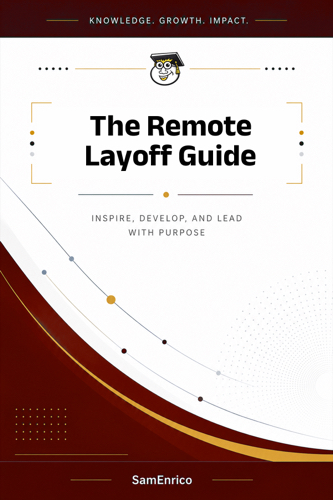
The Remote Layoff Guide eBook
Reduce workforce humanely when you can't meet in p
by Colon Pamela
Reduce workforce humanely when you can't meet in person.
Formats
Free sample
Chapter 1: The Zoom Hangover--–- The Slack notification arrived at 4:47 PM on a Tuesday. “Quick check-in?” the message read, sent by a manager the employee had spoken to twice in six months. The meeting was scheduled for 15 minutes later. No agenda. No context.
Just a calendar invite with HR copied as an optional attendee. The employee, let’s call her Priya, had just finished a client deliverable. She was holding her toddler on her hip, her laptop balanced on the edge of a folding table in her spare bedroom—a room she had converted into an office when her company went remote eighteen months earlier. She accepted the invite without thinking, muted her microphone, and waited.The manager joined first. Then HR.
The manager’s face was pale, his mouth opening and closing like a fish out of water. He kept looking at a script off-screen. Priya’s toddler started crying for a snack. She muted her microphone again, even though it was already muted, and watched as the manager stumbled through words she had heard before: “difficult decision,” “restructuring,” “not a reflection of your work.” The HR person said nothing. The call lasted eleven minutes.
When it ended, Priya’s access to Slack, email, and the company VPN was gone before she could type “what about my final paycheck?” Her toddler was still crying. Her laptop screen was now a gray box with a single line of text: “Your session has expired.”Priya’s story is not unique. In the past four years, millions of knowledge workers have experienced some version of this scene. A calendar invite that arrived like a punch. A manager reading from a script they clearly did not write.
A digital door slamming shut before the echo of “goodbye” faded. And then, nothing. No severance letter for weeks. No explanation of health insurance. No one to call.
Just the hollow sound of a Zoom call ending, replaced by the silence of a home office that suddenly felt less like a workplace and more like a trap.This chapter argues that traditional layoff playbooks—designed for conference rooms, handshakes, and security personnel walking terminated employees to the door—are not just ineffective in a remote setting. They are actively harmful. They transform an already difficult conversation into a traumatic one. They create legal liabilities that did not exist a decade ago. And they leave scars on both the person who is laid off and the manager who has to deliver the news through a screen, unable to reach out a hand or sit in shared silence.The term for this phenomenon is the “Zoom hangover.” It describes the lingering psychological state that defines post-2020 remote work: the blurred boundaries between home and office, the exhaustion of performing presence through a camera, the slow erosion of the non-verbal cues that once helped us understand each other, and the unique dread that comes from knowing a difficult conversation could appear in your calendar at any moment, with no warning, no context, and no physical human being to soften the blow.If you are reading this book, you have either conducted a remote layoff, are about to conduct one, or suspect that one is coming.
You are likely a manager, an HR professional, or a founder who never imagined that letting people go would be part of your job—let alone doing it through a screen while someone’s child plays in the background or their dog barks at the mail carrier. You want to do this right. You want to preserve dignity. You want to avoid the Priya scenario. But the old playbooks are useless, and no one has written a new one.Until now.The Old Playbook Was Written for a Different World Before March 2020, the standard Reduction in Force (RIF) playbook assumed a set of conditions that no longer exist for millions of workers.
Let us name them explicitly, because understanding what has broken is the first step toward building something better.Assumption One: You can read body language. In an in-person termination, a manager can see if the employee is about to cry, shout, or shut down. They can adjust their pacing, offer a tissue, or pause to let the employee collect themselves. The physical proximity creates a feedback loop that helps the manager calibrate their message in real time. On a video call, that feedback loop is severed.
You see a face on a screen, compressed and delayed. You cannot see hands gripping a chair. You cannot see someone’s shoulders drop. You cannot hear the sharp intake of breath that precedes tears. All you have is a rectangle of pixels and the vague sense that something is off.Assumption Two: You can separate the person from the place.
In an office, a layoff happens in a neutral space—a conference room, an HR office, a manager’s private office. The employee walks out of that space and leaves it behind. Their home, their sanctuary, remains untouched. In a remote layoff, the termination happens inside the employee’s home. The same room where they eat dinner, where their children do homework, where they sleep and argue and love and grieve.
The trauma of the layoff becomes embedded in the physical space. Months later, Priya told a researcher that she still cannot sit at her folding table without feeling her stomach drop. That table is now in her garage.Assumption Three: The employee has support nearby. In an office, after a layoff, the employee might walk out with a colleague, call a friend from the parking lot, or stop for coffee on the way home. The transition from “employee” to “former employee” is buffered by physical movement, fresh air, and other human beings.
In a remote layoff, the call ends, and the employee is still sitting in their home office, alone. Their partner might be in the next room, but they do not know what just happened. Their children might be home from school. There is no buffer. There is no transition.
There is just the end of one Zoom call and the beginning of the next silence.Assumption Four: You can control the timing and flow of information. In an office, a manager can call someone into a room, deliver the news, and have security escort them out before word spreads. In a remote environment, information moves at the speed of Slack. Within minutes of Priya’s call ending, her team had noticed that her status had gone from “active” to “inactive.” Within an hour, someone had started a private channel called “is priya okay?” Within three hours, a screenshot of her empty Slack profile was circulating on Twitter. The company’s carefully planned communication strategy collapsed before it even began.Assumption Five: The legal landscape is simple.
In an in-person world, the employee’s physical location is the office. The company knows exactly which laws apply. In a remote world, the employee’s home office could be in a different state, a different province, or a different country. California labor law applies to an employee who lives in California, even if the company is headquartered in Texas. European data protection laws apply to an employee…
This is the end of the free sample. Get the eBook to keep going. Buy now
About this book
Details
- Author
- Colon Pamela
- Publisher
- SamEnrico
- Language
- English
- Genre
- Non-Fiction, Business Brief, Layoffs
- Released
- 2026-06-10
- Pages (approx.)
- 144
- Available as
- eBook, Audiobook

Read better in the ZLOADR app
Your eBooks on your phone or tablet. Sign in with your SamEnrico account and start reading.
More by Colon Pamela
 Twelve Step Sponsorship GuideColon Pamela$11.99
 Stress and Friendship StrainColon Pamela$11.99
 Hair Loss after Weight LossColon Pamela$11.99
 Tall as the Sky: The Ladder to the StarsColon Pamela$11.99
 Translation Cost ForecastingColon Pamela$12.99
 How to Start a Books Printing BusinessColon Pamela$11.99
 How to Produce Bobblehead FiguresColon Pamela$11.99
 Business Operations SpecialistColon Pamela$11.99
You may also like
 Hong Kong Handover 1997Dunn Johnnie$11.99
 Zumba For Postnatal Recovery CourseNeal Christian$11.99
 Zumba for BeginnersLadner Nikia$11.99
 YouTube Comment Mining GuideHumes Pandora$12.99
 Worry Box MeditationCarlin Rudy$11.99
 Workplace Stress MeditationNguyen Lynn$11.99
 Workplace Stress and Sleep RepairHawley Ivory$11.99
 Workplace Perfectionism CureDelaney Jeffry$11.99
 Workplace Injustice Anger GuideWallen Isabelle$11.99
 Work Addiction and Burnout LinkGreenwood Ester$11.99
 Women in Yoga and WellnessBeattie Galina$11.99
 Women in Stand Up ComedyChun Evangeline$11.99