
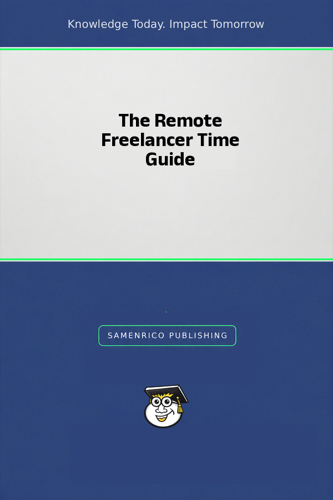
The Remote Freelancer Time Guide eBook
Manage multiple clients and projects without time
Manage multiple clients and projects without time tracking chaos.
Formats
Free sample
Chapter 1: The Hour Trap--–- The email arrived at 7:14 PM on a Wednesday. Sarah, a freelance graphic designer with six active clients, had just sat down to eat dinner when her phone buzzed. It was a time tracking reminder from her third app of the day: "You have 4 unlogged hours. Please categorize your time before midnight."She sighed, pushed her plate aside, and opened her laptop. Fifteen minutes later, she had reconstructed her day—sort of.
She knew she had worked on Client A's logo and Client B's presentation, but what about that 45-minute stretch where she answered Client C's "quick questions" and fixed Client D's file permissions? Where did that time go? She guessed. She categorized. She hit submit.Then she looked at her actual work.
The logo was 80% done. The presentation needed another round. Client C had sent three more "quick questions." Client D's project was now behind schedule. She had spent more time tracking her work than advancing it.Sarah is not real. But her story happens to thousands of remote freelancers every single day.If you are reading this book, you know the feeling.
You have tried the apps—Toggl, Harvest, Clockify, Rescue Time, maybe three others. You have tried the techniques—Pomodoro, time blocking, the 2-minute rule. You have tried the promises—"Just track everything for two weeks and you'll see the patterns!"But the chaos only gets worse.Here is the truth that no app wants you to hear: Real-time minute tracking is not the solution to time chaos. It is the cause.This chapter will dismantle the most destructive myth in freelancing—the belief that your value can be measured in 15-minute increments. It will introduce a radically different framework called Return on Time Invested (ROTI).
And it will give you permission to do something that feels terrifying at first: discard your timesheets.But first, we need to understand how you got here.The Lie You Were Sold The billable hour was invented in the 1950s by law firms as a way to charge clients consistently. It made sense for lawyers: they had no physical product to sell, so they sold time. Over the decades, the model spread to consulting, accounting, and eventually freelancing.Here is what no one tells you: the billable hour was never designed for creative, knowledge-based, or project-driven work. It was designed for predictable, repeatable, linear tasks. Drafting a standard contract takes roughly the same amount of time for most lawyers.
But designing a logo? Writing a blog post? Fixing a software bug? Those tasks vary wildly depending on inspiration, client feedback, and a hundred other factors.Yet freelancers adopted the billable hour as gospel. And with it came the timesheet.The logic seems unassailable: "If I don't track my time, how will I know what to charge?
How will I know if I'm profitable? How will I know where my day went?"These are reasonable questions. But the answers do not require a stopwatch. In fact, the stopwatch makes it harder to answer them accurately.The Cognitive Load of Minute Tracking Every time you start a timer, you perform a small mental transaction. You switch contexts from doing to recording.
That switch costs you something. Psychologists call it task-switching penalty—the cognitive friction of shifting between different types of mental activity.When you track time in real time, you are not switching once. You are switching constantly:Start timer for Client AWork Stop timer Start timer for email Read email Stop timer Start timer for Client BWork Stop timer Realize you forgot to track the 7-minute call with Client AStart timer, stop timer, curse quietly Each of these micro-switches consumes a small amount of mental energy. Over a full day, that energy adds up. Researchers have estimated that constant task-switching can reduce effective cognitive performance by up to 40 percent.
You are not just tracking time—you are paying a tax on your intelligence.But the hidden cost is worse than the switching penalty. It is the anxiety of incompleteness.Think about the last time you forgot to start a timer. What did you feel? A small spike of dread, perhaps. A sense that the day was now "contaminated" because you could not account for those minutes.
You might have tried to reconstruct them later, feeling vaguely fraudulent as you guessed. Or you might have simply left them untracked, feeling like a failure.That anxiety is not trivial. It lives in the background of your awareness, consuming bandwidth that should be devoted to creative work. The timesheet becomes a silent judge, constantly asking: "Where is your proof? Where is your evidence?
How do I know you were working?"You were not hired to produce proof. You were hired to produce results.The Scarcity Mindset Worse than the cognitive and emotional costs is the philosophical damage. Tracking every minute trains your brain to think of time as a finite resource to be spent—like money in a shrinking wallet.This is the scarcity mindset, and it is poison for creative work.When you believe time is scarce, you rush. You multitask. You say "yes" to low-value work just to fill the hours.
You feel guilty when you take a break, even if that break would help you solve a difficult problem. You become focused on efficiency (doing things right) rather than effectiveness (doing the right things).Consider two freelancers:Alex tracks every minute. At the end of the day, he sees 7.5 billable hours. He feels okay—not great, but okay. He does not notice that two of those hours were spent on low-value administrative work that could have been automated.
He does not notice that he spent 45 minutes on a client who pays poorly and causes stress. He only sees the number: 7.5.Jordan does not track minutes. At the end of the day, she asks a single question: "What three things moved my business forward today?" She notices that one of those things was a template she created that will save her 2 hours every week going forward. She notices that she said "no" to a bad-fit client, freeing up mental space. She does not know how many minutes she worked.
But she knows she made progress.Who is better off? Jordan is not just happier—she is more effective. She is building systems, exercising judgment, and focusing on outcomes. Alex is counting beans.The tragedy is that Alex thinks he is being professional. He is being precise.
He is being accountable. But precision without direction is just spinning in place.The False Promise of "Data-Driven"Time tracking apps love to promise that more data will lead to better decisions. "You cannot improve what you do not measure," they say. This sounds wise. But it is only true when you are measuring the right thing.Imagine a restaurant owner who decides to measure the number of plates washed per hour.
She installs a sensor on the dishwasher. She tracks every plate. She creates charts and dashboards. She rewards employees who wash the most plates.What happens? The restaurant goes out of business, because she forgot to measure customer satisfaction, food quality, and profitability.
She optimized the wrong variable.Freelancers do the same thing. They measure hours logged, because hours are easy to measure. But…
This is the end of the free sample. Get the eBook to keep going. Buy now
About this book
Details
- Author
- Jimenez Catherine
- Publisher
- SamEnrico
- Language
- English
- Genre
- Non-Fiction, Self-Help, Freelance
- Released
- 2026-06-08
- Pages (approx.)
- 142
- Available as
- eBook, Audiobook

Read better in the ZLOADR app
Your eBooks on your phone or tablet. Sign in with your SamEnrico account and start reading.
More by Jimenez Catherine
 TikTok Reality Check GuideJimenez Catherine$11.99
 Ketamine Alcohol Detox GuideJimenez Catherine$11.99
 Journey Method for SpeechesJimenez Catherine$11.99
 Influence EQ SkillsJimenez Catherine$11.99
 Rejection Trigger RecoveryJimenez Catherine$11.99
 Second Degree Burn CareJimenez Catherine$11.99
 Working Memory For TherapistsJimenez Catherine$11.99
 Rhythms on Wheels: The Birth of African Skateboarding LegendsJimenez Catherine$11.99
 The Silk Road Sabotage: The Great Tea Heist of 1850s ChinaJimenez Catherine$11.99
 How to Produce SaltJimenez Catherine$11.99
 How to Produce Fish FoodJimenez Catherine$11.99
 Basset Hound: Stubborn ScenthoundJimenez Catherine$11.99
You may also like
 Hong Kong Handover 1997Dunn Johnnie$11.99
 Zumba For Postnatal Recovery CourseNeal Christian$11.99
 Zumba for BeginnersLadner Nikia$11.99
 YouTube Comment Mining GuideHumes Pandora$12.99
 Worry Box MeditationCarlin Rudy$11.99
 Workplace Stress MeditationNguyen Lynn$11.99
 Workplace Stress and Sleep RepairHawley Ivory$11.99
 Workplace Perfectionism CureDelaney Jeffry$11.99
 Workplace Injustice Anger GuideWallen Isabelle$11.99
 Work Addiction and Burnout LinkGreenwood Ester$11.99
 Women in Yoga and WellnessBeattie Galina$11.99
 Women in Stand Up ComedyChun Evangeline$11.99