
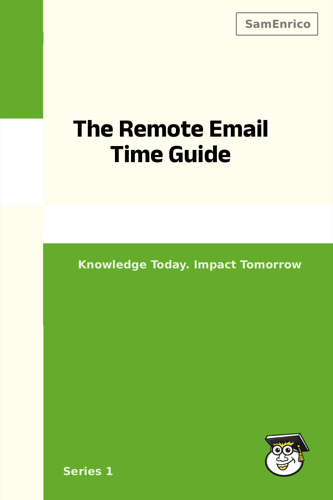
The Remote Email Time Guide eBook
Process email in scheduled batches instead of cons
Process email in scheduled batches instead of constantly interrupting focus.
Formats
Free sample
Chapter 1: The $10,000 Habit--–- Let me tell you a story about a woman named Sarah. She was a senior product manager at a mid-sized tech company, she worked remotely from her home office in Portland, and she checked her email 47 times per day. She knew this number not because she was tracking it, but because her company installed productivity monitoring software after the pandemic. One day, her manager pulled her aside and said something that made her blood run cold: "Sarah, you're responding to everything instantly, but you're not moving the needle on anything important. Your throughput looks busy, but your outcomes look average."Sarah was shocked.
She was working ten-hour days. She never let an email go more than twelve minutes without a reply. She was the most responsive person on her team. And that, it turned out, was exactly the problem.This chapter opens with a provocative calculation that I want you to perform right now. Take your annual salary.
Divide it by 2,000 (the approximate number of working hours in a year). That is your hourly rate. Now multiply that number by 0.33. That is what you lose every single day to email switching costs. For Sarah, earning $85,000 per year, her hourly rate was $42.50.
Her daily loss to email interruptions was approximately $210. Her annual loss was over $50,000. She was effectively paying her employer $50,000 per year to let other people dictate her attention.But here is the truth that no productivity book has ever said this bluntly: you are not lazy. You are not undisciplined. You are not bad at your job.
You are reacting to a system that was designed to distract you, and the people who designed that system are very, very good at what they do.The Morning Trap: Why Your First Hour Belongs to Strangers Every morning, Sarah woke up, poured a cup of coffee, and opened her laptop before she had even finished brushing her teeth. Her inbox was already full: fourteen new messages from colleagues in Europe, three from her boss, a newsletter from a vendor, two automated alerts from the customer support system, and a calendar invitation for a meeting that should have been an email. She replied to five of them before 7:30 AM. By 8 AM, she had already switched contexts six times. By 9 AM, she had forgotten what she intended to work on that day.This is the Morning Trap, and it is the single most destructive habit in remote work.Drawing from Morgenstern's seminal work Never Check Email in the Morning, the science here is unambiguous.
Creative work — writing, coding, designing, strategizing, problem-solving — requires a ramp-up period of fifteen to thirty minutes to enter what psychologists call "flow state." Flow is that magical condition where time disappears, self-consciousness evaporates, and your output quality doubles. Flow is where promotions are earned, breakthroughs occur, and real work gets done.Checking email first thing in the morning resets this ramp to zero.Not only that, but email actively poisons your ability to reach flow later. The subject lines you read — "urgent question," "quick ask," "following up" — trigger your brain's threat detection system. You enter a low-grade anxiety state that persists for hours. You are not relaxed enough to do deep work, but you are also not focused enough to process shallow work efficiently.
You are in the worst place: the productivity swamp.Remote workers are especially vulnerable to the Morning Trap because they lack the physical cues that used to protect them. In an office, you had a commute. You had a ritual of arriving, hanging up your coat, making coffee, and sitting down. That commute was not wasted time — it was a cognitive transition zone that told your brain "work is starting." Remote workers have lost that transition. Many roll out of bed and into Outlook in under sixty seconds.
Your brain never gets the signal to shift gears.The solution, which we will build throughout this book, begins with a single rule: no email before 11 AM. Not even one quick look. Not even "just to check if something is urgent." Not even while you are waiting for your coffee to brew. Zero. None.
This rule is not a suggestion. It is the foundation upon which every other practice in this book is built.The Neuroscience of Switching: Why 23 Minutes Is a Lie Let me tell you about a study that changed how I think about attention. In 2014, researchers at the University of California, Irvine observed a group of office workers and measured how long it took them to return to peak focus after an interruption. The number they found was twenty-three minutes and fifteen seconds.That number has been repeated so often in productivity literature that it has become gospel. But here is what most books do not tell you: the twenty-three minutes is an average.
The range was enormous. Some people bounced back in eight minutes. Others never returned to their original level of focus for the rest of the day. And crucially, the study measured interruptions that participants were aware of — a phone ringing, a colleague tapping their shoulder. It did not measure the far more insidious interruption of glancing at an email subject line and deciding not to open it.That glance, according to Levitin's The Organized Mind, triggers a dopamine release.
Your brain's reward system lights up because email offers the possibility of social reward, new information, or resolution of uncertainty. Each glance conditions you to seek more glances. You are not checking email because you need to. You are checking email because your brain has been hijacked.The neuroscience works like this. When you see a notification badge, your brain releases a small amount of dopamine — the same neurotransmitter involved in addiction.
The anticipation of a reward is often more stimulating than the reward itself. This is why you feel a little thrill when you see "23 unread messages" but feel nothing when you actually read them. Your brain wants the possibility of something interesting, not the reality of another status update.Over time, this conditioning becomes automatic. You do not decide to check email. You just find yourself in Outlook, with no memory of opening it.
This is called "habitual checking," and it is the same neurological mechanism that drives compulsive social media use. You have been trained, like one of Pavlov's dogs, to salivate at the sound of a notification bell.Remote work supercharges this effect because you have no one watching you. In an office, you might feel self-conscious about checking email during a meeting or while a colleague is presenting. At home, there is no social pressure to resist. Your laptop is always there.
Your inbox is always one click away. The badge is always red.The only defense is structural. You cannot rely on willpower. Willpower is a finite resource that depletes over the course of the day, and email notifications are an infinite temptation. You must build systems that make it impossible to check email outside your designated batches.
This means closing the application, hiding the icon, and using app blockers. We will cover these tools in detail in Chapter 8, but for now, understand this: if you can see your email…
This is the end of the free sample. Get the eBook to keep going. Buy now
About this book
Details
- Author
- Ritchie Miles
- Publisher
- SamEnrico
- Language
- English
- Genre
- Non-Fiction, Self-Help, Email
- Released
- 2026-06-09
- Pages (approx.)
- 139
- Available as
- eBook, Audiobook

Read better in the ZLOADR app
Your eBooks on your phone or tablet. Sign in with your SamEnrico account and start reading.
More by Ritchie Miles
 Detox For Dual Diagnosis GuideRitchie Miles$11.99
 Self Esteem Intimacy GuideRitchie Miles$11.99
 Personal Brand for ConsultantsRitchie Miles$11.99
 Flight Response RecoveryRitchie Miles$11.99
 Emotional Regulation TechniquesRitchie Miles$11.99
 Lawyers Professional LiabilityRitchie Miles$11.99
 Spatial Working Memory DrillsRitchie Miles$11.99
 The Phantom Coachman: The Victorian Highwayman Who Exposed Prison HorrorsRitchie Miles$11.99
 The Great Melbourne Zoo Escape: Tracking the Tiger That Outsmarted PoliceRitchie Miles$11.99
 A Collector's Handbook to the Aston Martin DBSRitchie Miles$11.99
 How to Trade Soybean MealRitchie Miles$11.99
 JEE Focus and Concentration GuideRitchie Miles$12.99
You may also like
 Hong Kong Handover 1997Dunn Johnnie$11.99
 Zumba For Postnatal Recovery CourseNeal Christian$11.99
 Zumba for BeginnersLadner Nikia$11.99
 YouTube Comment Mining GuideHumes Pandora$12.99
 Worry Box MeditationCarlin Rudy$11.99
 Workplace Stress MeditationNguyen Lynn$11.99
 Workplace Stress and Sleep RepairHawley Ivory$11.99
 Workplace Perfectionism CureDelaney Jeffry$11.99
 Workplace Injustice Anger GuideWallen Isabelle$11.99
 Work Addiction and Burnout LinkGreenwood Ester$11.99
 Women in Yoga and WellnessBeattie Galina$11.99
 Women in Stand Up ComedyChun Evangeline$11.99