
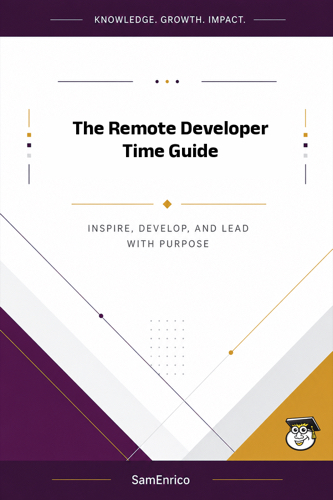
The Remote Developer Time Guide eBook
Protect coding flow from interruptions and context
Protect coding flow from interruptions and context switching.
Formats
Free sample
Chapter 1: The Twenty-Three Minute Ghost--–- It arrives without knocking. No chime, no banner, no red badge. One moment you are deep in the logic of a recursive function, the call stack held perfectly in working memory, the solution crystallizing. The next moment—a Slack DM. “Quick question.” Three innocuous words.
You reply in ten seconds. You return to your editor. And then you sit there, staring at the blinking cursor, because the entire mental architecture you spent forty-five minutes constructing has evaporated. The variables have lost their meaning. The edge case you were solving is a fog.
The compiler might as well be speaking ancient Greek.This is the twenty-three minute ghost. It is the single most expensive non-event in the life of a remote developer. It costs you nearly half an hour of productivity for every ten-second interruption. It is invisible on timesheets, absent from sprint reports, and never discussed in performance reviews. And it is slowly burning you out.The statistic arrives with the weight of a suppressed truth: a ten-minute interruption—a Slack DM, a “got a sec?” call, a quick email check—requires approximately twenty-three minutes to recover from.
This is not a motivational estimate or a productivity gimmick. It comes from decades of research into attentional residue, the cognitive phenomenon where the brain continues to process a previous task even after switching to a new one. When a developer is pulled away from deep coding, the mind does not simply stop and restart like a machine. It lingers. It fragments.
It leaks focus across the boundary between what you were doing and what you just did.The ghost is not the interruption itself. The ghost is the recovery time that follows—the period where you are neither fully present to the new demand nor returned to your original flow. You are in limbo. And most developers spend two to three hours every single day inside that limbo without ever realizing it.THE ARCHITECTURE OF DISTRACTIONRemote work promised liberation from the open office, that carnival of shoulder taps and drive-by conversations. And for a brief, shining moment, it delivered.
Developers retreated to home offices, closed doors, and enjoyed unprecedented stretches of uninterrupted time. But something unexpected happened. The physical interruptions disappeared, yes. But they were replaced by something far more insidious: architectural interruptions baked directly into the tools of the trade.Consider the design of Slack. Every unread message is accompanied by a small red badge.
That badge is not a neutral notification. It is a carefully engineered anxiety trigger, calibrated to exploit the same psychological mechanism that makes a gambler pull a slot machine lever. The variable reward—maybe the message is important, maybe it is not, but you will not know until you look—creates a compulsive checking loop that has been compared to nicotine addiction by researchers. The average developer checks Slack every six minutes. Six minutes.
That is not collaboration. That is a tic.Email is no better. The inbox is a to-do list written by other people, prioritized according to whoever shouted loudest most recently. The notification banner that slides across your screen during a debugging session is not an alert. It is a vote of no confidence in your ability to manage your own attention.
It assumes that whatever the sender wants is more important than whatever you are currently doing. And the assumption is almost always wrong.Then there are the invisible meetings. The Slack huddle that begins as a “quick question” and metastasizes into a twenty-minute call. The screen share that someone joins unannounced. The “can you glance at this?” that requires a full context load.
These interruptions do not appear on any calendar. They do not trigger a busy status. They simply arrive, consume your attention, and leave behind the ghost.The office interruption was physical—a hand on the shoulder, a voice at the desk. It required someone to make a deliberate, visible, often awkward decision to intrude. The remote interruption is architectural.
It is built into the foundation of the tools. It is constant, low-grade, and automated. And because it happens through software rather than social contact, it feels less rude—which paradoxically makes it more destructive. You would never tolerate a colleague tapping your shoulder every six minutes. But you tolerate Slack doing exactly that because the software has convinced you it is normal.THE PRODUCTIVITY HALLUCINATIONHere is a heresy that will get you shouted down in most remote work forums: developers who reply to Slack messages in under sixty seconds are not productive.
They are performative. They are mistaking activity for output, responsiveness for results, and the dopamine hit of clearing a notification for the satisfaction of shipping working software.The myth of the always-available developer runs deep. It is reinforced by managers who equate green status dots with work being done. It is amplified by the visible busyness of colleagues who type furiously in public channels. It is codified in team norms that reward the fastest reply rather than the most thoughtful solution.
But the myth collapses under the weight of a simple question: what are you actually producing?Think back to the last time you had a truly productive day. Not a busy day. Not a day where you answered eighty messages and attended six meetings and felt exhausted by 5 PM. A productive day. A day where you solved a hard problem, wrote elegant code, fixed a nasty bug, or designed a system that will save your team months of future work.
What did that day look like? Almost certainly, it contained at least one uninterrupted block of ninety minutes or more. Almost certainly, you turned off notifications, closed Slack, and disappeared into the problem. Almost certainly, you were not available.The developers who ship the most code, fix the most bugs, and generate the most business value are not the ones who reply fastest. They are the ones who protect their focus with religious intensity.
They batch communication. They set expectations. They say no to the trivial so they can say yes to the essential. They understand that responsiveness is not a KPI. Output is.But the myth persists because it serves a purpose.
For managers, the always-available developer reduces uncertainty. If you can ping someone and get an answer immediately, you do not have to think about whether the question actually needs to be asked. You do not have to prioritize. You do not have to plan. You simply delegate the cost of coordination to the developer, who pays for your convenience with their flow.
For developers, the myth offers a comforting illusion of control. If you are always responsive, no one can accuse you of slacking. You have visible proof of work. The green dot is your alibi. But an alibi is not a paycheck.
And visible busyness is not a promotion.THE COST OF A SINGLE INTERRUPTIONLet us calculate the true cost of an interruption. Not the theoretical cost. Not the motivational speaking version. The actual, mathematical, you-can-take-this-to-the-bank cost.The research on attentional residue, most famously synthesized by Professor Sophie Leroy at the University of Washington Bothell, demonstrates that when you switch from Task A to Task B…
This is the end of the free sample. Get the eBook to keep going. Buy now
About this book
Details
- Author
- Maldonado Jorge
- Publisher
- SamEnrico
- Language
- English
- Genre
- Non-Fiction, Self-Help, Software
- Released
- 2026-06-10
- Pages (approx.)
- 125
- Available as
- eBook, Audiobook

Read better in the ZLOADR app
Your eBooks on your phone or tablet. Sign in with your SamEnrico account and start reading.
More by Maldonado Jorge
 Facebook Envy Recovery PlanMaldonado Jorge$11.99
 Dexmedetomidine Detox GuideMaldonado Jorge$11.99
 Celiac Disease GuideMaldonado Jorge$11.99
 Enmeshment TriggersMaldonado Jorge$11.99
 Chemical Burn First AidMaldonado Jorge$11.99
 Alphabet Peg System TutorialMaldonado Jorge$11.99
 Board Member ImposterMaldonado Jorge$11.99
 The Angel of Death: Colombia's Hospital Nightmare (1970s)Maldonado Jorge$11.99
 The Iron Bridge of Istanbul: A 19th-Century Engineering RevolutionMaldonado Jorge$11.99
 How to Produce SaltilloMaldonado Jorge$11.99
 How to Produce Fish SauceMaldonado Jorge$11.99
 A Collector's Handbook to the Auburn 852sMaldonado Jorge$11.99
You may also like
 Outsourcing for Software DevelopersSands Breanne$11.99
 The OKR Software GuideRoller Lyman$11.99
 Team Creativity for DevelopersMoses Katia$11.99
 Daily Review for ProgrammersMoon Ouida$11.99
 Remote Software Development CommunicationGomez Sadie$11.99
 Delegation Software ToolsDunbar Maple$11.99
 Constraints for CodersHarter Elisha$11.99
 Chunking API DocumentationRoyster Ying$11.99
 The Software Engineer Creative CodeSisk Rosalva$11.99
 Pomodoro for CodingZimmer Blaine$11.99
 NVC In Tech Teams GuideMessina Larita$11.99
 Creative Habits for CodersValles Jeannetta$11.99