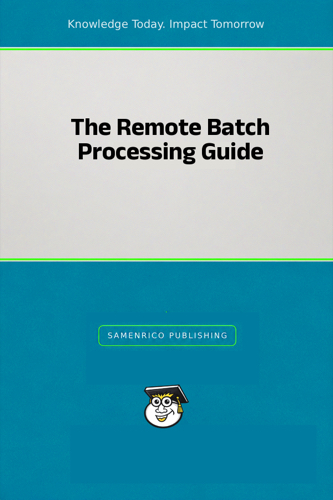
The Remote Batch Processing Guide eBook
Group similar shallow tasks to protect deep work b
Group similar shallow tasks to protect deep work blocks.
Formats
Free sample
Chapter 1: The Fragmentation Pandemic--–- The morning ritual of the modern remote worker has become a study in self-inflicted chaos. You pour your coffee. You sit down at your desk—maybe a dedicated home office, more likely the corner of your kitchen table. You open your laptop. And before you have typed two sentences of the report that was due yesterday, a Slack notification appears.
You glance at it. A colleague has a quick question. You reply in fifteen seconds. Then you see an email preview. Just a quick scan.
Then a calendar reminder pops up. Then a text from your partner. Then a news alert. Then another Slack message. Two hours later, you close your laptop, rub your eyes, and realize you have not finished the report.
You have not even added a third sentence. You have been busy all morning—you have replied to messages, attended a fifteen-minute check-in, approved a document, and answered a question on a thread. But when you ask yourself what you actually accomplished, the answer is unsettling: nothing strategic. Nothing that required your full brain. You have been a firefighter, not an architect.
And you are exhausted.This is not a failure of willpower. It is not a character flaw. It is the predictable result of an environment designed to steal your attention one micro-interruption at a time. Welcome to the fragmentation pandemic.The Always-On Expectation Remote work was supposed to free us. No commutes.
No open-plan office distractions. No colleagues stopping by your desk to chat about the weekend. We imagined long, uninterrupted stretches of deep concentration, punctuated only by the occasional Zoom call. But something unexpected happened. The absence of physical boundaries created a vacuum, and into that vacuum rushed an informal but ironclad rule: if you are home, you are available.In a physical office, there are natural friction points.
A colleague who wants to interrupt you must walk to your desk, see your expression, hear your tone, and make a social calculation about whether the interruption is worth the social cost. That walk takes time. That calculation takes mental effort. As a result, office workers are interrupted less frequently—not because their work is less urgent, but because interrupting requires work.Online, the cost of interruption is zero. A Slack ping carries no social friction.
An email arrives silently, demanding nothing from the sender but everything from the receiver. A calendar notification pops up without anyone having to walk across a room. The result is a catastrophic asymmetry: it costs senders nothing to interrupt you, but it costs you everything to recover.Data from remote work studies conducted between 2020 and 2024 reveals the scope of the problem. Remote workers experience three to four times more task-switching than their office-based counterparts. The average remote worker checks email or Slack every six minutes.
The average deep work session—defined as uninterrupted concentration on a single task—lasts less than eleven minutes before being broken by a notification. And here is the cruelest irony: most of those notifications are not urgent. In one study of over five thousand Slack messages, only twelve percent required a response within the hour. The rest could have waited. But they did not wait.
They arrived immediately, and they demanded your attention immediately, and you gave it to them because that is what the always-on expectation has trained you to do.The Anatomy of Attention Residue To understand why these micro-interruptions are so damaging, we need to look under the hood of the human brain. The concept was first popularized by Cal Newport in his book Deep Work, and it is called attention residue.Here is how it works. Imagine you are writing a quarterly strategy document. You are deep in the flow—sentences are coming easily, connections are forming, you can see the shape of the argument. Then a Slack message appears.
You decide to ignore it. But you glance at the preview. It is from your manager. She has a question about a client. You tell yourself you will reply later.
You return to your document. But something has changed. You are still typing, but your brain is not fully present. Part of it is stuck on that Slack message—wondering what the question is, worrying about whether you have the answer, planning how you will respond. That is attention residue.
A portion of your cognitive capacity remains attached to the previous task, even after you have nominally returned to the current one.The effect is measurable. Studies using functional magnetic resonance imaging have shown that when you switch between tasks, your brain does not simply unload Task A and load Task B. Instead, both tasks remain active in your working memory for a period of time, competing for neural resources. The residue reduces your cognitive capacity by twenty to forty percent for an average of eighteen minutes after the switch. That means a ten-second glance at an email costs you eighteen minutes of reduced brainpower.
If you check email ten times a day, you lose three hours of cognitive capacity—not from the time spent checking, but from the recovery period after each check.Let that sink in. Three hours. Every day. Wiped away not by laziness, not by poor time management, but by the simple act of glancing at notifications that could have waited.The Busy Bob Fallacy Consider two remote workers. Their names are Bob and Paula.
They have the same job title, the same responsibilities, the same number of meetings, and roughly the same intelligence. But their days look radically different.Bob is what we might call an "always-on" worker. He believes that responsiveness is the same as productivity. When a Slack message arrives, he answers it immediately. When an email lands in his inbox, he reads it within seconds.
He takes pride in his quick replies. By noon, he has sent forty-three Slack messages and replied to twenty-two emails. But he has not touched the proposal that was due at 10 AM. He tells himself he will get to it after lunch. After lunch, more messages have arrived.
He answers those too. By 5 PM, Bob has sent eighty-seven Slack messages, replied to forty-two emails, attended four Zoom calls, and completed zero strategic work. He feels exhausted. He feels busy. But when he looks back at his day, he cannot identify a single meaningful accomplishment.
He has been a ping-pong ball, bouncing from notification to notification, never staying in one place long enough to build anything.Paula works differently. She has set two batch windows each day: 11 AM to 11:30 AM, and 3 PM to 3:30 PM. During those windows, she processes all her Slack messages and emails. The rest of the day, her notifications are off. Her status is set to "Deep Work – Will reply at next batch." When she sits down to write her proposal at 9 AM, she writes for two uninterrupted hours.
No Slack. No email. No calendar reminders. Just her and the document. By Wednesday, not Friday, she has finished the proposal.
She has sent fewer messages than Bob—only eighteen—but those eighteen messages are thoughtful, complete, and action-oriented. She has not replied to every ping. She has replied to what matters. And…
This is the end of the free sample. Get the eBook to keep going. Buy now
About this book
Details
- Author
- Cavazos Shantae
- Publisher
- SamEnrico
- Language
- English
- Genre
- Non-Fiction, Self-Help, Batching
- Released
- 2026-06-06
- Pages (approx.)
- 122
- Available as
- eBook, Audiobook

Read better in the ZLOADR app
Your eBooks on your phone or tablet. Sign in with your SamEnrico account and start reading.
More by Cavazos Shantae
 Medical Error DisclosureCavazos Shantae$11.99
 Ego Protection In ConflictCavazos Shantae$11.99
 Personal Brand and Job SearchCavazos Shantae$11.99
 Outpatient Alcohol Detox GuideCavazos Shantae$11.99
 Working Memory Training For KidsCavazos Shantae$11.99
 Emotional Trigger IdentificationCavazos Shantae$11.99
 Equipment Breakdown ProtectionCavazos Shantae$11.99
 The Last Oracle of Delphi: When the Gods Spoke in RiddlesCavazos Shantae$11.99
 JEE Optics and Waves GuideCavazos Shantae$12.99
 Cooperative Exit and Dissolution WorkbookCavazos Shantae$12.99
 How to Produce Fire AlarmsCavazos Shantae$11.99
 A Collector's Handbook to the Aston Martin Db6Cavazos Shantae$11.99