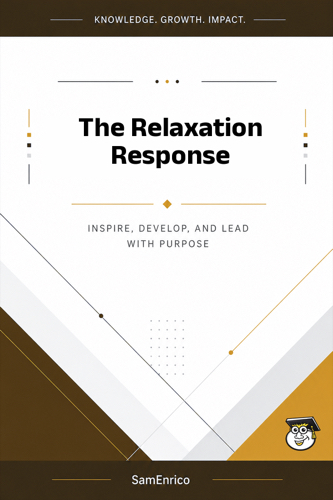
The Relaxation Response
Learn the physiological opposite of stress and how
Learn the physiological opposite of stress and how to activate it.
Formats
About this book
Free sample
Chapter 1: The Lion in Your Laptop--–- You wake up tired. Not the satisfying tiredness of a day spent hiking or building something with your hands. No, this is a deeper exhaustion—the kind that lives in your bones, that follows you from the bedroom to the bathroom mirror before you have even spoken your first word of the day. Your jaw aches from clenching overnight. Your phone, resting on the nightstand like a sleeping serpent, already glows with sixteen unread messages, two calendar reminders, and a news alert about something terrible happening somewhere you cannot influence.
You have not yet brushed your teeth, and already your heart rate has crept upward. Already your shoulders have begun their slow migration toward your ears.This is not a personal failing. This is not laziness, weakness, or a lack of discipline. This is your nervous system doing exactly what it evolved to do—responding to perceived threats with a cascade of hormones and electrical signals designed to keep you alive. The problem is not your biology.
The problem is that your biology cannot tell the difference between a saber-toothed tiger and a passive-aggressive email from your boss.The Evolutionary Mismatch Let us travel back two hundred thousand years. Imagine you are standing on the African savanna. The sun is brutal, your feet are calloused, and your entire social world consists of maybe fifty people whose names you know because you have known them your whole life. You are hungry, but there is no refrigerator. You are worried about your child, but there is no pediatrician.
Your life is difficult, dangerous, and short. Yet your nervous system has one advantage that you, reading this in the twenty-first century, do not: the threats you face are real, physical, and temporary.A lion appears on the horizon. Your body explodes into action. The amygdala—two small almond-shaped clusters deep in your brain—sounds the alarm. Your sympathetic nervous system, the body's gas pedal, floods your bloodstream with adrenaline and cortisol.
Your heart rate doubles. Your breathing quickens. Blood shunts away from your digestive system (you can digest lunch later) and…
This is the end of the free sample. Get the eBook to keep going. Buy now
Contents
- Chapter 1
- Chapter 2
- Chapter 3
- Chapter 4
- Chapter 5
- Chapter 6
- Chapter 7
- Chapter 8
- Chapter 9
- Chapter 10
- Chapter 11
- Chapter 12
Details
- Author
- Varner Wilhelmina
- Publisher
- SamEnrico
- Language
- English
- Genre
- Non-Fiction, Self-Help, Mind Body Medicine
- Released
- 2026-06-09
- Pages (approx.)
- 138
- Available as
- eBook, Audiobook

Read better in the ZLOADR app
Your eBooks on your phone or tablet. Sign in with your SamEnrico account and start reading.
More by Varner Wilhelmina
 Breast MRI Screening GuideVarner Wilhelmina$11.99
 Assertiveness In Grief Situations HandbookVarner Wilhelmina$11.99
 Anger Management for HealthcareVarner Wilhelmina$11.99
 The Emotion Regulation for First RespondersVarner Wilhelmina$11.99
 The Battle of Changping: Qin's Bloody ReckoningVarner Wilhelmina$11.99
 Understanding Roseola InfantumVarner Wilhelmina$17.99
 Natural Gas TradingVarner Wilhelmina$11.99
 How to Start a Accessories and Parts for Motor Vehicles and Their Engines Business (Beginners Guide)Varner Wilhelmina$11.99
 Small Business CTA ComplianceVarner Wilhelmina$12.99
 Invoice Factoring Ghana GuideVarner Wilhelmina$12.99