
Non-FictionSelf-HelpReferral Marketing
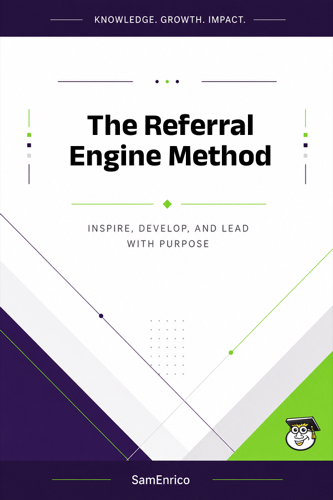
The Referral Engine Method eBook
Teaches how to become a go-to person so opportunit
Teaches how to become a go-to person so opportunities come to you through word-of-mouth.
Formats
Free sample
Chapter 1: The Referral Paradox--–- The first time someone refused to refer me, I deserved it. I had just finished a project for a happy client—genuinely happy, the kind who sends unsolicited thank-you emails. We were reviewing the final deliverable when I casually said, “So, if you know anyone else who needs this, send them my way.” She nodded, smiled, and said, “Absolutely.” Then nothing happened. No emails. No introductions.
No referrals. For six months.I told myself she was busy. I told myself she forgot. But the truth was harder to swallow: she didn’t forget. She just didn’t act.
And that distinction—between a happy client and an acting advocate—is where most professionals lose the referral game.This book exists because that moment forced me to confront an uncomfortable pattern. Over the next two years, I interviewed hundreds of business owners, consultants, and professionals who all described the same frustration. “My clients love me,” they would say, “but they don’t send me business.” Some blamed their clients. Some blamed their industry. A few blamed bad luck.
But the ones who figured it out—the ones who became the go-to person in their field—had discovered something the rest were missing.Referrals are not a reward for good work. They are a response to a specific set of conditions. And most professionals, through no fault of their own, are creating the opposite conditions.This chapter will dismantle everything you think you know about word-of-mouth. We will expose why traditional networking fails, why asking for referrals often backfires, and why the most successful professionals seem to have opportunities chase them without ever asking. More importantly, we will introduce the single framework that resolves the referral paradox: the two-phase engine that separates accidental word-of-mouth from systematic, predictable growth.The Pain of Traditional Networking Let us start with a confession.
I have attended more than two hundred networking events. Breakfast meetings, chamber of commerce mixers, industry conferences, speed networking sessions, even a “yoga and business cards” event that was exactly as awkward as it sounds. At every single one, I watched the same ritual play out.Two professionals meet. They exchange business cards. They ask, “So, what do you do?” They give a thirty-second elevator pitch.
They promise to “connect on Linked In” and “send anyone who needs your services your way.” Then they move to the next person. Repeat. Repeat. Repeat.Here is what actually happens in these exchanges. Both parties are performing extraction.
Each person is trying to figure out what the other person can give them. The question “What do you do?” is rarely curiosity. It is categorization. Is this person a potential lead? A potential partner?
A waste of time? The subtext is always, “What can you do for me?”The tragedy is that this approach fails for both people. The one asking for referrals signals neediness. The one being asked feels the subtle pressure of a transaction. Neither leaves energized.
Neither leaves with a genuine connection. And almost no actual referrals emerge from these exchanges.Research on social networks supports this observation. Sociologist Ronald Burt’s work on “structural holes” found that the most valuable networks are not built through symmetrical exchange but through brokerage—connecting people who wouldn’t otherwise meet. But here is the catch: brokerage only works when both parties trust the broker. And trust is not built through business cards and elevator pitches.
Trust is built through demonstrated value, vulnerability, and time.The networking event model is fundamentally broken because it reverses the correct order. It asks for the transaction (the referral or introduction) before the relationship (the trust) has been established. Worse, it trains professionals to constantly ask, which signals scarcity. And scarcity, in social dynamics, is repellent.The Scarcity Trap Consider two professionals. One is constantly asking for referrals.
She sends emails, posts on Linked In, mentions it at the end of every client call. She is competent, even talented, but her requests feel slightly desperate. The other professional rarely asks. In fact, he sometimes turns down business because he is “too selective” or “currently at capacity.” He shares insights publicly, answers questions generously, and never seems to need anything from anyone.Which one do you want to refer? Which one do you want to be?The answer is obvious.
The second professional—the one who appears to need nothing—is magnetic. The first professional, despite her competence, feels like a burden. This is the scarcity trap. When you need referrals, you signal that you are not the go-to person. You signal that you are chasing, not attracting.
And chasing, in human psychology, triggers avoidance.There is a neurological basis for this phenomenon. The hypothalamus, a small but powerful region of the brain, processes social reward and punishment. When we recommend someone to a friend, and that recommendation goes well, the hypothalamus releases oxytocin—the bonding hormone. We feel good. We feel generous.
We feel proud. But here is the critical detail: the hypothalamus is exquisitely sensitive to risk. If recommending someone could make us look bad—if the person we refer might under-deliver, embarrass us, or waste our friend’s time—the hypothalamus suppresses the reward response. We feel hesitation instead of enthusiasm.This means that referring is biologically pleasurable only under one condition: when the referral reflects well on the recommender. The recommender must feel safe, confident, and proud to make the introduction.
And safety, in this context, is destroyed by scarcity. If you appear to need referrals, you signal that you might be desperate for work. And a desperate professional is a risky recommendation. Will they over-promise? Will they be too busy chasing leads to deliver?
Will they make me look bad?The scarcity trap explains why the traditional “ask for referrals” approach fails. It signals the exact opposite of what the recommender needs to feel: safety.The Neuroscience of Word-of-Mouth To build a referral engine, we must understand why people refer at all. It is not altruism. It is not even generosity. At its core, referring is self-interest dressed in the clothes of helpfulness.Let me explain.
When you recommend a great restaurant to a friend, and the friend loves it, several things happen. Your friend thanks you. You feel validated. You gain social credit. The friend trusts your judgment more in the future.
And your own brain rewards you with a small hit of oxytocin. You have successfully increased your social standing while helping someone else. It is a win-win, but the win for you is primary. The help for your friend is secondary.This is not cynical. It is neurological.
The brain does not distinguish between “helping others” and “helping yourself” when the outcome is positive. The reward pathway fires either way. The problem arises only when the outcome is negative. If you recommend a terrible restaurant, your friend is annoyed. Your judgment is questioned.
Your social credit decreases. And your brain withholds the reward. You feel embarrassment instead of pleasure.Therefore, every referral is a reputation gamble. The person referring you is staking their social capital on your performance. If you deliver, they win.
If you fail, they lose. And because humans are loss-averse (losses hurt twice as much as equivalent gains feel good)…
This is the end of the free sample. Get the eBook to keep going. Buy now
About this book
Details
- Author
- Serrano Karrie
- Publisher
- SamEnrico
- Language
- English
- Genre
- Non-Fiction, Self-Help, Referral Marketing
- Released
- 2026-06-08
- Pages (approx.)
- 145
- Available as
- eBook, Audiobook

Read better in the ZLOADR app
Your eBooks on your phone or tablet. Sign in with your SamEnrico account and start reading.
More by Serrano Karrie
 Tennis Serve Hypnosis Training GuideSerrano Karrie$11.99
 Cocaine Dependency Heart Health GuideSerrano Karrie$11.99
 Groin Pain Meditation GuideSerrano Karrie$11.99
 Health Anxiety Meditation GuideSerrano Karrie$11.99
 Credit Score Anxiety ReliefSerrano Karrie$11.99
 Character Walk Improv GuideSerrano Karrie$11.99
 Press Release ToolkitSerrano Karrie$11.99
 Bangladeshi Father LaborerSerrano Karrie$11.99
 The Silk Road GambitSerrano Karrie$11.99
 The Silent Strategist: The Genius of John 'The Gamester' Perry in 18th-Century CricketSerrano Karrie$11.99
 How to Produce Bearing SteelSerrano Karrie$11.99
 Biomedical Engineering and Medical Devices ProfessionalSerrano Karrie$11.99
You may also like
 Hong Kong Handover 1997Dunn Johnnie$11.99
 Zumba For Postnatal Recovery CourseNeal Christian$11.99
 Zumba for BeginnersLadner Nikia$11.99
 YouTube Comment Mining GuideHumes Pandora$12.99
 Worry Box MeditationCarlin Rudy$11.99
 Workplace Stress MeditationNguyen Lynn$11.99
 Workplace Stress and Sleep RepairHawley Ivory$11.99
 Workplace Perfectionism CureDelaney Jeffry$11.99
 Workplace Injustice Anger GuideWallen Isabelle$11.99
 Work Addiction and Burnout LinkGreenwood Ester$11.99
 Women in Yoga and WellnessBeattie Galina$11.99
 Women in Stand Up ComedyChun Evangeline$11.99