
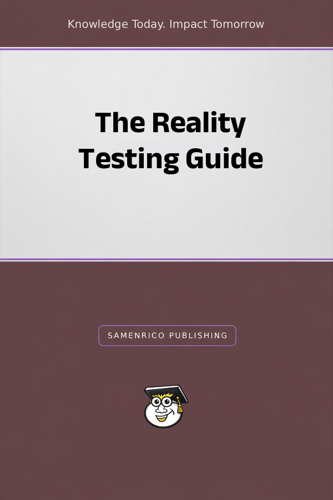
The Reality Testing Guide eBook
Checks waking state to trigger lucidity in dreams.
Checks waking state to trigger lucidity in dreams.
Formats
Free sample
Chapter 1: The 25-Year Gift--–- You are going to spend approximately twenty-five years of your life asleep. Let that number settle for a moment. Twenty-five years. That is not a typo, and it is not an exaggeration meant to shock you. Based on a standard human lifespan of seventy-nine years, with eight hours of sleep per night, the math is brutal and unassailable: one-third of your existence will be spent in a state of unconsciousness.
If you live to eighty, you will have slept for roughly twenty-six and a half years. Within those years, an estimated six to eight years will be spent dreaming. Six to eight years of vivid, sensory-rich, emotionally charged hallucinations generated entirely by your own brain—experiences that feel real while they happen, vanish upon waking, and are never revisited unless you train yourself to remember them.Now consider what you could do with six years of waking life. You could earn a doctorate, become fluent in three languages, write two novels, raise a child from birth to kindergarten, or travel to every continent. But those six years of dreaming are not waking life.
They are something stranger and, in many ways, more valuable. In dreams, you can fly without an airplane. You can speak to the dead. You can revisit childhood homes that have been demolished. You can confront your deepest fears without physical consequence.
You can rehearse conversations, solve creative problems, and experience impossible beauty. And yet, for almost all of human history, these six years have been passive—a theater where you are both the audience and the actor, but never the director. You watch your dreams happen to you. You do not choose them. You do not question them.
You wake up, perhaps with a vague impression of a chase or a conversation, and then you go about your day, having surrendered another night of your life to unconscious randomness.This book is about taking those six years back.The Reality Testing Guide is not a mystical text. It will not teach you to astral project, communicate with spirits, or predict the future. It will not ask you to believe in anything that cannot be measured, repeated, or explained by the current neuroscience of sleep. What it will do is teach you a single, practical skill: how to know, while you are inside a dream, that you are dreaming. This state is called lucid dreaming, and the gateway to lucid dreaming is reality testing—a set of simple cognitive exercises performed during waking hours that train your brain to recognize the difference between waking consciousness and the dream state.The premise is straightforward, but the implications are not.
If you can learn to become aware within your dreams, those six to eight years transform from passive experience into active exploration. You can choose to fly, but you can also choose to sit quietly and observe the architecture of your own unconscious mind. You can confront recurring nightmares and rewrite their endings. You can practice real-world skills—public speaking, athletic performance, creative problem-solving—in a consequence-free simulation that engages the same neural circuits as waking practice. You can, quite simply, live more life.
Not by sleeping less, but by waking up within sleep.This chapter has three goals. First, to explain why the standard approach to lucid dreaming—obsessing over "dream control" and exotic techniques—fails for most people. Second, to introduce the neurobiology of dreaming in a way that is accurate but not overwhelming. Third, to lay the foundation for everything that follows: reality testing is not a magic trick. It is a cognitive exercise that strengthens the very brain circuits responsible for self-awareness.
You are not learning to "break" the dream. You are learning to build a stronger waking brain that happens to remain active during sleep.Let us begin with a question that most books on this topic avoid: Why do you want to lucid dream?The Wrong Question: "What Would You Do If You Could Control Your Dreams?"Walk into any bookstore or scroll through any online forum about lucid dreaming, and you will encounter the same seductive question: "What would you do if you could control your dreams?" The answers are predictable and, frankly, adolescent. People want to fly. They want to have sex with celebrities. They want to eat infinite pizza without gaining weight.
They want to fight dragons, visit fictional worlds, or exact revenge on childhood bullies. These are not wrong desires. They are simply incomplete. And more importantly, they are built on a misunderstanding of what lucid dreaming actually is.The distinction that matters—and that almost every popular guide gets wrong—is the difference between being lucid and being in control. Lucidity means awareness.
It means knowing, with certainty, that the world around you is a hallucination generated by your sleeping brain. Control means manipulation. It means actively changing that hallucination: flying, summoning objects, transforming the environment. These two states are separate. You can be lucid without any control at all, simply observing the dream as it unfolds with the knowledge that it is not real.
Conversely, you can exert control without full lucidity—a state sometimes called "dream scripting" where you influence the narrative without realizing you are dreaming.Here is the uncomfortable truth that most books hide: chasing control usually destroys the dream.The moment you become lucid, your brain releases a small surge of norepinephrine, a neurotransmitter associated with alertness and excitement. This is the same chemical that wakes you up when you hear a loud noise. A little bit of norepinephrine is helpful—it sharpens awareness. But when you immediately try to fly or summon a specific person, your excitement spikes, norepinephrine floods your system, and your brain shifts toward waking consciousness. The dream collapses.
You open your eyes. You are in bed, frustrated, having just lost the very experience you were trying to have.The most successful lucid dreamers do not chase control. They chase stability. They learn to remain calm, to observe, to gently test the boundaries of the dream without forcing change. They understand that lucidity is the goal, and control is a bonus that comes later—if it comes at all.
This book will teach you the Reality Testing method, which prioritizes awareness over control. You will learn to recognize the dream state reliably and consistently. What you do once you are there is up to you, but the book will also teach you stabilization techniques in Chapter 11 to prevent premature awakening.First, however, you need to understand what is happening inside your skull when you dream.The Neurobiology of Knowing: Why Your Brain Forgets That It Is Dreaming The human brain is the most complex object in the known universe. Approximately eighty-six billion neurons, each connected to thousands of others, forming a network so dense that it defies complete mapping. During wakefulness, these neurons fire in coordinated patterns, processing sensory input, generating thoughts, storing memories, and maintaining a continuous sense of self.
That sense of self—the feeling that there is an "I" experiencing the world—is not a mystical soul. It is a function of specific brain regions, primarily the dorsolateral prefrontal cortex (DLPFC).The DLPFC is…
This is the end of the free sample. Get the eBook to keep going. Buy now
About this book
Details
- Author
- Tanner Christopher
- Publisher
- SamEnrico
- Language
- English
- Genre
- Non-Fiction, Self-Help, Reality Checks
- Released
- 2026-06-05
- Pages (approx.)
- 148
- Available as
- eBook, Audiobook

Read better in the ZLOADR app
Your eBooks on your phone or tablet. Sign in with your SamEnrico account and start reading.
More by Tanner Christopher
 Exercise as a Cessation ToolTanner Christopher$11.99
 Meeting Recurrence Audit GuideTanner Christopher$11.99
 Navigating Virtual Difficult TalksTanner Christopher$11.99
 Burnout Prevention for FreelancersTanner Christopher$11.99
 Understanding X-linked DominanceTanner Christopher$17.99
 10 Ways to Use Firm-ball Stage (Recipe Book)Tanner Christopher$11.99
 User Testing Niche SpecializationTanner Christopher$12.99
 Consultant CAC PlaybookTanner Christopher$12.99
 Silent MajorityTanner Christopher$11.99