
Non-FictionScience Breakthrough
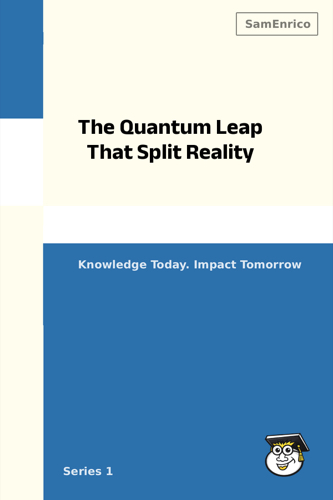
The Quantum Leap That Split Reality eBook
Unravel the mind-bending story of the 1989 quantum
Unravel the mind-bending story of the 1989 quantum experiment that accidentally created two parallel timelines, leaving scientists questioning everything.
Formats
Free sample
Chapter 1: The Heretic’s Gambit...--–- The letter arrived on a Tuesday, smeared with olive oil and desperation.Dr. Elena Voss unfolded the single sheet of paper with trembling fingers, already knowing what she would find. The foundation’s letterhead was embossed in gold—obscene for an institution that claimed to fund only “fringe theoretical physics.” The rejection was polite, almost gentle. Your proposal, while intriguing, does not align with our current priorities. She had received twelve such rejections in the past eighteen months.
This one hurt worst of all, because it came from the last organization that still pretended to take Many-Worlds seriously.She crumpled the letter and threw it at the overflowing waste bin in the corner of her office. It missed, joining a small mountain of failed ambitions on the linoleum floor. The office itself was a confession of poverty: water stains on the ceiling, a desk that had belonged to three previous occupants, bookshelves bowed under the weight of journals no one else in the department bothered to read. Outside her single window, the gray spires of the University of Leuven blurred into a Belgian sky that had not seen sunlight in two weeks.Elena leaned back in her chair and closed her eyes. She was thirty-nine years old, tenured only because the university had needed a woman in the physics department to satisfy a diversity requirement, and brilliant in a way that made her colleagues uncomfortable.
She did not publish often. When she did, her papers were dense, uncompromising, and laced with footnotes that savaged the logical gaps in Copenhagen orthodoxy. Her department head had once told her, over cheap wine at a faculty mixer, that she had “the mind of a revolutionary and the social skills of a guillotine.” She had taken it as a compliment.The Many-Worlds Interpretation of quantum mechanics was not supposed to be controversial. Hugh Everett had laid it out in his 1957 Ph.D. thesis with mathematical elegance: the wave function never collapses.
Every quantum outcome branches into a separate universe, all of them equally real. The cat is both dead and alive, not in some probabilistic purgatory, but in two distinct realities that split at the moment of measurement. It was the simplest interpretation of the Schrödinger equation, the one that required no additional mechanisms, no mysterious “collapse” that physicists had been arguing about for decades.And yet, the establishment hated it.Elena opened her eyes and looked at the framed photograph on her desk. It showed a young man in his twenties, grinning at the camera with the easy confidence of someone who had never been told he was wrong. Hugh Everett III.
He had submitted his MWI thesis in 1957, been dismissed by Niels Bohr himself as “incomprehensible,” and promptly left academia to work on nuclear weapons simulations for the Pentagon. He died in 1982 of a heart attack, his theory still considered a fringe curiosity. Elena had never met him. But she felt his absence like a phantom limb.“They killed you with politeness,” she muttered to the photograph. “They’ll do the same to me if I let them.”The Copenhagen Tyranny The dominant interpretation of quantum mechanics was, Elena thought, a masterpiece of intellectual cowardice.
The Copenhagen Interpretation, hammered out by Niels Bohr and Werner Heisenberg in the 1920s, held that quantum systems exist in a superposition of states until measured. At the moment of measurement, the wave function “collapses” to a single outcome. It worked mathematically. It gave correct predictions. But it offered no mechanism for how or why collapse occurred.
It simply asserted that measurement causes it, and measurement, conveniently, was whatever physicists did in laboratories.Bohr had been a giant, there was no denying that. But he had also been a bully. Elena had read the transcripts of his debates with Einstein, the famous “God does not play dice” exchanges. Bohr had won not because he was right, but because he was louder, more respected, and more willing to dismiss his opponents as confused. By the 1960s, Copenhagen had become orthodoxy.
To question it was to question the very foundations of physics—and to mark yourself as a crank.Everett’s sin had been to take the Schrödinger equation literally. If the wave function never collapses, then all outcomes coexist. It was elegant. It was parsimonious. And it was radioactive.Elena stood up from her desk and walked to the chalkboard that covered one wall of her office.
It was covered in equations, most of them crossed out. At the center, circled in red, was the problem she had been trying to solve for three years:How long can a quantum system maintain superposition in the presence of environmental decoherence?Decoherence was the enemy. When a quantum system interacts with its environment—with air molecules, thermal radiation, cosmic rays—its superposition leaks away, entangling with countless external particles until the original quantum state becomes unrecoverable. This was why Schrödinger’s cat remained theoretical. In practice, decoherence destroyed superposition almost instantly, at timescales measured in microseconds or less.But decoherence was not fundamental.
It was a practical limitation, not a law of physics. And Elena had become obsessed with a question no one else was asking: What if you could suppress decoherence?The Quantum Zeno Hypothesis She picked up a piece of chalk and began to write, her handwriting small and precise. The Quantum Zeno Effect was well-established. If you measure a quantum system frequently enough, you can “freeze” it in its initial state. The act of observation prevents evolution.
It was paradoxical—measurement usually changes things, but in the quantum realm, too much measurement could stop change entirely.Elena had been exploring the inverse. If frequent measurement froze a quantum state, could a specific pattern of measurements keep a system in superposition? Not frozen, but suspended—held between possibilities, never forced to choose. The mathematics was brutal. She had been working on it for three years, and only in the past month had she begun to see a path forward.The key was feedback.
A standard measurement collapsed the wave function. But if you measured not the particle itself but its relationship to a reference system—if you measured the entanglement rather than the state—you might avoid collapse while maintaining coherence. It was like watching a dancer from across a crowded room. If you looked directly at her, she would stop. But if you watched her reflection in a window, she would continue moving, unaware she was being observed.Elena had named the approach “reflexive measurement.” She had published a single paper on it in Physical Review Letters in 1984, and it had been ignored.
The referees had called it “interesting but speculative.” One had written, in a review that still made her blood boil, “The author appears to misunderstand the fundamental nature of quantum measurement.”She understood it perfectly. That was the problem.The Assistant’s Arrival A soft knock interrupted her thoughts. Elena did not turn around. “Enter.”The door creaked open, and a young man stepped inside. He was tall, thin, with the kind of permanent slouch that came from being too tall for most doorframes.
His name was Samuel Renn, and he was twenty-four years old, two years out of his own Ph.D., and currently…
This is the end of the free sample. Get the eBook to keep going. Buy now
About this book
Details
- Author
- Conyers Mitzi
- Publisher
- SamEnrico
- Language
- English
- Genre
- Non-Fiction, Science Breakthrough
- Released
- 2026-06-04
- Pages (approx.)
- 118
- Available as
- eBook, Audiobook

Read better in the ZLOADR app
Your eBooks on your phone or tablet. Sign in with your SamEnrico account and start reading.
More by Conyers Mitzi
 Body Image Resilience Against Media MythsConyers Mitzi$11.99
 Ben Silbermann PinterestConyers Mitzi$11.99
 Nobel Prize Poverty Research GuideConyers Mitzi$11.99
 Elder Financial Abuse SignsConyers Mitzi$11.99
 Vehicle Through Sahara SandsConyers Mitzi$11.99
 Petrified Forest VanishedConyers Mitzi$11.99
 Glasses Push as DisagreementConyers Mitzi$11.99
 Beginner Mindfulness Of UrgesConyers Mitzi$11.99
 Anansi's Golden Web: Lessons from the Spider TricksterConyers Mitzi$11.99
 The Mineral Guide to AlarsiteConyers Mitzi$11.99
 How to Become a Brine Maker IConyers Mitzi$11.99
 Cracking JEE Through Self StudyConyers Mitzi$12.99
You may also like
 Hong Kong Handover 1997Dunn Johnnie$11.99
 Zumba For Postnatal Recovery CourseNeal Christian$11.99
 Zumba for BeginnersLadner Nikia$11.99
 YouTube Comment Mining GuideHumes Pandora$12.99
 Worry Box MeditationCarlin Rudy$11.99
 Workplace Stress MeditationNguyen Lynn$11.99
 Workplace Stress and Sleep RepairHawley Ivory$11.99
 Workplace Perfectionism CureDelaney Jeffry$11.99
 Workplace Injustice Anger GuideWallen Isabelle$11.99
 Work Addiction and Burnout LinkGreenwood Ester$11.99
 Women in Yoga and WellnessBeattie Galina$11.99
 Women in Stand Up ComedyChun Evangeline$11.99