
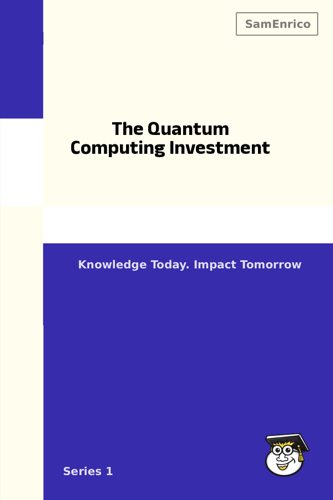
Non-FictionForecast & OutlookQuantum Tech
The Quantum Computing Investment eBook
Allocates early capital to hardware, error correct
Allocates early capital to hardware, error correction, and algorithm development.
Formats
Free sample
Chapter 1: The Qubit Trap--–- In the autumn of 2021, a venture capitalist named Sarah Chen flew to Washington, D.C., to visit a quantum computing startup that was raising a Series B round. The company had fifty employees, a beautiful laboratory filled with tangled wires and gold-plated hardware, and a valuation of $400 million. The founder, a charismatic physicist with a TED Talk to his name, walked Sarah through a demonstration. On a large screen, he showed a simulation of a molecule – caffeine, he explained – being modeled by the company's quantum processor. The simulation ran in seconds.
A classical supercomputer, he claimed, would have taken days. "This," he said, "is the beginning of the end for classical computing."Sarah was impressed. She had made her fortune in enterprise software, where valuations were driven by revenue growth and customer acquisition costs. But quantum was different. Quantum was magic.
Quantum was the future. She signed the term sheet. The deal closed in December 2021.By December 2022, the company's valuation had fallen by 70 percent. The "caffeine simulation" turned out to be a carefully staged demo that used classical precomputation to cheat. The company had no paying customers.
The founder had left to start another venture. Sarah's limited partners were furious. She had broken the first rule of technology investing: she had fallen in love with a story instead of a business.This chapter is about why that story was so seductive, why it collapsed, and how you can avoid making the same mistake. The story has a name. It is called the qubit trap.The Seduction of Simple Numbers Human beings are pattern-seeking animals.
We crave simple metrics that correlate with success. In the early days of classical computing, that metric was megahertz. A 500 MHz processor was faster than a 250 MHz processor, end of story. Investors understood it. Consumers understood it.
It drove purchasing decisions for two decades.Then the megahertz wars ended. Engineers realized that raw clock speed was a poor proxy for actual performance once you factored in pipelining, caching, and parallelization. Today, no serious technologist would compare processors by clock speed alone. But the habit of seeking a single, simple number is hard to break.In quantum computing, that number is qubit count. How many qubits does your machine have?
Fifty? One hundred? One thousand? The logic seems obvious: more qubits means more computational power. The company with the most qubits must be the leader.
Therefore, invest in that company.This logic is seductive. It is also catastrophically wrong.Here is what the qubit count does not tell you. It does not tell you how long those qubits maintain their quantum state – their coherence time. It does not tell you how accurately you can perform operations on them – their gate fidelity. It does not tell you how well the qubits are isolated from one another – their cross-talk.
It does not tell you whether the qubits can be connected in the arbitrary ways that algorithms require – their connectivity. And crucially, it does not tell you how noisy the system is – the rate at which random errors corrupt your computation.A quantum computer with one thousand noisy qubits is less useful than a quantum computer with fifty high-fidelity, long-coherence, fully connected qubits. The thousand-qubit machine will produce garbage faster. But the investor who only looks at the qubit count will pour money into the thousand-qubit machine every single time.The physics behind this is unforgiving. Every quantum operation – every gate, every measurement, every reset – introduces error.
Those errors accumulate. For a circuit of depth D (meaning D sequential layers of operations), the probability that your output is uncorrupted decays roughly as (1 - p)^D, where p is the per-gate error rate. If p is one percent – which is typical for today's best devices – then after one hundred gates, your chance of an error-free computation is about 37 percent. After two hundred gates, it is 13 percent. After five hundred gates, it is effectively zero.Most useful quantum algorithms require thousands or millions of gates.
That means even a 99 percent gate fidelity is useless for practical computation. What you need is 99.9 percent fidelity. Or 99.99 percent. Or, for truly fault-tolerant quantum computing, 99.9999 percent.Qubit count tells you nothing about any of this. It is a vanity metric.
And the companies that have learned to market their qubit counts while hiding their error rates have raised billions of dollars from investors who should have known better.The SPAC Mania: A Case Study in Collective Delusion The special purpose acquisition company, or SPAC, was the perfect vehicle for quantum hype. SPACs allowed private companies to go public with minimal financial disclosure and maximal storytelling. The management team of the SPAC – often a group of former bankers or celebrity investors – would present a "business combination" that promised massive growth. The target company would present a "projection" that showed revenues soaring from zero to hundreds of millions in five years. No one asked how those projections were calculated.
No one asked what assumptions underpinned them. Everyone was too busy buying the story.Ion Q was the poster child for this phenomenon. When it went public via SPAC in October 2021, its valuation touched nearly $2 billion. The company's 2020 revenue was less than $2 million. Its 2021 revenue, projected optimistically, was about $6 million.
The valuation implied a price-to-sales ratio of over 300. For comparison, Google's price-to-sales ratio at its 2004 IPO was about 5. Nvidia's was about 6. Even Amazon, which lost money for years, never traded at a price-to-sales ratio above 15 in its early years.What justified Ion Q's valuation? Qubits.
The company had announced a 32-qubit system. It promised a 64-qubit system by 2022. It talked about its "trapped ion" technology, which had certain theoretical advantages over the superconducting qubits used by IBM and Google. Investors heard "32 qubits" and "trapped ion" and assumed they were buying into a technology that would soon make classical computing obsolete.They were wrong. Ion Q's 32-qubit system had gate fidelities that were respectable but not revolutionary.
Its coherence times were measured in milliseconds – decent, but far below what is needed for error correction. Its connectivity was limited, meaning that many algorithms required additional "swap" gates that introduced further errors. The company was a legitimate research enterprise, but it was not a $2 billion business. It was not even a $200 million business.The stock collapsed. By mid-2023, Ion Q was trading below $5 per share, down from a peak of nearly $30.
The company survived – it had raised enough cash to weather the storm – but its shareholders were devastated. The same pattern played out at D-Wave, Rigetti, and a half-dozen smaller quantum startups that went public through SPACs.The lesson is not that these companies are worthless. The lesson is that their valuations were detached from any reasonable estimate of their future cash flows. The investors who bought at the peak were not investing; they were gambling on a narrative. And the narrative was built on qubit counts.The NISQ Reality: What Noisy Quantum Computers Can Actually Do In 2018, the physicist John Preskill coined the term NISQ – Noisy Intermediate-Scale Quantum – to describe the quantum computers that would be built over the following decade.
NISQ devices have between fifty and five hundred physical qubits. Their gate errors are typically between 0.1 percent and 1…
This is the end of the free sample. Get the eBook to keep going. Buy now
About this book
Details
- Author
- Ratcliff Claris
- Publisher
- SamEnrico
- Language
- English
- Genre
- Non-Fiction, Forecast & Outlook, Quantum Tech
- Released
- 2026-06-05
- Pages (approx.)
- 125
- Available as
- eBook, Audiobook

Read better in the ZLOADR app
Your eBooks on your phone or tablet. Sign in with your SamEnrico account and start reading.
More by Ratcliff Claris
 Internal Comms Case Study TemplateRatcliff Claris$11.99
 Anger for Software EngineersRatcliff Claris$11.99
 Work Addiction and SleepRatcliff Claris$11.99
 The First Lap: Medieval Horse Racing and the Birth of SpeedRatcliff Claris$11.99
 Investment Cooperative GuideRatcliff Claris$12.99
 Back to Back Meeting BreaksRatcliff Claris$12.99
 Understanding Spondyloepimetaphyseal Dysplasia Congenita, IraqiRatcliff Claris$17.99
 How to Become a Pipe Coverer And InsulatorRatcliff Claris$11.99
 Apprentice PlumberRatcliff Claris$11.99
You may also like
 Hong Kong Handover 1997Dunn Johnnie$11.99
 Zumba For Postnatal Recovery CourseNeal Christian$11.99
 Zumba for BeginnersLadner Nikia$11.99
 YouTube Comment Mining GuideHumes Pandora$12.99
 Worry Box MeditationCarlin Rudy$11.99
 Workplace Stress MeditationNguyen Lynn$11.99
 Workplace Stress and Sleep RepairHawley Ivory$11.99
 Workplace Perfectionism CureDelaney Jeffry$11.99
 Workplace Injustice Anger GuideWallen Isabelle$11.99
 Work Addiction and Burnout LinkGreenwood Ester$11.99
 Women in Yoga and WellnessBeattie Galina$11.99
 Women in Stand Up ComedyChun Evangeline$11.99