
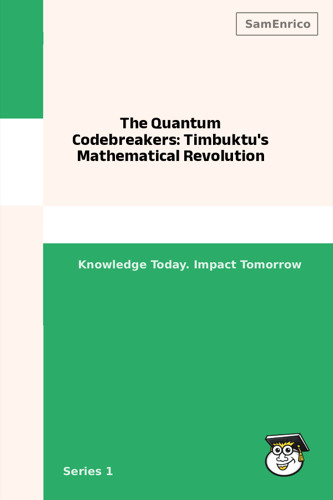
The Quantum Codebreakers: Timbuktu's Mathematical Revolution
Unveil the brilliance of Timbuktu’s 16th-century m
by Grier Cayla
Unveil the brilliance of Timbuktu’s 16th-century mathematicians who decoded advanced algebraic equations and statistical models, shaping the foundations of modern computation.
Formats
About this book
Free sample
Chapter 1: The Silicon Sands...–- The programmer in Palo Alto stared at her screen, watching lines of Python scroll upward like a digital tide. She had just written a function to optimize a search algorithm—a recursive loop that would save the company three milliseconds per query. Three milliseconds. In the world of high-frequency trading, that meant millions of dollars. She did not think, in that moment, about where algorithms came from.
She did not wonder who first asked the question: Can we teach a machine to repeat a logical procedure until it solves itself? She assumed, like most people, that computation was born in the twentieth century, in air-conditioned labs and university basements, on punch cards and silicon chips. She was wrong.Fifteen hundred miles to the northeast, in the basement of a university library in Bamako, Mali, a conservator named Fatoumata Diakité was doing something that looked entirely different but was, in a profound sense, exactly the same. She was deciphering a manuscript written in 1587 by a scholar named Al-Samlali. The manuscript contained a proof about addition—not about how to add numbers, but about what addition actually meant.
Al-Samlali had written: To add is to remove some numbers from their original configuration and reassemble them in a new configuration that preserves total value. The operation is not physical. It is logical. Fatoumata set down her tweezers and stared at the brittle page. She was not a programmer.
She had never written a line of code. But she recognized, instantly, that she was looking at an algorithm.This book is about the bridge between those two moments. It is about the forgotten city where scholars asked the same questions that drive modern computation, centuries before the first computer was built. That city is Timbuktu. And this is its mathematical revolution.The City That Should Not Exist Timbuktu sits at the edge of the Sahara, where the desert meets the Niger River.
By any rational calculation, it should not be a city at all. The average temperature exceeds 100 degrees Fahrenheit for half the year. Dust storms blanket the…
This is the end of the free sample. Get the eBook to keep going. Buy now
Contents
- Chapter 1
- Chapter 2
- Chapter 3
- Chapter 4
- Chapter 5
- Chapter 6
- Chapter 7
- Chapter 8
- Chapter 9
- Chapter 10
- Chapter 11
- Chapter 12
Details
- Author
- Grier Cayla
- Publisher
- SamEnrico
- Language
- English
- Genre
- Non-Fiction, Particle Physics
- Released
- 2026-06-04
- Pages (approx.)
- 134
- Available as
- eBook, Audiobook

Read better in the ZLOADR app
Your eBooks on your phone or tablet. Sign in with your SamEnrico account and start reading.
More by Grier Cayla
 The Growth Mindset JournalGrier Cayla$11.99
 Diaphragmatic Breathing For PelvisGrier Cayla$11.99
 My Voice Behind The CartoonGrier Cayla$11.99
 Tender Points GuideGrier Cayla$11.99
 Stress and Chronic FatigueGrier Cayla$11.99
 Senior Self Worth WorkbookGrier Cayla$11.99
 Body Acceptance BedtimeGrier Cayla$11.99
 Job Loss and Physical HealthGrier Cayla$11.99
 The Thunderbird's Sky Forge: A Haida Legend of the CloudsGrier Cayla$11.99
 How to Become a Rug-cutter HelperGrier Cayla$11.99
 Epagneul Pont Audemers: French SpanielGrier Cayla$11.99
 Quick Ratio Acid Test HandbookGrier Cayla$12.99
You may also like
 Hong Kong Handover 1997Dunn Johnnie$11.99
 Zumba For Postnatal Recovery CourseNeal Christian$11.99
 Zumba for BeginnersLadner Nikia$11.99
 YouTube Comment Mining GuideHumes Pandora$12.99
 Worry Box MeditationCarlin Rudy$11.99
 Workplace Stress MeditationNguyen Lynn$11.99
 Workplace Stress and Sleep RepairHawley Ivory$11.99
 Workplace Perfectionism CureDelaney Jeffry$11.99
 Workplace Injustice Anger GuideWallen Isabelle$11.99
 Work Addiction and Burnout LinkGreenwood Ester$11.99
 Women in Yoga and WellnessBeattie Galina$11.99
 Women in Stand Up ComedyChun Evangeline$11.99