
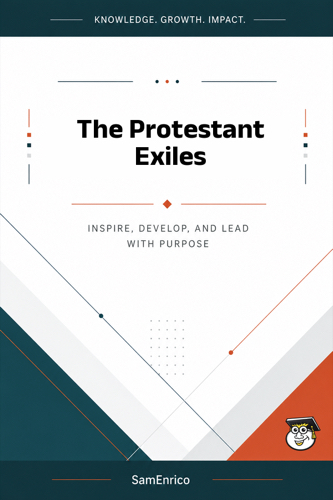
The Protestant Exiles eBook
Trace Marian exiles who fled England during Mary T
Trace Marian exiles who fled England during Mary Tudor's persecutions.
Formats
Free sample
Chapter 1: The Lost Decade...--January 28, 1547. Greenwich Palace, England. The most powerful man in the realm lay dying. Henry VIII, the tyrant king who had broken with Rome, beheaded two of his wives, and declared himself Supreme Head of the Church of England, was slowly rotting from the inside out. His legs, ulcerated and foul, gave off a stench that filled the entire bedchamber.
His body, once athletic and imposing, had swollen to grotesque proportions. He could no longer walk, could barely lift a cup to his lips, and needed a mechanical contraption just to be raised from his bed.But even in his final hours, Henry VIII remained terrifying. When his doctors told him that his end was near, he allegedly growled: "Is there no one who will rid me of these physicians?" The men in that room—Thomas Cranmer, Archbishop of Canterbury; William Cecil, a rising young bureaucrat; Edward Seymour, the dead king's brother-in-law—knew that one wrong word could still mean death. They waited. They watched.
And when the king finally stopped breathing in the early hours of January 28, they exhaled for the first time in weeks.Then they got to work.The death of Henry VIII was not merely a change of monarchs. It was a seismic shift in the tectonic plates of English history. The man who died that night had been a Catholic in all but name—he had kept the mass, believed in transubstantiation, and burned both Protestants and Catholics when it suited his political needs. But the men who now held power hated everything Henry stood for. They were Protestants.
They were reformers. And they had a nine-year-old boy to mold into the most radical king England had ever seen.That boy was Edward VI. He would reign for only six years. But in those six years—what historians would later call England's Lost Decade—a small group of godly men would dismantle a thousand years of Catholic practice, build a Protestant state from the rubble, and train a generation of exiles who would one day flee for their lives and return to capture the English soul.This chapter is about that lost decade. Because to understand the Marian exiles—the men and women who fled England when Mary Tudor took the throne—you must first understand what they were fleeing from, and what they dreamed of rebuilding.The Godly Party: Architects of a New England The Protestant Reformation had been brewing in England for decades.
Martin Luther's ideas had crossed the Channel in the 1520s. William Tyndale had smuggled his English New Testament into the country in 1526, paying for the crime with his life in 1536. But under Henry VIII, reform had always been limited. The king was a theologian, not an evangelist. He wanted a church that answered to him, not to Rome—but he had little interest in changing what people believed or how they prayed.All that changed with Henry's death.
The men who gathered around the new boy-king were different. They were not politicians playing the Reformation for power. They were true believers. And they were organized.The most important of these men was Thomas Cranmer, Archbishop of Canterbury. Cranmer was a reluctant revolutionary.
A shy, bookish scholar from Nottinghamshire, he had been plucked from obscurity by Henry VIII because he supported the king's divorce from Catherine of Aragon. But over the years, Cranmer's theology had shifted. He had secretly married a German Lutheran woman. He had read Calvin and Bullinger. By 1547, he was no longer a Catholic who rejected the pope—he was a Protestant who wanted to remake the English church in the image of Zurich and Geneva.Cranmer was not alone.
He was surrounded by what contemporaries called the "godly party"—bishops and reformers who shared his vision. Nicholas Ridley, Bishop of London, was a firebrand who would eventually burn at the stake rather than renounce his faith. Hugh Latimer, Bishop of Worcester, was the old man of the group, a former chaplain to Henry VIII who had become the most famous preacher in England. John Hooper, a future bishop, had fled to Zurich during Henry's later years and returned with radical ideas about church governance. And William Cecil, though only a young bureaucrat in his twenties, was already proving himself the most capable administrator of his generation—a man who planned for every contingency, who built networks of allies, who thought five moves ahead.Together, these men formed a shadow government.
Edward VI was a child, interested primarily in his studies and his health. But the godly party controlled the regency council, the church, and the universities. They had a king who did what he was told. And they had a mandate from heaven—or so they believed—to build the first truly Protestant nation in European history.The Machinery of Reformation: How to Dismantle a Church The speed of the Edwardian Reformation was breathtaking. Within months of Henry's death, the reformers began tearing down centuries of Catholic practice—not with mob violence (though that would come), but with parliamentary statutes, royal injunctions, and episcopal visitations.
They were bureaucrats of revolution.1547: The regency council issued the Book of Homilies, a collection of Protestant sermons to be read in every parish. The same year, the Chantries Act dissolved the last remaining Catholic guilds and chantries, seizing their wealth and redirecting it to the crown. Ordinary Englishmen watched as their local altars were stripped, their rood screens torn down, their statues of saints carted away.1548: The Order of Communion introduced communion in both kinds (bread and wine) for the laity, a radical break with Catholic practice that had reserved the wine for priests alone. Cranmer began work on a new prayer book.1549: The first Book of Common Prayer was published in English, replacing the Latin mass. It was a compromise—still containing some Catholic elements—but it changed everything.
For the first time, ordinary English people could understand the words of their worship. They could hear the service in their own tongue. They could participate, not just observe.The 1549 Prayer Book sparked the Western Rebellion, a massive uprising in Devon and Cornwall. Thousands of peasants marched on Exeter, demanding the return of the old mass. The rebels carried banners with the five wounds of Christ and chanted "Kyrie eleison" as they fought.
The godly party crushed the rebellion with German mercenaries and hanged the leaders from their own church steeples. But the uprising revealed how deeply Catholic England still was. The reformers were building a nation of converts—but most of their subjects were not yet converted.1550: Ridley, now Bishop of London, ordered all altars in his diocese torn down and replaced with wooden communion tables. Altars, he argued, were for sacrifice; tables were for fellowship. The change was symbolic but profound.
When a congregation walked into their church and saw a table where an altar had stood, they knew that something fundamental had shifted.1551: The Privy Council issued a new set of royal injunctions, banning all Catholic ceremonies and mandating Protestant preaching in every parish. Bishops who resisted were imprisoned. Priests who celebrated mass in secret were arrested.1552: Cranmer published the second Book of Common Prayer—a…
This is the end of the free sample. Get the eBook to keep going. Buy now
About this book
Details
- Author
- Sorrell Phoebe
- Publisher
- SamEnrico
- Language
- English
- Genre
- Non-Fiction, History, Exile
- Released
- 2026-06-10
- Pages (approx.)
- 133
- Available as
- eBook, Audiobook

Read better in the ZLOADR app
Your eBooks on your phone or tablet. Sign in with your SamEnrico account and start reading.
More by Sorrell Phoebe
 The Gacy House TodaySorrell Phoebe$11.99
 Slum Based Mental Health Outreach GuideSorrell Phoebe$11.99
 Empowerment Leadership GuideSorrell Phoebe$11.99
 Chunking MemorizationSorrell Phoebe$11.99
 The Sobriety Financial PlanSorrell Phoebe$11.99
 FCPA Licensing Permit BriberySorrell Phoebe$11.99
 Missing TM PracticeSorrell Phoebe$11.99
 Affirmations For BankruptcySorrell Phoebe$11.99
 Anansi's Web of Deception: The Spider's Grand DesignSorrell Phoebe$11.99
 The Silk Road’s Forgotten Queens: Women Who Ruled the Ancient Trade EmpireSorrell Phoebe$11.99
 The Quantum Sculptors: Black Genius in Form and LightSorrell Phoebe$11.99
 How to Start a Adhesive Plaster and Surgical Bandage Business (Beginners Guide)Sorrell Phoebe$11.99
You may also like
 Hong Kong Handover 1997Dunn Johnnie$11.99
 Zumba For Postnatal Recovery CourseNeal Christian$11.99
 Zumba for BeginnersLadner Nikia$11.99
 YouTube Comment Mining GuideHumes Pandora$12.99
 Worry Box MeditationCarlin Rudy$11.99
 Workplace Stress MeditationNguyen Lynn$11.99
 Workplace Stress and Sleep RepairHawley Ivory$11.99
 Workplace Perfectionism CureDelaney Jeffry$11.99
 Workplace Injustice Anger GuideWallen Isabelle$11.99
 Work Addiction and Burnout LinkGreenwood Ester$11.99
 Women in Yoga and WellnessBeattie Galina$11.99
 Women in Stand Up ComedyChun Evangeline$11.99