
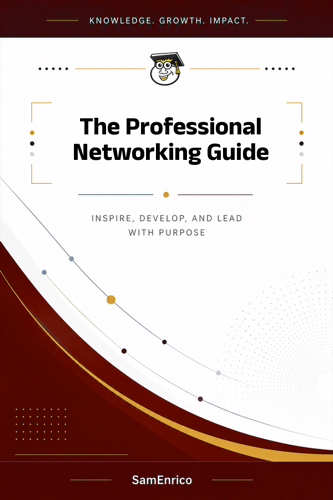
Non-FictionSelf-HelpCareer Development
The Professional Networking Guide eBook
Teaches building authentic connections for career
by Bell Dallas
Teaches building authentic connections for career advancement.
Formats
Free sample
Chapter 1: The Empty Pocket--–- James showed up to the conference with 200 business cards freshly printed on premium stock. He had practiced his thirty-second elevator pitch in the mirror fourteen times. He wore his best blazer, arrived thirty minutes early, and shook one hundred and forty-seven hands by the end of the night. He came home exhausted, threw the collected cards into a drawer, and never spoke to a single one of those people again. Six months later, when he was laid off, he scrolled through his 2,300 Linked In connections and realized he had no one to call.This is not a story about laziness or social anxiety.
James was diligent, ambitious, and genuinely eager to connect. He followed the playbook that every well-meaning career advisor, Linked In influencer, and corporate training session had handed him. He showed up. He collected. He followed up with generic "nice to meet you" messages.
And yet, when it mattered, his network was a mirage—impressive from a distance, empty up close.James is not the exception. He is the rule.The Great Networking Illusion For the past twenty years, professionals have been sold a seductive lie: that networking is a numbers game. That success belongs to the person with the thickest stack of business cards, the highest number of Linked In connections, or the most crowded inbox. This lie is perpetuated by platforms that profit from engagement metrics, by organizations that measure activity instead of outcomes, and by a culture that confuses busyness with effectiveness.But the research tells a different story. A landmark study published in the Academy of Management Discoveries tracked 1,500 professionals over three years and found that simply having a large network—defined as hundreds of weak, transactional connections—had no correlation with career advancement, salary growth, or job satisfaction.
In fact, participants with the largest networks reported higher rates of burnout and lower rates of trust in their professional relationships. What predicted success was not the size of the network but the depth of a small subset of relationships—specifically, relationships characterized by mutual advocacy, vulnerability, and what researchers called "sponsorship intensity."Yet the vast majority of professionals continue to network like James. They attend events with a harvesting mentality: how many cards can I collect? They send connection requests on Linked In with a generic "I'd like to add you to my professional network" message. They treat follow-up emails as an administrative chore to be completed as quickly as possible.
And then they wonder why, when they need a job referral, an introduction to a decision-maker, or honest feedback on a risky career move, their network offers nothing but silence.The problem is not that these professionals lack social skills or motivation. The problem is that they are operating within a broken model—a model that this book will systematically dismantle and replace.The Transactional Trap The traditional networking model is fundamentally transactional. It operates on an implicit logic of exchange: I give you my card, you give me yours. I attend your panel, you listen to my pitch. I endorse you on Linked In, you endorse me back.
This logic feels fair and efficient. But it contains a fatal flaw: transactions create zero trust.Trust is not built through symmetrical exchanges. It is built through asymmetrical vulnerability—through one person extending a gesture of goodwill without any guarantee of return. When networking reduces to a series of tit-for-tat exchanges, it becomes what sociologists call an "economic exchange relationship" rather than a "social exchange relationship." In economic exchanges, the relationship ends the moment the transaction is complete. In social exchanges, the relationship deepens over time because neither party is keeping a ledger.Think about the last time someone sent you a Linked In message that said, "I saw you work at X Company.
I'm looking for a job in your field. Can we connect?" What did you feel? Most people feel used. They feel like a vending machine into which a stranger has inserted a request and from which they expect a snack to fall. And even if you do respond—even if you grant the informational interview or forward the resume—you do not feel closer to that person.
You feel neutral at best, or slightly resentful at worst.That is the transactional trap. It produces the appearance of networking without any of the substance. It allows professionals to feel productive—"I sent twenty messages today!"—while building absolutely no relational capital. And it leaves people like James with a drawer full of cards and an empty pocket of influence when the crisis comes.The False God of Mentorship The transactional model is reinforced by another widely repeated myth: that the key to career success is finding a mentor. Countless books, articles, and corporate programs emphasize the importance of mentorship.
Young professionals are told to seek out senior leaders who can offer advice, guidance, and wisdom. Mentorship programs are institutionalized in nearly every Fortune 500 company.But here is the uncomfortable truth that the research keeps revealing: mentorship, by itself, does not produce career advancement. A meta-analysis of fifty-seven studies on workplace relationships found that having a mentor had a statistically significant but small effect on promotion rates—and that effect disappeared entirely when researchers controlled for the mentor's willingness to engage in public advocacy. In other words, advice alone is cheap. What moves careers is not someone telling you what to do.
It is someone using their reputation to open a door for you.That distinction—between advice-giving and advocacy—is the single most important distinction in this entire book. And it is so important that we will spend an entire chapter on it later (Chapter 5). But for now, let me introduce the two terms clearly:Mentorship is when someone gives you advice, feedback, wisdom, or guidance. A mentor says, "Here is what I would do in your situation." Mentorship is helpful. It can prevent mistakes and clarify thinking.
But mentorship is also passive. It costs the mentor nothing except time. They are not putting their reputation on the line. They are not advocating for you in rooms where decisions are made.Sponsorship is when someone uses their influence and social capital to actively advocate for you. A sponsor says, "I know this person.
I trust them. You should give them a chance." Sponsorship is active and risky. When a sponsor recommends you for a role, their own reputation is attached to your performance. If you fail, they look bad. That risk is precisely what makes sponsorship powerful—it signals genuine belief, not polite encouragement.Here is what the data shows: among professionals who received mentorship without sponsorship, the promotion rate was twenty-two percent.
Among professionals who received both mentorship and sponsorship, the promotion rate was sixty-seven percent. Sponsorship triples the impact. And among the small subset of professionals who had a sponsor but no formal mentor, the promotion rate was still fifty-eight percent—more than double the mentorship-only group.Sponsorship is the engine of career advancement. Mentorship is the fuel gauge. Both are useful, but only one moves the car forward.The Network Audit: Diagnosing Your Current State Before we go any further, you need to know where you…
This is the end of the free sample. Get the eBook to keep going. Buy now
About this book
Details
- Author
- Bell Dallas
- Publisher
- SamEnrico
- Language
- English
- Genre
- Non-Fiction, Self-Help, Career Development
- Released
- 2026-06-06
- Pages (approx.)
- 144
- Available as
- eBook, Audiobook

Read better in the ZLOADR app
Your eBooks on your phone or tablet. Sign in with your SamEnrico account and start reading.
More by Bell Dallas
 Self Talk for Boundaries WorkbookBell Dallas$11.99
 ServiceNow ITSM OutageBell Dallas$11.99
 Spin Motivation Mindset CourseBell Dallas$11.99
 Body Scan for Public Speaking FearBell Dallas$11.99
 The Last Brushstroke: The Vanishing Masterpiece HeistBell Dallas$11.99
 How to Start a News Syndicates BusinessBell Dallas$11.99
 MetallurgistBell Dallas$11.99
 Recourse Factoring StrategiesBell Dallas$12.99
 Bubble Analytics IntegrationBell Dallas$12.99
 Understanding Ventricular Septal DefectBell Dallas$17.99
You may also like
 Hong Kong Handover 1997Dunn Johnnie$11.99
 Zumba For Postnatal Recovery CourseNeal Christian$11.99
 Zumba for BeginnersLadner Nikia$11.99
 YouTube Comment Mining GuideHumes Pandora$12.99
 Worry Box MeditationCarlin Rudy$11.99
 Workplace Stress MeditationNguyen Lynn$11.99
 Workplace Stress and Sleep RepairHawley Ivory$11.99
 Workplace Perfectionism CureDelaney Jeffry$11.99
 Workplace Injustice Anger GuideWallen Isabelle$11.99
 Work Addiction and Burnout LinkGreenwood Ester$11.99
 Women in Yoga and WellnessBeattie Galina$11.99
 Women in Stand Up ComedyChun Evangeline$11.99