
Non-FictionSelf-HelpProductivity
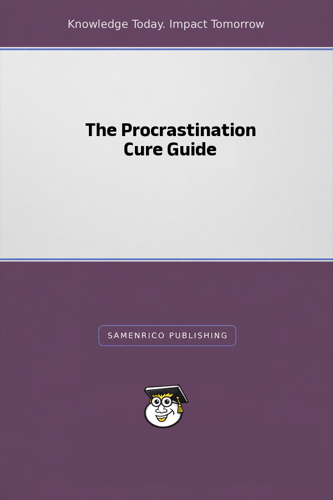
The Procrastination Cure Guide eBook
Stop delaying assignments and reduce last minute p
by Lowe Marion
Stop delaying assignments and reduce last minute panic with proven strategies.
Formats
Free sample
Chapter 1: The Deadline Monster--–- The email arrived at 11:47 PM on a Sunday. Three hours earlier, you had opened your laptop with every intention of starting the assignment due Monday morning. Then you checked “just one” notification. Then you reorganized your desktop folders. Then you watched a video about optimizing your study playlist.
Then you made tea. Then you stared at the blinking cursor until your eyes unfocused. Now, at 11:47 PM, the panic arrives like a physical force—a tightness in your chest, a rush of heat, a voice in your head screaming, “Go, go, go!” You type furiously, your fingers barely keeping pace with your racing thoughts. By 3:00 AM, you submit something. It is not your best work.
It is not even good work. But it is done. You collapse into bed, promising yourself, “Never again.” And yet, deep down, you know that is a lie. Next Sunday will look exactly the same. This is the anatomy of the Deadline Monster, and until you understand how it hunts, you will never escape its jaws.The Anatomy of a Panic Cycle The Deadline Monster is not a metaphor for laziness or poor time management.
It is a precise neurological and behavioral pattern that repeats with such mechanical regularity that it can be mapped, predicted, and ultimately dismantled. Every procrastinator knows the cycle, but few have named it. The cycle has five distinct stages, and recognizing each stage as it happens is the first and most powerful tool you will gain from this book.Stage One: Calm (The Illusion of Infinite Time)The cycle begins not with anxiety but with its opposite: a deceptive, tranquil calm. The assignment is announced. The deadline is set—perhaps seven days away, perhaps fourteen.
In this stage, the task exists only as a abstract concept, a ghost in the distance. Your brain, wired for immediate survival rather than long-term planning, registers the deadline as “not now.” And because it is not now, it feels not real. This is temporal discounting, the neurological quirk that causes your brain to value a small reward today over a larger reward tomorrow. A deadline two weeks away is discounted so heavily that it registers as nearly zero. You tell yourself, “I have plenty of time.” You believe it.
This is not laziness. This is your brain’s predictive machinery making an honest error. The future self, the one who will do the work, seems like a different person—more capable, more motivated, more organized. You trust that future self completely. That trust is always misplaced.Stage Two: Anxiety (The First Twinge)Several days pass.
The deadline moves from “far away” to “sometime soon.” You see the assignment in your calendar or hear a classmate mention it. A small, quiet feeling arises: a flicker of unease, a brief contraction in your stomach. You push it away. You tell yourself you will start tomorrow. But the anxiety does not disappear.
It goes underground, surfacing as vague irritability, as fatigue, as a sudden need to clean your apartment or call a relative you have not spoken to in months. This is avoidance behavior, and it is exquisitely creative. Your brain, sensing discomfort on the horizon, generates a thousand legitimate-seeming reasons to do anything other than the assignment. You are not “procrastinating” in the moral sense. You are fleeing a perceived threat.
The brain does not distinguish between a tiger and a term paper. Both trigger the same ancient alarm system: the amygdala. And the amygdala does not care about grades. It only cares about survival. So it tells you to run.Stage Three: Avoidance (The Spiral)This is where the Deadline Monster feeds.
The anxiety grows louder, so you run harder. You check social media not for pleasure but for numbness. You refresh the same page twenty times in an hour, each time finding nothing new but doing it again anyway. You tell yourself you are “researching” or “getting organized” or “waiting for inspiration.” But deep down, you know the truth: you are hiding. The shame begins here.
You know you should be working. You know you are capable of doing the work. And yet you are not doing it. This gap between what you should do and what you are doing creates cognitive dissonance, a psychological state so uncomfortable that your brain will twist reality to escape it. You begin to tell yourself stories: “The assignment is stupid.” “The professor doesn’t care anyway.” “I work better under pressure.” The last one is the most dangerous because it contains a grain of truth—but only a grain.
You have likely done good work under pressure before. What you forget is the cost. The all-nighter. The sloppy reasoning. The errors you did not have time to catch.
The days of recovery afterward. The avoidance spiral tightens until you cannot see a way out.Stage Four: Rush (The Panic Zone)This stage typically begins between 24 and 12 hours before the deadline. The anxiety that you have been running from finally catches you. It arrives not as a whisper but as a scream. Your heart pounds.
Your breathing quickens. Your focus, which you could not summon for days, suddenly snaps into laser-like intensity. Adrenaline floods your system. This is the body’s emergency response, designed for escaping predators, not writing essays. But it works—sort of.
You write. You calculate. You produce. The work flows not from creativity or insight but from raw survival instinct. You are not writing; you are fleeing.
And fleeing feels productive because the adrenaline gives you energy and focus. This is the cruel trick of the Deadline Monster: it rewards you for waiting until the last minute by giving you a chemical boost that feels like a superpower. You finish at 3:00 AM. You submit. You collapse.
And your brain learns a terrible lesson: panic works.Stage Five: Relief (The Trap Resets)The moment you submit, the relief is almost intoxicating. The weight lifts. The pressure vanishes. You promise yourself, with complete sincerity, that you will never do this again. You mean it.
You make plans. You vow to start early next time. But here is the problem: relief is a powerful reward. Your brain releases dopamine not only when you succeed but when you escape a threat. The panic-rush-relief sequence is neurologically similar to the cycle of addiction.
You are not just procrastinating. You are training yourself to procrastinate. Each cycle strengthens the neural pathways that make the next cycle more likely. And because you survived—because you submitted something—your brain files the experience under “success.” It does not file it under “misery” or “failure” or “near-disaster.” It files it under “that worked.” And so next time, when the assignment appears, your brain will wait. Not because you are lazy.
Not because you lack discipline. Because your brain has learned, through repeated experience, that waiting produces a reliable sequence of reward. The Deadline Monster is not your enemy. It is your brain’s broken strategy for coping with discomfort. And broken strategies can be replaced.Why Last-Minute Panic Destroys Quality (Even When It Feels Productive)The most insidious lie of the panic zone is that you do your best work under pressure.…
This is the end of the free sample. Get the eBook to keep going. Buy now
About this book
Details
- Author
- Lowe Marion
- Publisher
- SamEnrico
- Language
- English
- Genre
- Non-Fiction, Self-Help, Productivity
- Released
- 2026-06-08
- Pages (approx.)
- 132
- Available as
- eBook, Audiobook

Read better in the ZLOADR app
Your eBooks on your phone or tablet. Sign in with your SamEnrico account and start reading.
More by Lowe Marion
 Dreams And Racial Trauma GuideLowe Marion$11.99
 Invalidation Recovery DBTLowe Marion$11.99
 Joey Logano Young Gun StoryLowe Marion$11.99
 The Sustainability Sales CareerLowe Marion$11.99
 The Vanishing of the Victoria Falls: Africa's First Digital Kidnapping Mystery (1890)Lowe Marion$11.99
 Small Lab Experience AdvantageLowe Marion$12.99
 Pop Up Permits London GuideLowe Marion$12.99
 Understanding Syringocystadenoma PapilliferumLowe Marion$17.99
 Industrial Warehouse PersonLowe Marion$11.99
You may also like
 Hong Kong Handover 1997Dunn Johnnie$11.99
 Zumba For Postnatal Recovery CourseNeal Christian$11.99
 Zumba for BeginnersLadner Nikia$11.99
 YouTube Comment Mining GuideHumes Pandora$12.99
 Worry Box MeditationCarlin Rudy$11.99
 Workplace Stress MeditationNguyen Lynn$11.99
 Workplace Stress and Sleep RepairHawley Ivory$11.99
 Workplace Perfectionism CureDelaney Jeffry$11.99
 Workplace Injustice Anger GuideWallen Isabelle$11.99
 Work Addiction and Burnout LinkGreenwood Ester$11.99
 Women in Yoga and WellnessBeattie Galina$11.99
 Women in Stand Up ComedyChun Evangeline$11.99