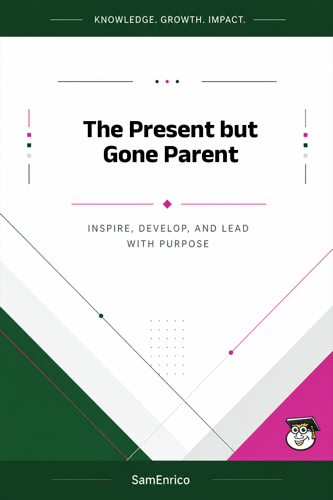
The Present but Gone Parent eBook
Live with a parent who was physically there but em
Live with a parent who was physically there but emotionally absent.
Formats
Free sample
Chapter 1: The Ghost in the Room--–- My father was a good man. He went to work every day. He came home every night. He paid for my piano lessons, attended my school plays, and remembered my birthdays. By every external measure, he was present.
And yet, for the first thirty years of my life, I felt like I was raising myself in an empty house.The confusion this caused me—and causes millions of adult children—cannot be overstated. When a parent leaves physically, the world offers sympathy. “I’m so sorry your father died.” “It must have been so hard when your mother left.” But when a parent stays—when they sit at the dinner table, sleep in the next room, drive you to soccer practice—and you still feel profoundly, achingly alone, there is no script. There is no cultural ritual for this grief. There is only a quiet, persistent voice that whispers: What is wrong with me?This chapter exists to answer that question with a radical reframe: nothing is wrong with you.
What is wrong is what you were never given. And the first step to healing is naming that absence.The Central Confusion: “But They Were There”Let me ask you something. When you hear the words “emotionally absent parent,” what image comes to mind? For most people, it is the parent who left—the one who moved across the country, the one who chose addiction over family, the one who was incarcerated or institutionalized. That parent is easy to name as absent.
Their absence has a shape. It has a story. It has a before and an after.But what about the parent who sat across from you at breakfast every single morning and never once asked how you slept? What about the parent who drove you to school in silence, who attended your violin recital but stared at their phone the entire time, who was physically present at every major event of your childhood but never actually saw you?That parent is the ghost in the room. And their presence makes the wound more confusing, not less.Here is the paradox that defines this entire book: A parent who is physically there but emotionally gone leaves the child doubting their own reality.
When a parent leaves physically, the child can point to the empty chair and say, “See? They are gone. That is why I am hurting.” But when the parent stays, the child looks around and sees a complete family—two parents, a house, meals, holidays—and cannot find a villain. Cannot find the moment of abandonment. Cannot find the thing to blame.And so the child blames themselves.This is the first and most damaging lie of the present-but-gone parent: If I am hurting, and nothing is visibly wrong, then the problem must be me.
You learned to swallow your loneliness because there was no proof that you deserved to feel it. You learned to apologize for your needs because your needs were always met with indifference. You learned to be “low maintenance” because being high maintenance—asking for attention, for connection, for someone to look at you—only led to disappointment.Let me be clear: You were not too sensitive. You were not asking for too much. You were asking for the bare minimum of emotional attunement, and it was not there.Physical Abandonment vs.
Emotional Absence: A Crucial Distinction To understand why the present-but-gone parent is so damaging, we must first distinguish between two very different kinds of absence.Physical abandonment is when the parent leaves the home, the family, or the child’s daily life. This includes death, divorce where one parent is not present, incarceration, or a parent who chooses to live elsewhere. Physical abandonment is traumatic, absolutely. But it has one advantage that emotional absence does not: it is visible. The child can name it.
The child can be angry at it. The child can grieve it openly, and society will support that grief.Emotional absence is when the parent is physically present—in the home, at the table, in the next room—but is not psychologically or emotionally available. This parent may be distracted by work, consumed by their own mental health struggles, trapped in narcissistic self-focus, or simply incapable of attunement. The child grows up with a parent in the house but not in their life. And because the parent is there, the child learns that their own emotional needs must be invisible.Here is what research tells us about these two forms of absence: Emotional neglect—the consistent failure of a parent to respond to a child’s emotional needs—is correlated with the same long-term mental health outcomes as physical abuse or abandonment.
Depression, anxiety, attachment disorders, complex PTSD, and difficulty with emotional regulation are all common in adults who grew up with emotionally absent parents. The wound is real. The damage is real. But because it is a wound of omission rather than commission, it is harder to name.A wound of commission is something done to you: a hit, a scream, a leaving. A wound of omission is something not done for you: no mirroring, no attunement, no emotional safety.
And here is what makes omission so insidious: you cannot point to it. You cannot say, “On June 3rd, my mother did X.” You can only say, “Every day, my mother did nothing. Every day, she was there but not there. Every day, I asked to be seen and was met with a wall.”That wall is the ghost. And this book is about learning to see it, name it, and finally stop trying to knock it down.The Six Patterns of the Present-but-Gone Parent Over decades of clinical research and thousands of adult children’s stories, certain patterns of emotional absence recur.
I call these “patterns” deliberately, not “diagnoses” or “archetypes.” They are not clinical labels. They are not boxes to put your parent in. They are lenses—tools to help you name your experience, not to pathologize your parent. You may recognize one pattern. You may recognize several.
The goal is not to diagnose your mother or father; the goal is to understand what you lived with, so you can understand what you are healing from.The Distracted Provider This parent is present in body but absent in attention. They work long hours, scroll on their phone during dinner, and answer emails during your school play. They provide financially—bills are paid, food is on the table, there are presents under the tree—but they are rarely with you. When you speak, they give half-listening responses: “Uh-huh,” “That’s nice,” “Tell me later.” Later never comes. The message you internalize: Your voice is not worth hearing.
Your stories are not worth pausing for.The Depressed Ghost This parent is physically present but emotionally inert. They may spend hours in bed, on the couch, or staring out a window. They are not mean. They are not cruel. They are simply not there—drowned in a fog of depression, anxiety, or exhaustion.
You learn not to disturb them. You learn that your needs are a burden. You learn to make your own…
This is the end of the free sample. Get the eBook to keep going. Buy now
About this book
Details
- Author
- Robertson Alfonso
- Publisher
- SamEnrico
- Language
- English
- Genre
- Non-Fiction, Biography, Emotional
- Released
- 2026-06-12
- Pages (approx.)
- 140
- Available as
- eBook, Audiobook

Read better in the ZLOADR app
Your eBooks on your phone or tablet. Sign in with your SamEnrico account and start reading.
More by Robertson Alfonso
 GH Receptor SensitivityRobertson Alfonso$11.99
 Nicoyan Light Dinner PlanRobertson Alfonso$11.99
 Parenting Stress and Social LifeRobertson Alfonso$11.99
 The Silk Road Whisperers: How Spice Traders Shaped EmpiresRobertson Alfonso$11.99
 Email DeveloperRobertson Alfonso$11.99
 Payment Matching for Partial ShipmentsRobertson Alfonso$12.99
 How to Produce Bubble Blowing SolutionRobertson Alfonso$11.99
 Ultimate Handbook Guide to Haiyang : (China) Travel GuideRobertson Alfonso$11.99