
Non-FictionHealth & WellnessErgonomics
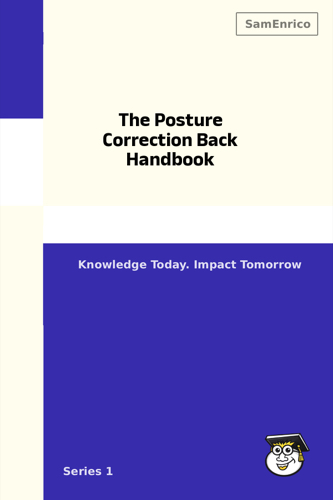
The Posture Correction Back Handbook eBook
Fixes anterior pelvic tilt, swayback, and slouchin
Fixes anterior pelvic tilt, swayback, and slouching contributions.
Formats
Free sample
Chapter 1: The Kinetic Lie--–- Stand up for a moment. Don’t adjust anything. Don’t suck in your stomach, pull your shoulders back, or tilt your pelvis. Just stand the way you normally stand when you’re alone—waiting for coffee to brew, brushing your teeth, or staring blankly at your phone. Now look down at your feet.
Are they pointed straight ahead or slightly turned out? Let your hands hang at your sides. Do they rest in front of your thighs or slightly behind? Now tilt your chin down toward your chest and notice what happens to your lower back. Feel that movement?
That small shift in your lumbar spine? That connection between your skull and your sacrum, traveling through sixteen vertebrae, dozens of muscles, and a nervous system that never sleeps—that is the kinetic chain.Most people believe their posture problems are isolated. They think, “I have a slouch,” or “My lower back arches too much,” or “My head drifts forward.” They treat these as separate issues with separate solutions. Stretch your chest for the slouch. Strengthen your core for the arch.
Tuck your chin for the forward head. But here is the kinetic lie: the belief that your body is a stack of blocks that can be corrected one piece at a time. In truth, your body is a single, continuous, living chain of tension and compression. Pull on one end, and every other link moves. And right now, whether you realize it or not, every posture problem you have is connected to every other posture problem you have.This chapter dismantles that lie.
You will learn why a forward head position forces your pelvis to tilt, why a rounded upper back flattens your lower back, and why trying to fix one without addressing the others is like trying to level a four-legged table by sawing off only one leg. By the time you finish reading, you will see your body not as a collection of broken parts but as an elegant, adaptable system that has been compensating for years—and you will know exactly which compensation is driving the others.The Three Faces of Postural Collapse Every poor posture falls into one of three primary patterns, or more commonly, a combination of them. These are not arbitrary categories invented by physical therapists to sell exercise programs. They are distinct biomechanical signatures that have been observed, measured, and documented for decades. You will likely recognize yourself in one of these descriptions more than the others.
That is your primary driver.The first pattern is Anterior Pelvic Tilt, often called APT for short. Imagine a person standing in profile. Their belt buckle points slightly toward the floor. Their buttocks protrude behind them. Their lower back has an exaggerated curve, like a sway bridge.
This is the posture often called “Donald Duck” because of how the abdomen pushes forward and the rear pushes back. But APT is not just a visual quirk. In APT, the front of the pelvis drops downward while the back of the pelvis lifts upward. This happens because the hip flexors—the muscles that run from your lower spine down to your thigh bones—have become short and tight from too much sitting, while the gluteal muscles at the back of your hips have become long and weak from not being used. The result is a pelvis that is permanently tipped forward, like a bowl of water spilling out the front.The second pattern is Swayback.
This is the opposite of APT in many ways, yet it often produces similar pain. In swayback, the entire pelvis shifts forward relative to the ankles. Imagine standing with your hips pushed ahead of your shoulders, your upper back rounded, and your chin poked out to keep your eyes level. This posture is common among people who have spent years slumping in deep, soft furniture or who have developed a habit of “standing at ease” with one hip cocked to the side. In swayback, the lower back is often flat rather than arched.
The sacrum (the triangular bone at the base of your spine) tucks under like a dog tucking its tail. The hamstrings become chronically overstretched and painful, while the hip flexors become weak in a completely different way than in APT.The third pattern is Thoracic Slouching. This is the classic “hunchback” posture of the upper body. The shoulders roll forward. The head juts out ahead of the chest.
The upper back rounds into a C-shape. But here is what most people miss: thoracic slouching is almost never an isolated upper-body problem. When your head moves forward, your center of mass shifts. Your body must compensate somewhere else to keep you from falling over. Usually, the compensation happens at the pelvis.
The pelvis tucks under (swayback) or tilts forward (APT) to bring the center of mass back over the feet. In other words, a slouch in your upper back creates a tilt in your lower pelvis. You cannot fix one without addressing the other.The Vestibular Compass Why does your body do this? Why not just let you fall over? The answer lives in your inner ear, in a tiny, fluid-filled organ called the vestibular system.
This system is your body’s gyroscope. It detects the position of your head in space relative to gravity. It cares about exactly one thing: keeping your eyes level with the horizon. Everything else is negotiable.Here is a demonstration you can perform right now. Stand up again.
This time, deliberately slouch your upper back and push your head forward about two inches, as if you were reading a phone held in your lap. Hold that position for five seconds. Now, without moving your head back, try to relax your pelvis. Let it do whatever it wants. What happened?
For most people, the pelvis tucked under. The lower back flattened or even rounded slightly. That was your vestibular system at work. By moving your head forward, you shifted your center of mass ahead of your feet. To prevent a face-plant, your body automatically pulled the pelvis backward, shifting your center of mass back under you.
Your head moved forward. Your pelvis moved backward. The chain moved as one unit.Now try the reverse. Stand normally, then deliberately tilt your pelvis forward into an APT position—push your buttocks out and let your belly hang forward. Hold that for five seconds.
What happened to your upper back? For most people, the upper back rounded and the head drifted forward. Again, the chain moved as one. Your pelvis tilted forward, so your upper body leaned back to compensate, which pulled your head back, but then your vestibular system pushed your head forward to keep your eyes level. The result: a compensatory slouch.This is the most important concept in this entire book.
Your posture is not a choice you make consciously. It is the emergent result of your nervous system trying to keep your eyes level, your spine stable, and your joints safe, all while working around the tight muscles and weak muscles that your daily habits have created. You cannot “just stand up straight” because your nervous system doesn’t know…
This is the end of the free sample. Get the eBook to keep going. Buy now
About this book
Details
- Author
- Shumate Stephany
- Publisher
- SamEnrico
- Language
- English
- Genre
- Non-Fiction, Health & Wellness, Ergonomics
- Released
- 2026-06-05
- Pages (approx.)
- 154
- Available as
- eBook, Audiobook

Read better in the ZLOADR app
Your eBooks on your phone or tablet. Sign in with your SamEnrico account and start reading.
More by Shumate Stephany
 Scarcity as SpringboardShumate Stephany$11.99
 TM for Veterans GuideShumate Stephany$11.99
 Assertiveness for Passive AggressionShumate Stephany$11.99
 Advanced Nuclear Reactors GuideShumate Stephany$11.99
 The Peanut Whisperer: George Washington Carver’s Green RevolutionShumate Stephany$11.99
 Understanding Perisylvian SyndromeShumate Stephany$17.99
 Payment Gateway Migration GuideShumate Stephany$12.99
 London Pop Up Real Estate PlatformsShumate Stephany$12.99
 How to Become a Tumbler-machine OperatorShumate Stephany$11.99
 Strategic Sales ConsultantShumate Stephany$11.99
You may also like
 Hong Kong Handover 1997Dunn Johnnie$11.99
 Zumba For Postnatal Recovery CourseNeal Christian$11.99
 Zumba for BeginnersLadner Nikia$11.99
 YouTube Comment Mining GuideHumes Pandora$12.99
 Worry Box MeditationCarlin Rudy$11.99
 Workplace Stress MeditationNguyen Lynn$11.99
 Workplace Stress and Sleep RepairHawley Ivory$11.99
 Workplace Perfectionism CureDelaney Jeffry$11.99
 Workplace Injustice Anger GuideWallen Isabelle$11.99
 Work Addiction and Burnout LinkGreenwood Ester$11.99
 Women in Yoga and WellnessBeattie Galina$11.99
 Women in Stand Up ComedyChun Evangeline$11.99