
Non-FictionHealth & WellnessBonding
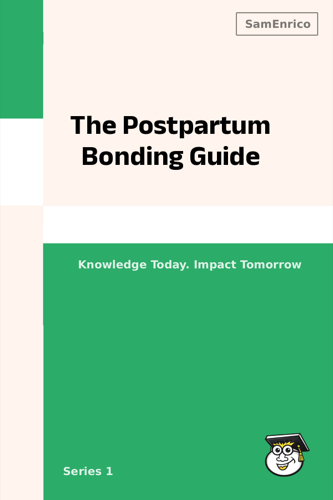
The Postpartum Bonding Guide eBook
Build connection with baby when depression interfe
Build connection with baby when depression interferes.
Formats
Free sample
Chapter 1: The Stranger in the Nursery...--The rocking chair was supposed to be a throne. You imagined yourself here a thousand times during pregnancy—one hand on your belly, the other cradling a sleeping newborn, your face soft with a love so pure it felt like sunlight. The catalogs showed women like that. The movies showed women like that. Your own mother, when you described the fantasy, smiled and said, "It's exactly like that."But tonight, at 3:47 AM, the rocking chair is not a throne.
It is a wooden torture device that squeaks with every movement, a metronome counting down the minutes until you have to pretend again. Your baby is asleep in the bassinet six feet away. She is beautiful—objectively beautiful, the kind of baby strangers stop to coo over. Her lips are shaped like a tiny bow. Her eyelashes are just beginning to appear, dark against her impossible skin.
She looks like a doll.You feel nothing.Not sadness. Not anger. Not even exhaustion, though you haven't slept more than ninety consecutive minutes since she was born. What you feel is a vast, hollow nothing—the kind of nothing you imagine exists between stars. You are watching your daughter breathe, and your chest is a vacant lot.
No warmth. No rush of love. No instinct to reach out and touch her.Instead, your mind is whispering: I think I made a mistake.You have never said this aloud. You are not even sure you believe it. But the thought arrives unbidden, like a bad smell you cannot locate.
It settles into the rocking chair beside you and refuses to leave.You think about your phone, sitting on the nightstand. You could Google this. You have Googled stranger things at 3 AM—"why is my baby breathing fast," "can newborns dream," "how to know if you're a bad mother." But you are afraid of what the search bar will suggest. You are afraid that typing "why don't I love my baby" will summon an answer you cannot unsee.So you sit. And you rock.
And you feel nothing.The Silence You Are Not Supposed to Break If you recognize yourself in that rocking chair, welcome. You are not broken. You are not a monster. You are not the only mother who has looked at her perfect, wanted, deeply loved baby and felt a wall where her heart should be.This chapter exists because the silence around this experience is killing mothers. Not literally—though postpartum depression can lead to suicidal ideation, and we will talk about that honestly in later chapters.
But spiritually. Relationally. The silence convinces you that you are alone, that you are uniquely defective, that every other mother in every other nursery is swimming in oxytocin while you are drowning in emptiness.That silence is a lie.The experience of feeling like a stranger to your own child is so common that clinicians have given it a name: Postpartum Bonding Disorder (PBD). It affects an estimated 7-15% of mothers—roughly one in ten. But those numbers are almost certainly undercounts, because mothers who feel this way rarely admit it.
They are too ashamed. Too afraid of being reported to child protective services. Too terrified that saying "I don't feel connected to my baby" will mean "I am unfit to be a mother."You are not unfit. You are symptomatic. And symptoms can be treated.The Three Things That Are Probably Running Through Your Mind Right Now Before we go any further, let me name three thoughts that may be circling your brain like sharks.
These thoughts are so common that I have heard them, in almost identical language, from hundreds of mothers. If you have had any of these thoughts, you are not unusual. You are not dangerous. You are having a predictable response to a physiological event.Thought #1: "I regret having this baby."This is the nuclear thought—the one that feels most unforgivable. You wanted this baby.
You planned for this baby. You may have endured fertility treatments, pregnancy loss, or a traumatic birth to get this baby. And now, in the quiet hours, you think: I wish I could go back.Here is what is actually happening: You do not regret your child. You regret the loss of your old self. The baby is the symbol of that loss—the screaming, demanding, ever-present reminder that you are no longer the person you were.
Your brain has collapsed two different things into one: "I miss my old life" and "I wish my baby didn't exist." They are not the same. But depression is a liar, and it speaks in shortcuts.Thought #2: "My baby would be better off without me."This thought is terrifying because it feels like evidence of your unfitness. If you truly loved your baby, wouldn't you want to be with them? The fact that you imagine their life improved by your absence must mean you are a terrible mother.Stop. This thought is not evidence of your danger.
It is evidence of your pain. Depression convinces you that you are a burden to everyone, including your infant. The thought is a symptom, not a verdict. We will spend several chapters dismantling it, but for now, know this: Babies do not need perfect mothers. They need present mothers.
And you are present. You are reading this book at 3 AM. That is presence.Thought #3: "What is wrong with me?"This is the meta-thought—the one that loops over all the others. You scan your childhood for evidence of brokenness. You wonder if you are a sociopath.
You wonder if you secretly hate children. You wonder if you are fundamentally, irreparably damaged.Here is the answer: Nothing is wrong with you that cannot be understood and addressed. The fact that you are asking the question—the fact that you are worried about your capacity to bond—is itself evidence of your capacity to bond. Truly disconnected mothers do not lie awake wondering if they are disconnected. They simply do not care.
Your caring, even in the form of anxiety, is the seed of attachment.The Critical Distinction: Baby Blues vs. PPD vs. Bonding Disorder One of the reasons mothers suffer in silence is that no one has given them a clear map of what they are experiencing. The terms get thrown around—"baby blues," "postpartum depression," "postpartum anxiety"—but they are not interchangeable. Understanding the differences is the first step toward knowing what help you need.The Baby Blues (Days 2-10)Approximately 80% of new mothers experience the "baby blues." This is not a mental illness; it is a hormonal event.
Your body has just withdrawn from pregnancy levels of estrogen and progesterone—a biochemical drop that would make anyone weepy. The blues typically begin on day two or three after birth, peak around day five, and resolve by day ten.Symptoms include:Tearfulness (crying at commercials, at sunsets, at nothing)Mood swings (laughing one minute, sobbing the next)Irritability Anxiety (especially in the evenings)Crucially: The baby blues do NOT impair bonding. A mother with the blues may cry while holding her baby, but she still wants to hold her baby. She still feels the pull toward connection, even if…
This is the end of the free sample. Get the eBook to keep going. Buy now
About this book
Details
- Author
- Wells Jermaine
- Publisher
- SamEnrico
- Language
- English
- Genre
- Non-Fiction, Health & Wellness, Bonding
- Released
- 2026-06-07
- Pages (approx.)
- 123
- Available as
- eBook, Audiobook

Read better in the ZLOADR app
Your eBooks on your phone or tablet. Sign in with your SamEnrico account and start reading.
More by Wells Jermaine
 Compulsive Spending In MenWells Jermaine$11.99
 Partner Anticipatory Grief GuideWells Jermaine$11.99
 Office Nap Etiquette GuideWells Jermaine$11.99
 Crime Scene Reconstruction WorkbookWells Jermaine$11.99
 Self Hypnosis for Social Media HabitsWells Jermaine$11.99
 Nonverbal Cues for ConstructionWells Jermaine$11.99
 Dental Pulp AnalysisWells Jermaine$11.99
 The Commonwealth of Reason: Oxford’s Enlightenment LegacyWells Jermaine$11.99
 Kali's Dark Dance: The Shadow of the DestroyerWells Jermaine$11.99
 Ultimate Handbook Guide to Yizheng : (China) Travel GuideWells Jermaine$11.99
 Amazon vs Jumia Product PhotographyWells Jermaine$12.99
 Amazon Lending for Sellers GuideWells Jermaine$12.99
You may also like
 Hong Kong Handover 1997Dunn Johnnie$11.99
 Zumba For Postnatal Recovery CourseNeal Christian$11.99
 Zumba for BeginnersLadner Nikia$11.99
 YouTube Comment Mining GuideHumes Pandora$12.99
 Worry Box MeditationCarlin Rudy$11.99
 Workplace Stress MeditationNguyen Lynn$11.99
 Workplace Stress and Sleep RepairHawley Ivory$11.99
 Workplace Perfectionism CureDelaney Jeffry$11.99
 Workplace Injustice Anger GuideWallen Isabelle$11.99
 Work Addiction and Burnout LinkGreenwood Ester$11.99
 Women in Yoga and WellnessBeattie Galina$11.99
 Women in Stand Up ComedyChun Evangeline$11.99