
Non-FictionHealth & WellnessAnger
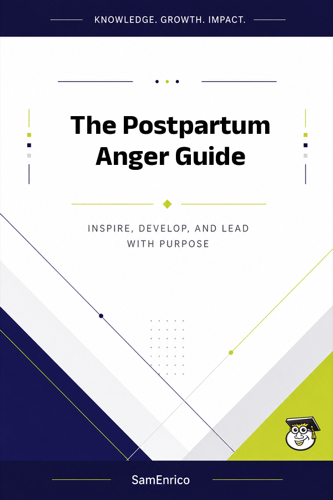
The Postpartum Anger Guide eBook
Manage rage and irritability common in PPD and PPA
by Owen Sabrina
Manage rage and irritability common in PPD and PPA.
Formats
Free sample
Chapter 1: The Secret Fire...--She was standing in the kitchen, a bottle of half-warmed formula in her hand, when she realized she hated her husband.Not disliked. Not felt annoyed with. Hated. A hot, pure, clarion-clear hatred that rose from somewhere deep in her chest and threatened to spill out of her mouth in words she would never be able to take back. The baby had been crying for forty-seven minutes.
Her husband was in the living room, sitting on the couch, scrolling through his phone. He had not heard the crying. Or rather, he had heard it the way one hears traffic outside a window—as background noise, not as an emergency siren demanding immediate action. She had not slept more than three consecutive hours in six weeks. Her nipples were cracked and bleeding.
Her body felt like a stranger's body, soft in places that had once been firm, scarred in ways no one had warned her about. And now this bottle was taking too long to warm. Too long. The seconds stretched like taffy. The baby screamed.
The husband scrolled. And somewhere inside her, something that had been wound tight for weeks finally snapped.She did not throw the bottle. She wanted to. She imagined the arc of it, the satisfying shatter of glass against the tile floor, the way the formula would pool and dry and become someone else's problem. But she did not throw it.
Instead, she placed it on the counter with a control that felt like violence, walked into the nursery, picked up her screaming infant, and sat down in the rocking chair. She rocked. The baby screamed. She rocked harder. And then, without any warning, without any decision to do so, she began to cry.
Not the dignified tears of a movie mother. Ugly, gasping, snot-running-down-her-face sobs that scared the baby into silence. The baby stared at her with wide, confused eyes. And in that silence, she thought: I am not sad. I am angry.
I am so, so angry. And I don't know what to do with it.That woman is not a monster. She is not broken. She is not a bad mother. And neither are you.If you are reading this book, chances are good that you have felt something like what that woman felt.
Maybe you have screamed at your partner over something trivial—a dish left in the sink, a light left on, a question asked at exactly the wrong moment. Maybe you have slammed a door so hard the frame splintered. Maybe you have thrown a pacifier across the room, or a burp cloth, or a phone. Maybe you have felt the heat rise in your chest and known, with absolute certainty, that if you did not leave the room immediately, you would do something you would regret forever. Maybe you have not done any of those things.
Maybe your anger is quieter. Maybe it's the constant, grinding irritability that makes every sound your partner makes feel like nails on a chalkboard. Maybe it's the low-grade annoyance that follows you through every feeding, every diaper change, every sleepless hour—not explosive, just there. Always there. Like a toothache you've learned to live with.Here is what you need to know, right now, before you read another word: This is not your fault.
This is not a character flaw. This is not evidence that you are a bad mother or a bad person. This is a medical symptom with a name, a cause, and a solution.The Silence Around Postpartum Rage Let us begin with what you already know: when people talk about postpartum mental health, they talk about sadness. Postpartum depression has become a household term. Celebrities discuss it.
Doctors screen for it. There are support groups, medications, and workbooks dedicated to the weepy, withdrawn, exhausted mother who cannot get out of bed. Postpartum anxiety is gaining recognition too—the racing heart, the catastrophic thoughts, the constant vigilance that turns motherhood into a series of imagined disasters.But no one talks about the anger.And yet, the research is clear. Up to twenty to twenty-five percent of new mothers experience a perinatal mood or anxiety disorder. Among those mothers, a significant proportion—some studies suggest forty to sixty percent—report anger as a primary symptom.
Not sadness. Not worry. Anger. Irritability. Rage.
A short fuse where a long one used to be. A tendency to snap, to shout, to slam, to throw. And yet, when these mothers go to their doctors, they are handed the Edinburgh Postnatal Depression Scale—a questionnaire that asks about crying, about sadness, about whether they can laugh at things. It does not ask about rage. It does not ask about the desire to throw things, or the impulse to scream, or the shame that follows.So these mothers sit in their doctors' offices and say nothing.
Or they say, "I think I might have postpartum depression," because that is the language they have been given. And when the doctor asks if they feel sad, they say yes—because sadness is there too, sometimes, underneath the anger. But the sadness is not the main thing. The anger is the main thing. And because no one has given them words for it, they leave the office with a prescription and a diagnosis that does not quite fit, and they wonder what is wrong with them that they are not getting better.Nothing is wrong with them.
The screening tools are wrong. The cultural script is wrong. The anger is real, and it is common, and it is treatable.A Note on Safety Before We Continue Before we go any further, a brief but essential word about safety. This book will contain frank discussions of postpartum rage, including moments when mothers have felt out of control, have said things they regret, have done things that frightened them. If you are currently having thoughts of harming yourself or your baby, please close this book and call for help immediately.Postpartum Support International Hotline: 1-800-944-4773 (available 24/7, English and Spanish)Crisis Text Line: Text HOME to 741741Emergency Services: 911This book is a tool for managing rage and irritability.
It is not a replacement for emergency care. If you are in crisis, please get help now. The book will still be here when you return.For everyone else: let us begin.Defining the Beast: What Postpartum Rage Actually Is One of the reasons postpartum rage is so confusing—so shaming—is that it does not look like what we think mental illness looks like. We have a cultural image of depression: a woman lying in a dark room, unable to get out of bed, crying into a pillow. We have a cultural image of anxiety: a woman pacing, wringing her hands, checking the baby's breathing for the fiftieth time.
But postpartum rage? Postpartum rage looks like a woman who seems fine until she isn't. It looks like a woman who can hold it together all day—at the pediatrician's office, at the grocery store, on the phone with her mother-in-law—only to explode the moment she walks through her own front door. It looks like a woman who loves…
This is the end of the free sample. Get the eBook to keep going. Buy now
About this book
Details
- Author
- Owen Sabrina
- Publisher
- SamEnrico
- Language
- English
- Genre
- Non-Fiction, Health & Wellness, Anger
- Released
- 2026-06-07
- Pages (approx.)
- 139
- Available as
- eBook, Audiobook

Read better in the ZLOADR app
Your eBooks on your phone or tablet. Sign in with your SamEnrico account and start reading.
More by Owen Sabrina
 Spouse Terminal Grief WorkbookOwen Sabrina$11.99
 SMART for Remote TeamsOwen Sabrina$11.99
 Shopping Addiction 12 Step ProgramOwen Sabrina$11.99
 Theme Days Scheduling StrategyOwen Sabrina$11.99
 Death Scene ReconstructionOwen Sabrina$11.99
 Self Hypnosis for Coffee ReductionOwen Sabrina$11.99
 Body Language for ChefsOwen Sabrina$11.99
 The Hollow Hill: Where the Fairy King RulesOwen Sabrina$11.99
 Storm Over the Dunes: The Tech That Won the Gulf WarOwen Sabrina$11.99
 Moorhens: WaterbirdOwen Sabrina$11.99
 How to Produce PerliteOwen Sabrina$11.99
 How to Produce CucumbersOwen Sabrina$11.99
You may also like
 Hong Kong Handover 1997Dunn Johnnie$11.99
 Zumba For Postnatal Recovery CourseNeal Christian$11.99
 Zumba for BeginnersLadner Nikia$11.99
 YouTube Comment Mining GuideHumes Pandora$12.99
 Worry Box MeditationCarlin Rudy$11.99
 Workplace Stress MeditationNguyen Lynn$11.99
 Workplace Stress and Sleep RepairHawley Ivory$11.99
 Workplace Perfectionism CureDelaney Jeffry$11.99
 Workplace Injustice Anger GuideWallen Isabelle$11.99
 Work Addiction and Burnout LinkGreenwood Ester$11.99
 Women in Yoga and WellnessBeattie Galina$11.99
 Women in Stand Up ComedyChun Evangeline$11.99