
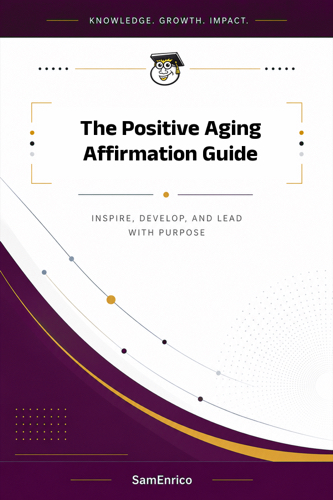
Non-FictionSelf-HelpAffirmations
The Positive Aging Affirmation Guide eBook
Use daily statements to reinforce your value as an
by Culp Nida
Use daily statements to reinforce your value as an older adult.
Formats
Free sample
Chapter 1: The Hidden Voice...-- Every morning, before you brush your teeth, before you pour your coffee, before you speak a single word to another human being, you have already spoken to yourself. You have whispered a verdict about who you are, what you deserve, and whether today will be a continuation of your value or a slow erosion of it. Most people never hear this voice because it has become as invisible as the air they breathe. But it is there. And it is either building you up or tearing you down, sentence by sentence, decade by decade.This chapter is not about positive thinking.
It is not about pasting a smile over pain or pretending that aging is easy when it is often hard. This chapter is about something far more specific and far more powerful: the science of what happens when you deliberately choose the words you feed your own mind. It is about rewiring a lifetime of internalized ageism—the quiet, insidious belief that older means lesser—and replacing it with a neural architecture of self-worth that no external force can dismantle.If you have ever caught yourself saying "I'm having a senior moment" after forgetting a name, or "I'm too old for that" when considering something new, or "Who wants to hear from someone my age?" before speaking up, you have been practicing affirmations already. You have been practicing negative affirmations. And they have worked exactly as intended: they have made you smaller, quieter, and more convinced of your own irrelevance.
This chapter will show you how to reverse that program.The Voice You Did Not Know You Were Listening To Every human being possesses what psychologists call a "default mode network"—a set of brain regions active when you are not focused on the outside world. This is your mind's resting state, and it is where your internal narrator lives. For most older adults, that narrator has been trained by decades of cultural messaging: wrinkles are bad, memory lapses are shameful, slowing down is failure, and your best years are behind you.The research is unequivocal on this point. A 2022 study published in The Gerontologist found that older adults who frequently used self-deprecating ageist language (calling themselves "old fool" or joking about their "senior moments") had significantly higher cortisol levels and lower self-reported well-being than peers who refrained from such language. The words you speak to yourself are not neutral.
They are physiological events.Consider Margaret, an 82-year-old former librarian who participated in the pilot program that informed this book. When asked to record her internal dialogue for one week, she wrote down phrases like "I'm so slow now," "They probably think I'm senile," and "I used to be sharp." None of these statements were true. Her cognitive assessments were normal for her age. Her family admired her wit. But her internal voice had become a prosecutor, not a witness.
After six weeks of the practices in this chapter, Margaret reported that the voice had not disappeared—it never fully does—but she had learned to recognize it as a foreign agent, not her own truth. "I realized I was reciting lines someone else wrote," she said. "Now I write my own."The Science of Self-Affirmation: How Words Rewire the Brain Self-affirmation theory, developed by social psychologist Claude Steele in the 1980s and extensively validated since, rests on a simple but radical premise: humans are motivated to maintain a sense of global self-integrity—the perception that they are moral, competent, and capable of adapting to changing circumstances. When that integrity is threatened (by a forgotten name, a physical limitation, a younger person's dismissive tone), the brain activates a stress response. Cortisol rises.
Defensiveness increases. The mind searches for evidence that confirms the threat.Here is where affirmation changes everything. Functional MRI studies have shown that self-affirmation tasks (repeating positive statements about core values, reflecting on past successes, articulating what matters most) increase activity in the ventromedial prefrontal cortex and the posterior cingulate cortex—regions associated with self-related processing and reward. In plain language: affirming yourself feels good to your brain, not in a superficial way, but in a deep, neurochemical way that actually reduces the threat response.One landmark study by Falk and colleagues (2015) demonstrated that participants who engaged in self-affirmation before receiving threatening health information showed increased activity in the ventromedial prefrontal cortex and decreased activity in the anterior cingulate cortex (the brain's alarm system). They were more open to the information, less defensive, and more likely to change their behavior.
The implications for aging are enormous. If you affirm your value before encountering a reminder of your limitations, your brain will process that reminder as information rather than as an indictment.The Practical Takeaway: You do not need to believe your affirmations at first. You do not need to feel good when you say them. You only need to say them. The brain's reward network does not wait for belief—it responds to repetition.
Neural pathways are strengthened by use, not by conviction. This is why a skeptic can still benefit from affirmation practice. Your brain does not care if you mean it yet. It only cares that you are saying it.Identifying Your Personal Vocabulary of Diminishment Before you can build a new internal language, you must audit the old one. This chapter includes the first of several self-assessments in this book: The Internal Ageism Vocabulary Audit.Take out a piece of paper or open a notes application.
For the next three days, write down every phrase you say to yourself about your age, your memory, your body, or your capabilities. Do not censor. Do not judge. Simply record. At the end of three days, you will likely notice patterns.
Common categories include:Memory Diminishment:"I'm losing it.""Senior moment.""My mind isn't what it used to be.""I can't remember anything anymore."Body Diminishment:"I'm falling apart.""Everything hurts.""I used to be able to...""I look so old."Social Diminishment:"They don't want to hear from me.""I'm invisible.""I'm a burden.""I should just stay quiet."Future Diminishment:"It's all downhill from here.""My best years are behind me.""What's the point?""I'm too old to start anything new."Each of these phrases is an affirmation. Each one is a command your brain is executing. And each one can be rewritten.The Rewriting Protocol: From Diminishment to Affirmation Once you have identified your personal vocabulary of diminishment, you are ready for the rewriting protocol. This is not about pretending the opposite is true. It is about finding a more accurate, more useful, and more compassionate statement that honors both the difficulty of aging and your enduring value.Step One: Name the Diminishment Without Shame Simply say: "I just told myself I'm having a senior moment." That is all.
No scolding. No "shouldn't." Just observation. Shame shuts down learning. Observation opens it.Step Two: Ask the Reframing Question Ask yourself: "What would I say to a beloved friend who just said that about themselves?" This question is powerful because it bypasses your internal critic. You know how to be kind to others.
You already have the skill. You simply need to aim it inward.Step Three: Translate Into a Situational Affirmation Take the…
This is the end of the free sample. Get the eBook to keep going. Buy now
About this book
Details
- Author
- Culp Nida
- Publisher
- SamEnrico
- Language
- English
- Genre
- Non-Fiction, Self-Help, Affirmations
- Released
- 2026-06-07
- Pages (approx.)
- 159
- Available as
- eBook, Audiobook

Read better in the ZLOADR app
Your eBooks on your phone or tablet. Sign in with your SamEnrico account and start reading.
More by Culp Nida
 Mice Phobia Pest ControlCulp Nida$11.99
 Research Proposal for STEM FieldsCulp Nida$11.99
 Sector Research ReviewCulp Nida$11.99
 The Consumer Choice FrameworkCulp Nida$11.99
 Cannabis and Motivation GuideCulp Nida$11.99
 Recovery Self Hypnosis ScriptsCulp Nida$11.99
 Addison Rae DanceCulp Nida$11.99
 The Hollow King’s Last Stand: A Warrior’s Oath in the OtherworldCulp Nida$11.99
 Kali’s Shadow: The Goddess Who Dances on CorpsesCulp Nida$11.99
 The Mineral Guide to BorniteCulp Nida$11.99
 Crowd Monitoring and Public Safety DronesCulp Nida$11.99
 UK Company Credit Score FactorsCulp Nida$12.99
You may also like
 Hong Kong Handover 1997Dunn Johnnie$11.99
 Zumba For Postnatal Recovery CourseNeal Christian$11.99
 Zumba for BeginnersLadner Nikia$11.99
 YouTube Comment Mining GuideHumes Pandora$12.99
 Worry Box MeditationCarlin Rudy$11.99
 Workplace Stress MeditationNguyen Lynn$11.99
 Workplace Stress and Sleep RepairHawley Ivory$11.99
 Workplace Perfectionism CureDelaney Jeffry$11.99
 Workplace Injustice Anger GuideWallen Isabelle$11.99
 Work Addiction and Burnout LinkGreenwood Ester$11.99
 Women in Yoga and WellnessBeattie Galina$11.99
 Women in Stand Up ComedyChun Evangeline$11.99