
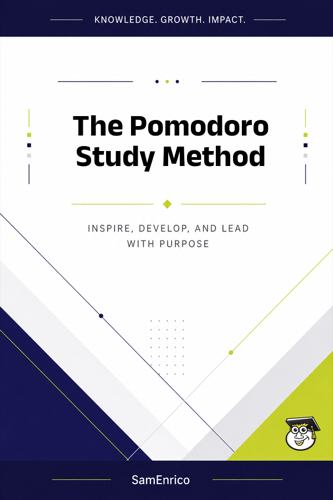
The Pomodoro Study Method eBook
Use timed 25 minute focused sessions with breaks t
Use timed 25 minute focused sessions with breaks to prevent burnout.
Formats
Free sample
Chapter 1: The Broken Timer...--–- Sarah sat at her desk for four hours. Her textbook was open to page 45. Her highlighters were arranged by color. Her phone was face-down, set to Do Not Disturb. By every external measure, she was studying.
But when she closed the book at 11 PM, she realized she remembered almost nothing. She had read the same paragraph about the Krebs cycle seven times. She had checked her phone forty-two times. She had written exactly three sentences of notes, all of which ended in question marks. Sarah was a pre-med sophomore with a 3.8 GPA, and she was convinced that something inside her was broken.She is not alone.Every semester, millions of students sit down to study and walk away with nothing but guilt.
They blame themselves. They call themselves lazy, undisciplined, or unfocused. They scroll through social media and see peers who seem to study effortlessly, and they wonder: What is wrong with me?The answer, revealed in this chapter, is both surprising and liberating: Nothing is wrong with you. You are using the wrong timer.The Myth of the Marathon Student Before we can fix the problem, we must first name it. The dominant model of studying in Western education is what researchers call massed practice—cramming large amounts of information into long, uninterrupted blocks of time.
The marathon study session. The all-nighter. The four-hour library grind.This model is a lie.It persists because it feels virtuous. When you sit at a desk for four hours, you feel like you have worked hard. Your parents are proud.
Your roommate is impressed. But feeling virtuous is not the same as learning. In fact, decades of cognitive science research have shown that massed practice is one of the least effective ways to retain information.Consider the evidence. In a landmark 1978 study published in the Journal of Experimental Psychology, researchers asked two groups of students to learn the same material. One group studied in a single four-hour session.
The other group studied in four one-hour sessions spread across four days. The results were dramatic: the spaced group remembered nearly twice as much material one week later. Twice as much, in the same total study time.Why does spacing work so much better? The answer lies in your brain's biology.Your Brain Is Not a Muscle (It's a Leaky Bucket)Most students think of their brains like muscles: the longer you work it, the stronger it gets. But this metaphor is dangerously wrong.
A more accurate image is a leaky bucket.When you learn something new, your brain creates temporary neural connections in a region called the hippocampus. Think of these connections as water poured into a bucket. But here is the problem: your bucket has holes. Within minutes of learning something new, you begin to forget it. This is the forgetting curve, first described by German psychologist Hermann Ebbinghaus in 1885.Ebbinghaus discovered that without reinforcement, humans forget approximately 50% of new information within one hour, 70% within 24 hours, and 90% within one week.
Your brain is not designed to retain information after a single exposure. It is designed to filter out most of what you experience as irrelevant.This sounds like bad news. But it is actually the key to effective studying. The forgetting curve tells us that the problem is not how long you study. The problem is how often you interrupt the forgetting process.Every time you revisit information just before you would have forgotten it, you strengthen the neural pathway.
This is called spaced repetition. And the Pomodoro method—with its timed sprints and forced breaks—is one of the most practical tools ever designed for implementing spaced repetition in real time.The Peak-End Rule: Why Your Brain Judges Your Study Sessions Harshly There is another psychological principle at work here, one that explains why marathon study sessions feel so punishing. It is called the Peak-End Rule, and it was discovered by Nobel Prize-winning psychologist Daniel Kahneman.The Peak-End Rule states that people judge an experience based on two moments: the most intense point (the peak) and the final moment (the end). The duration of the experience is almost irrelevant to how it is remembered.Consider a simple experiment. Kahneman asked patients undergoing a painful medical procedure to rate their experience.
One group endured a short, intensely painful procedure. Another group endured the same intense pain, followed by a longer period of mild discomfort. Which group rated their experience as worse?Counterintuitively, the group with the shorter procedure rated it as more painful. Why? Because the second group's experience ended with mild discomfort rather than intense pain.
The ending changed everything.Now apply this to studying. A four-hour marathon study session typically has a terrible ending: you are exhausted, frustrated, and guilty about everything you did not accomplish. That ending colors your entire memory of the session. You associate studying with exhaustion and failure. So the next day, you procrastinate.
The cycle repeats.Now imagine a different pattern. You study for 25 minutes. You stop while you still have energy. You take a 5-minute break. You come back.
At the end of four sprints, you have studied for two hours, but you end with a 15-minute walk. The ending is pleasant. You feel accomplished, not drained.The Peak-End Rule predicts that you will remember the second pattern as dramatically more positive—even though the total study time is the same. And because you remember it as positive, you will be more likely to do it again tomorrow.This is not magic. This is neuroscience.The Attention Span Lie Perhaps the most damaging myth in all of education is the belief that humans have short attention spans because of smartphones and social media.
This is a comforting lie for older generations, but it is scientifically false.The truth is that human attention spans have always been short. In 1887, long before Tik Tok or Instagram, philosopher William James wrote in his landmark text The Principles of Psychology that voluntary attention cannot be sustained for more than a few seconds without constant effort. He called sustained focus "the momentary triumph of the will."Modern research confirms this. A 2016 study from the University of California, Irvine found that the average knowledge worker switches tasks every three minutes and five seconds. Another study found that it takes an average of 23 minutes and 15 seconds to return to full focus after an interruption.
These numbers have remained stable across decades, regardless of technology.Your attention span is not broken. It is working exactly as evolution designed it. Your brain is wired to scan for threats, opportunities, and changes in your environment. Sustained focus on a single abstract task—like reading a textbook or solving a calculus problem—is not natural. It is a learned skill that requires constant training.This is the deep truth that the Pomodoro method respects: you cannot force your brain to focus for hours.
But you can train it to focus for minutes.The Birth of the Tomato Timer Francesco Cirillo was a university student in Rome in the late 1980s when he discovered this truth for himself. He was overwhelmed by his coursework, unable to concentrate for more than a…
This is the end of the free sample. Get the eBook to keep going. Buy now
About this book
Details
- Author
- Solis Allegra
- Publisher
- SamEnrico
- Language
- English
- Genre
- Non-Fiction, Self-Help, Productivity
- Released
- 2026-06-06
- Pages (approx.)
- 150
- Available as
- eBook, Audiobook

Read better in the ZLOADR app
Your eBooks on your phone or tablet. Sign in with your SamEnrico account and start reading.
More by Solis Allegra
 Pet Loss Grief GuideSolis Allegra$11.99
 Mindful Walking for PregnancySolis Allegra$11.99
 Pre Sleep Memory CueSolis Allegra$11.99
 Study Environment Optimization GuideSolis Allegra$11.99Study Environment Optimization GuideSolis Allegra$11.99
 Compulsive Spending Recovery CoachSolis Allegra$11.99
 Difficult Customer TalksSolis Allegra$11.99
 SMART Goals for VolunteeringSolis Allegra$11.99
 The Silk Road Kingpin: The Untold Story of Paul Le RouxSolis Allegra$11.99
 The Iron Will of the Arctic: Nansen’s Impossible JourneySolis Allegra$11.99
 Service Providers Guide to Special EventsSolis Allegra$11.99
 How to Produce a KitSolis Allegra$11.99
You may also like
 Productivity Habit SystemWinter Cameron$11.99
 Five AM Club Morning RoutineLarue Alva$11.99
 Workload Prioritization Stress HandbookToney Dolly$11.99
 The Prevention PlanPepper Veta$11.99
 SMART Goals Action Planning GuideSouza Charlyn$11.99
 Memory Palace for Daily TasksBlair Ida$11.99
 Deep Work Interruption Shield GuideKasper Myriam$11.99
 Chunking Grocery ShoppingSmalls Carolyne$11.99
 Time Management Pattern GuideRollins Sherell$11.99
 The Remote Work Time TrackerAbney Vonda$11.99
 The Distraction Proof Morning RoutineGray Marsha$11.99
 The Deep Work Interruption Shield ManualParks Ian$11.99