
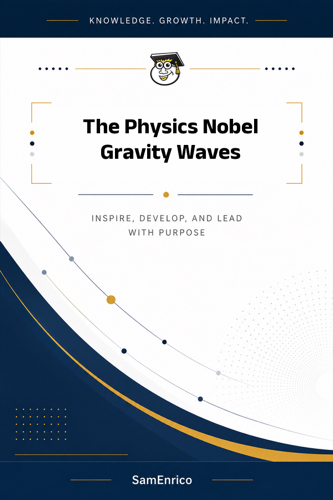
Non-FictionBiographyGravitational Wave
The Physics Nobel Gravity Waves eBook
Traces LIGO discovery and Nobel for Weiss, Barish,
by Hay Juliette
Traces LIGO discovery and Nobel for Weiss, Barish, Thorne.
Formats
Free sample
Chapter 1: The Falling Man...--–- In the summer of 1907, a 28-year-old patent clerk in Bern, Switzerland, had a thought that would bend the arc of physics for the next century. He was not in a laboratory surrounded by graduate students. He was not funded by a government grant or supported by a university. He was sitting in a small office at the Swiss Patent Office, reviewing applications for mundane inventions—electrical timers, mechanical couplings, hydraulic pumps—when his mind drifted to a problem that had haunted him for years.The problem was gravity.Albert Einstein had already revolutionized physics once. In 1905, his "miracle year," he had published four papers that upended centuries of thinking about light, time, energy, and matter.
Special relativity had shown that time slows down at high speeds, that mass and energy are two sides of the same coin (E=mc²), and that nothing—not even light—can outrun the cosmic speed limit. But Special Relativity had a fatal flaw: it could not handle acceleration. It was a theory for a universe moving in straight lines at constant speeds, a universe that did not exist anywhere except in idealized textbooks.Einstein wanted to generalize his theory. He wanted a theory of gravity that would work for everyone, everywhere, whether standing still, falling, or spinning. And in that summer of 1907, sitting in his patent office chair, he had what he later called "the happiest thought of my life."He imagined a man falling from a roof.The Physics of Falling The falling man, Einstein realized, feels no weight.
During the fall, his stomach does not lurch. His arms do not feel heavy. If he drops a coin from his pocket, the coin falls alongside him, keeping pace exactly. From the man's perspective, he is floating in empty space, weightless, as if no gravity existed at all. Only when he hits the ground does gravity announce itself with brutal finality.This was not a new observation.
Galileo had dropped balls from the Leaning Tower of Pisa. Newton had watched apples fall from trees. But Einstein saw something deeper. He realized that a person in free fall cannot perform any experiment—dropping a ball, measuring a heartbeat, swinging a pendulum—that would reveal whether he was falling toward Earth or floating in deep space. The two situations, falling and floating, were physically identical.This was the principle of equivalence.
And it was the key that unlocked General Relativity.The principle of equivalence told Einstein that gravity and acceleration are the same thing, viewed from different perspectives. If you are standing on Earth, you feel weight because the ground is accelerating you upward relative to free fall. If you are in a rocket ship accelerating through space at 9.8 meters per second squared, you would feel exactly the same weight pressing you into the floor. There is no experiment you could do inside a sealed room that would tell you whether you were on Earth or in an accelerating rocket.This was radical. It meant that gravity was not a force like magnetism or electricity, reaching across space to pull objects together.
Gravity was something else entirely. Gravity was the shape of reality itself.The Fabric of Spacetime To understand what Einstein meant, the reader must first abandon a deeply intuitive picture of the universe. Most of us imagine space as an empty stage, a three-dimensional container in which events occur. Time is a river flowing evenly from past to future, indifferent to what happens within it. Einstein's Special Relativity had already begun to erode this picture, showing that space and time are not separate but woven together into a single four-dimensional fabric: spacetime.General Relativity went further.
If gravity is not a force, Einstein reasoned, then what is it? His answer: gravity is the curvature of spacetime itself.Imagine a stretched rubber sheet, flat and taut. Roll a marble across it. The marble moves in a straight line. Now place a heavy bowling ball in the center of the sheet.
The sheet dimples, curving downward around the ball. Roll the marble again. The marble no longer moves in a straight line. It curves toward the bowling ball, following the shape of the dimpled sheet. From above, the marble appears to be "attracted" to the bowling ball by some mysterious force.
But in reality, the marble is simply following the curved surface.This is Einstein's theory of gravity. Massive objects—stars, planets, black holes—curve the spacetime around them. Smaller objects, like Earth or a falling apple, are not "pulled" by a force. They are simply moving along the straightest possible paths through curved spacetime. Those paths are called geodesics.
And what we experience as gravity is just the sensation of resisting those natural paths—standing on the ground instead of falling toward the center of the Earth.The falling man from the roof was not experiencing the absence of gravity. He was experiencing gravity in its purest form: following a geodesic through curved spacetime, weightless and free, until the ground interrupted his journey.The Ripple in the Fabric If massive objects curve spacetime, then what happens when massive objects move? Einstein asked this question in 1916, a year after completing General Relativity. His answer, published in a paper that would echo for a century, was that accelerating masses should create ripples in the fabric of spacetime—waves that travel outward at the speed of light, stretching and squeezing space itself as they pass.These were gravitational waves.The mathematics was elegant. The implications were staggering.
Every time a star explodes, every time a black hole swallows a companion, every time two dense objects spiral together and merge, the universe should ring like a bell. These ripples would carry information about cataclysms that no telescope could ever see—events hidden behind dust clouds, events that emit no light, events that occurred billions of years ago in galaxies so distant that their light has not yet reached us.But there was a problem. A devastating, seemingly insurmountable problem.The Smallness Problem Einstein calculated the size of the ripples. The numbers were absurd.When a gravitational wave passes through Earth, it stretches and squeezes the entire planet by about one ten-thousandth the diameter of a single proton. The distance between New York and Los Angeles would change by less than the width of an atomic nucleus.
The distance between Earth and the Sun—93 million miles—would change by less than the width of a human hair.These were not metaphors. These were the actual predictions of Einstein's equations.To put this in perspective: imagine trying to measure the width of a human hair from a distance of 93 million miles. Now imagine that the hair changes length for only a fraction of a second, once every few thousand years. Now imagine that everything else in the universe—earthquakes, ocean waves, passing trucks, the thermal jiggling of atoms in your detector—creates vibrations billions of times larger than the signal you are seeking.This was the smallness problem. And it led Einstein to a conclusion that would haunt the field for decades.In 1936, Einstein submitted a paper to the journal Physical Review claiming that gravitational waves might not exist at all—that…
This is the end of the free sample. Get the eBook to keep going. Buy now
About this book
Details
- Author
- Hay Juliette
- Publisher
- SamEnrico
- Language
- English
- Genre
- Non-Fiction, Biography, Gravitational Wave
- Released
- 2026-06-07
- Pages (approx.)
- 129
- Available as
- eBook, Audiobook

Read better in the ZLOADR app
Your eBooks on your phone or tablet. Sign in with your SamEnrico account and start reading.
More by Hay Juliette
 The No Spend Social Life GuideHay Juliette$11.99
 The Five Minute Self TalkHay Juliette$11.99
 Japanese Nobel Laureates Across SciencesHay Juliette$11.99
 Toe Point Direction GuideHay Juliette$11.99
 Olympic Peninsula DisappearancesHay Juliette$11.99
 Bob Newhart ButtonHay Juliette$11.99
 Workaholism Self Assessment GuideHay Juliette$11.99
 The Sugar King of Cuba: Julio Lobaton's Sweet EmpireHay Juliette$11.99
 The Silk and Sun: Australia's Fashion RevolutionHay Juliette$11.99
 The Mystery of MH370: The Vanishing of a JetlinerHay Juliette$11.99
 Growing Convallaria (Lily-of-the-valley)Hay Juliette$11.99
 PhD Application Comparison Without PapersHay Juliette$12.99
You may also like
 Hong Kong Handover 1997Dunn Johnnie$11.99
 Zumba For Postnatal Recovery CourseNeal Christian$11.99
 Zumba for BeginnersLadner Nikia$11.99
 YouTube Comment Mining GuideHumes Pandora$12.99
 Worry Box MeditationCarlin Rudy$11.99
 Workplace Stress MeditationNguyen Lynn$11.99
 Workplace Stress and Sleep RepairHawley Ivory$11.99
 Workplace Perfectionism CureDelaney Jeffry$11.99
 Workplace Injustice Anger GuideWallen Isabelle$11.99
 Work Addiction and Burnout LinkGreenwood Ester$11.99
 Women in Yoga and WellnessBeattie Galina$11.99
 Women in Stand Up ComedyChun Evangeline$11.99