
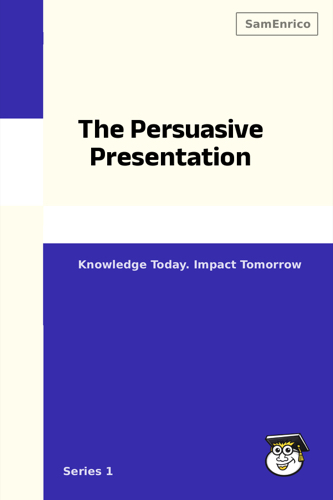
Non-FictionSelf-HelpPersuasion
The Persuasive Presentation eBook
Structure arguments to win buy-in, funding, or app
Structure arguments to win buy-in, funding, or approval.
Formats
Free sample
Chapter 1: The Lizard in the Room...--Before you utter a single word, your audience has already decided whether they will buy what you are about to sell.This is not hyperbole. It is not the paranoid fantasy of a nervous presenter. It is a neurological fact, confirmed by decades of research into the ancient architecture of the human brain. The moment you walk into the room—before you open your mouth, before you click to the first slide, before you even shake the first hand—the decision-makers across the table have begun to render a verdict. They are not judging your logic.
They are not evaluating your evidence. They are not weighing the merits of your proposal. They are scanning for one thing and one thing only: Where do I stand relative to this person?And if their ancient, preverbal, reptilian brain detects even a whisper of lower status, neediness, or deference, your proposal is dead. Not "challenged." Not "deferred for further discussion." Not "in need of additional data." Dead. The remaining thirty minutes of your presentation will be a formality, a polite performance where everyone nods thoughtfully while their internal veto has already been cast, locked, and thrown into the sea.This is the single most misunderstood truth about high-stakes persuasion.
We are taught that facts convince, that data speaks for itself, that a well-reasoned argument built on solid evidence will win the day. But the neuroscientists who study decision-making have known for decades what most business books refuse to admit: the brain that decides is not the brain that reasons.Welcome to the lizard in the room.The Triune Brain: A Brief Tour of Your Audience's Head To understand why your carefully prepared Power Point slides are often irrelevant, you need to understand a simplified but extraordinarily useful model of the human brain. In the 1960s, neuroscientist Paul Mac Lean proposed a framework he called the triune brain. While modern neuroscience has refined and challenged some of its details, the triune model remains the most powerful metaphor for understanding persuasion because it maps directly onto what we feel happening when we try to convince someone.Mac Lean argued that the human brain is not a single, unified organ but three distinct neural structures stacked atop one another like layers of sedimentary rock, each representing a different stage of evolution.Layer One: The Reptilian Complex At the core, buried deepest, is the oldest part of the brain, sometimes called the "R-complex" or simply the reptilian brain. This structure—which includes the brainstem and the basal ganglia—controls basic survival functions: breathing, heart rate, body temperature, hunger, territorial defense, mating, and, most critically for our purposes, status detection and threat assessment.The reptilian brain does not speak.
It does not reason. It does not weigh pros and cons, analyze data, or consider long-term consequences. It makes split-second, binary judgments: friend or enemy? Higher status or lower status? Safe or dangerous?
And it makes these judgments before the rest of the brain has any idea what is happening. The reptilian brain is fast, automatic, and utterly indifferent to your Power Point slides.Layer Two: The Limbic System Surrounding the reptilian core is the limbic system, sometimes called the "emotional brain" or the "mammalian brain" because it is more developed in mammals than in reptiles. This structure—which includes the amygdala, hippocampus, and hypothalamus—processes emotional valence. It answers the question: Is this good or bad? Does this feel right or wrong?The limbic system is where fear, excitement, trust, anxiety, affection, and intuition live.
It is slower than the reptilian core but faster than logic. It generates the "gut feelings" that we call instinct, and it can override the rational brain when emotions run high. The limbic system is why you can feel that something is off about a proposal even when you cannot articulate why.Layer Three: The Neocortex Wrapped around both is the neocortex, the "rational brain" or the "human brain." This is the most recent evolutionary development, responsible for language, mathematics, logic, abstract reasoning, long-term planning, and conscious self-awareness. The neocortex is what we think of as "us"—the voice in our heads that builds arguments, analyzes spreadsheets, and believes it is in charge of the decision-making process.Here is the painful truth that upends most presentation training: information flows upward, not downward. The reptilian brain processes a stimulus first.
If it detects a threat—including the threat of being persuaded by someone of lower status—it floods the body with cortisol and adrenaline. The limbic system amplifies the emotional signal. And by the time the signal reaches the neocortex, the decision has already been made. The rational brain's job is not to decide; it is to rationalize the decision the lower brains have already made.In practical terms: when a decision-maker perceives you as low-status, needy, or desperate, their reptilian brain labels you as a threat to their position and their safety. Their limbic system generates a feeling of aversion.
And their neocortex—the part that believes it is in charge—invents a logical reason to say no. "The numbers don't quite work." "We need to see more data." "Let's circle back next quarter." These are not reasons. They are post-hoc justifications for a reptilian veto.You are arguing with a lizard, and the lizard does not speak English.The Seven-Second Status Scan Research in social neuroscience and evolutionary psychology has identified a phenomenon called spontaneous status evaluation. Within the first seven seconds of encountering someone, the human brain automatically assigns a relative status ranking. This happens without conscious thought.
It is not a choice. It is a reflex, as automatic as pulling your hand from a hot stove.The evolutionary logic is straightforward. In our ancestral environment, misreading status could be fatal. If you treated a dominant individual as subordinate, you could be attacked, exiled, or killed. If you treated a subordinate as dominant, you would waste resources and lose mating opportunities.
The brain that could assess status quickly and accurately outcompeted the brain that could not. After hundreds of thousands of years of this selective pressure, status evaluation became automatic, unconscious, and virtually instantaneous.What triggers this status scan? A constellation of micro-signals that most presenters never notice, let alone control.Posture. Do you stand tall with your shoulders back, your chest open, and your feet planted firmly? Or do you shrink, crossing your arms, rounding your shoulders, shifting your weight from foot to foot, leaning away from the center of the room?
The reptilian brain reads expansive, grounded posture as high status. It reads constricted, unstable posture as low status.Eye contact. Do you hold gaze steadily, breaking only occasionally to gesture or to think? Or do your eyes dart around the room, drop to the floor, fixate on your slides, or flick nervously from face to face? Prolonged, relaxed eye contact signals confidence, comfort, and high status.
Broken, hurried, or averted eye contact signals submission, anxiety, and low status.Vocal pace and pitch. Do you speak slowly, with descending intonation at the end of sentences? Or do you speed up, raise your pitch at the end of statements (turning them into questions), and fill…
This is the end of the free sample. Get the eBook to keep going. Buy now
About this book
Details
- Author
- Geary Kimberli
- Publisher
- SamEnrico
- Language
- English
- Genre
- Non-Fiction, Self-Help, Persuasion
- Released
- 2026-06-09
- Pages (approx.)
- 130
- Available as
- eBook, Audiobook

Read better in the ZLOADR app
Your eBooks on your phone or tablet. Sign in with your SamEnrico account and start reading.
More by Geary Kimberli
 Natural Disaster Trauma GuideGeary Kimberli$11.99
 Industrial Pollution Home GuideGeary Kimberli$11.99
 Fintech Capital StrategiesGeary Kimberli$11.99
 Anxiety Relief Hypnosis ScriptGeary Kimberli$11.99
 Alcohol Recovery Financial RecoveryGeary Kimberli$11.99
 Sarcopenia Metabolic Rate GuideGeary Kimberli$11.99
 Dreaming for Trauma ProcessingGeary Kimberli$11.99
 DesignOps Team AlignmentGeary Kimberli$11.99
 The Caspian's Hidden Energy: How a 19th-Century Russian Scientist Unlocked the Secrets of ThermodynamicsGeary Kimberli$11.99
 The Hammer of the North: Ragnar Lothbrok and the Siege of Paris (885-886 AD)Geary Kimberli$11.99
 NFT Standards and Token ModelsGeary Kimberli$11.99
 Growing TrichosanthesGeary Kimberli$11.99
You may also like
 Hong Kong Handover 1997Dunn Johnnie$11.99
 Zumba For Postnatal Recovery CourseNeal Christian$11.99
 Zumba for BeginnersLadner Nikia$11.99
 YouTube Comment Mining GuideHumes Pandora$12.99
 Worry Box MeditationCarlin Rudy$11.99
 Workplace Stress MeditationNguyen Lynn$11.99
 Workplace Stress and Sleep RepairHawley Ivory$11.99
 Workplace Perfectionism CureDelaney Jeffry$11.99
 Workplace Injustice Anger GuideWallen Isabelle$11.99
 Work Addiction and Burnout LinkGreenwood Ester$11.99
 Women in Yoga and WellnessBeattie Galina$11.99
 Women in Stand Up ComedyChun Evangeline$11.99