
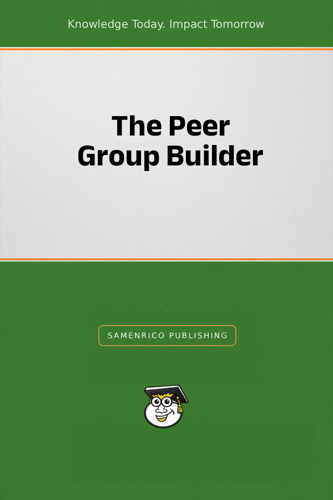
The Peer Group Builder eBook
Create mastermind groups and peer advisory boards
Create mastermind groups and peer advisory boards for mutual support.
Formats
Free sample
Chapter 1: The Mentorship Lie--–- Let me tell you something that might cost me some friends in the coaching industry.You have been lied to. Not maliciously, but systematically. The lie sounds like wisdom. It sounds like this: "Find a mentor." "Everyone needs a mentor." "You cannot succeed without a mentor."This advice has been repeated so often on Linked In, in graduation speeches, and in every business book written since 1980 that we have stopped questioning it. We nod along.
We tweet it. We paste it into our bios: "Mentor to aspiring leaders."But here is the truth that no one making money from mentorship wants you to hear: Mentorship is structurally flawed for the very problems that keep you up at night. And the sooner you accept this, the sooner you will stop searching for that one wise elder and start building something that actually works—a table of peers who have no power over you, no agenda for you, and every reason to tell you the truth.I have sat in rooms with billionaires who admitted they have no one to call at 2 AM. I have watched CEOs cry in their cars after board meetings because admitting weakness to their team would be "professional suicide." And I have seen the same solution work every single time—not a better coach, not a smarter mentor, but a circle of equals who say "me too."This chapter is not an attack on good mentorship. Good mentors exist.
They add value. But they cannot solve the problem that this book exists to solve: the epidemic of professional isolation that afflicts the very people who seem most successful.To understand why, we need to dismantle the Mentorship Lie—piece by piece, three fatal flaws at a time.The Power Imbalance Problem A mentor, by definition, has something you want. Access. Wisdom. Connections.
A title that opens doors. And because they have something you want, you cannot be fully honest with them.Think about the last time you had a difficult conversation with a mentor. Did you tell them about the time you lied to a client? Did you admit that you have been faking your way through financial statements? Did you confess that you secretly resent your co-founder and have fantasized about quitting for six months?Of course not.Because mentors hold power.
They write recommendations. They make introductions. They decide whether to invite you into their network or leave you outside it. And even the most enlightened, well-intentioned mentor cannot escape this dynamic. It is baked into the relationship structure itself.I once interviewed a senior executive at a Fortune 50 company who had been formally mentoring a junior employee for two years.
"I thought we had a great relationship," she told me. "She seemed so open. So vulnerable." Then the junior employee resigned. In her exit interview, she said: "I never told my mentor that I was miserable because I was terrified she would think I was ungrateful or weak. I performed vulnerability, not real vulnerability.
There is a difference."That is the Power Imbalance Problem in action. The mentee performs. The mentor believes the performance. And everyone walks away convinced that mentorship works—because no one tells the truth about what they held back.This is not a failure of individual mentors. It is a structural feature of any relationship where one person has more status, resources, or control than another.
The person with less power will always self-censor. Not because they are dishonest. Because they are rational.Peer groups solve this problem by eliminating the power differential entirely. When everyone in the room has a similar level of authority, income, and experience, the cost of vulnerability drops to near zero. You can say "I have no idea what I am doing" without fearing that the person across the table will use that confession against you.
Because they cannot. They are your equal, not your gatekeeper.The Generational Gap Problem Even if you find a mentor who genuinely holds no power over you—a rare and beautiful thing—you still face a second structural flaw: the Generational Gap Problem.Your mentor succeeded in a different economy. Their playbook was written in a different era, with different rules, different technologies, and different cultural expectations. What worked for them may not work for you. In fact, it probably will not.Consider the classic mentor advice: "Just knock on doors." "Show up early and stay late." "Work your way up from the mailroom." These strategies made sense in 1985.
In 2026, they range from useless to actively harmful. Knocking on unannounced doors gets you escorted out by security. Showing up early and staying late signals that you have poor boundaries and cannot manage your time. The mailroom no longer exists.I am not being facetious. A recent study of executive mentorship programs found that mentors' advice was rated as "highly applicable" by mentees only 37 percent of the time.
The rest of the time, mentees reported that the advice felt outdated, out of touch, or actively counterproductive to their current reality.And here is the cruel irony: the mentor does not know that their advice is outdated. They genuinely believe they are helping. They are telling you what worked for them. But their success may have been the result of timing, luck, or structural advantages that no longer exist—and that they may not even recognize.I once watched a mentor tell a young founder to "just get a bank loan like I did." The founder was starting a business in a post-2008 regulatory environment where banks had stopped lending to startups. The mentor had started his business in 1997.
The gap was not just years. It was a completely different financial universe. The founder smiled, nodded, and walked away with useless advice that wasted three months of his time.Peer groups eliminate the Generational Gap Problem because everyone in the room is operating in the same economic reality. You are facing the same market conditions, the same hiring challenges, the same technological shifts. When a peer says "here is what worked for me," you can trust that the context is relevant because you are living through it together.This does not mean that older, more experienced voices have no value.
They have enormous value—as advisors, as board members, as occasional guest experts. But they cannot serve as your primary support system for the day-to-day challenges of navigating a rapidly changing world. Only peers can do that.The Ego Problem The third structural flaw is the most uncomfortable to discuss because it touches on something no mentor wants to admit: mentors have egos, and those egos shape the advice they give.A mentor has built an identity around being successful, wise, and effective. That identity is precious to them. It has taken decades to construct.
And they will protect it—often unconsciously—by giving advice that confirms their own worldview, validates their own choices, and avoids any suggestion that they might have been wrong about something.This manifests in several predictable ways.First, mentors tend to give advice that worked for them, even when that advice is statistically unlikely to work for anyone else. Survivorship bias is real. For every…
This is the end of the free sample. Get the eBook to keep going. Buy now
About this book
Details
- Author
- Browder Johna
- Publisher
- SamEnrico
- Language
- English
- Genre
- Non-Fiction, Self-Help
- Released
- 2026-06-06
- Pages (approx.)
- 141
- Available as
- eBook, Audiobook

Read better in the ZLOADR app
Your eBooks on your phone or tablet. Sign in with your SamEnrico account and start reading.
More by Browder Johna
 Hypnotic Reaction TrainingBrowder Johna$11.99
 Chemo Neuropathy GuideBrowder Johna$11.99
 Emotional Eating MythsBrowder Johna$11.99
 Prison Guard Burnout GuideBrowder Johna$11.99
 Whispers in the Silk Road: The Unseen Hand of Marco Polo's MentorBrowder Johna$11.99
 The Frozen Mirage: Antarctica's Forgotten Explorer and the Congo's Hidden TruthsBrowder Johna$11.99
 Understanding Familial ALSBrowder Johna$17.99
 Data Presentation Quick Reference for Daily UseBrowder Johna$12.99
 Brazil Payment Methods GuideBrowder Johna$12.99
 Portraiture PhotosBrowder Johna$11.99
 How to Start a Feather Sorting Business (Beginners Guide)Browder Johna$11.99
You may also like
 Hong Kong Handover 1997Dunn Johnnie$11.99
 Zumba For Postnatal Recovery CourseNeal Christian$11.99
 Zumba for BeginnersLadner Nikia$11.99
 YouTube Comment Mining GuideHumes Pandora$12.99
 Worry Box MeditationCarlin Rudy$11.99
 Workplace Stress MeditationNguyen Lynn$11.99
 Workplace Stress and Sleep RepairHawley Ivory$11.99
 Workplace Perfectionism CureDelaney Jeffry$11.99
 Workplace Injustice Anger GuideWallen Isabelle$11.99
 Work Addiction and Burnout LinkGreenwood Ester$11.99
 Women in Yoga and WellnessBeattie Galina$11.99
 Women in Stand Up ComedyChun Evangeline$11.99