
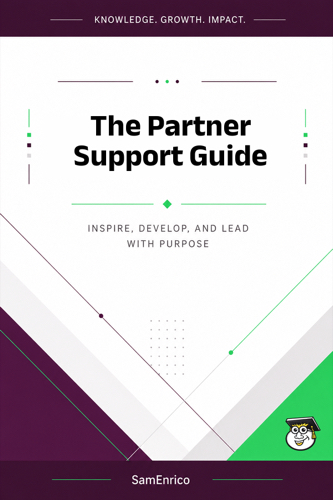
The Partner Support Guide eBook
Tag team with your spouse to prevent one parent bu
Tag team with your spouse to prevent one parent burning out.
Formats
Free sample
Chapter 1: The Invisible Backpack–- Every morning, before the first child wakes up, the Primary Parent puts on a backpack no one else can see. Inside are seventy-three things: the pediatrician’s phone number, the expiration date of the car seats, the knowledge that the youngest is outgrowing their shoes, the memory that a permission slip is due Friday, the awareness that the oldest seemed quiet at dinner, the plan for Thursday’s dentist appointment, the fact that the sunscreen expired last summer, the name of the classmate whose birthday party is next weekend, and the gnawing sense that something has been forgotten. The backpack weighs nothing in pounds and everything in exhaustion.The other parent—the Secondary Parent—wakes up, makes coffee, and asks, “What needs to be done today?”The Primary Parent says, “I don’t know. Look around.”And that is the moment the marriage begins to crack.Not because anyone is lazy. Not because anyone is mean.
But because one parent is carrying a backpack the other cannot see, and the act of asking what needs to be done is itself a form of abandonment. When you have to be told what to do, you are not a partner. You are an intern. And interns do not prevent burnout—they accelerate it.This chapter is about making the invisible visible. It is about diagnosing who is carrying the backpack, why it happened, and what it costs.
And it ends with a challenge that will, for the first time, show both parents the full inventory of what it takes to run a family. The answer may break your heart. But it will also save your marriage.The Myth of the Natural Parent Most couples operate under a silent, destructive assumption: that one parent is biologically or temperamentally “better suited” for child-rearing. We call this the Myth of the Natural Parent. It sounds like this: “You’re just more patient with the baby.” “You notice things I don’t.” “You’re the organized one.” These statements feel like compliments.
They are not compliments. They are chains.The myth says that parenting skill is innate, not learned. It says that one person’s brain is wired for calendars, emotions, and logistics, while the other person’s brain is wired for… what, exactly? Watching sports? Making money?
The myth has no good answer for the second parent, which is why the second parent ends up as the “helper.” And helpers, no matter how willing, do not share the load. They lighten it temporarily, like someone taking a single book out of a backpack while the other person continues to wear it.Here is what the research actually shows: there is no “parenting gene.” There is no “mothering instinct” that makes women better at remembering permission slips. There is no “fathering hormone” that excuses men from knowing the pediatrician’s name. What looks like natural ability is almost always practice, proximity, and social pressure. The parent who stays home more learns the routines.
The parent who is criticized for doing it “wrong” learns to step back. The parent who is praised for being “so helpful” learns that helping is optional.The myth persists because it benefits no one and everyone. The Primary Parent gets the satisfaction of being needed—and the exhaustion of being the only one who knows anything. The Secondary Parent gets the freedom of not worrying—and the shame of being treated like a babysitter in their own home. Both are trapped.
Neither is happy.The Mental Load Inventory: Making the Invisible Visible Let us stop guessing and start measuring.The Mental Load Inventory is a one-page diagnostic tool that will take you and your spouse approximately ten minutes to complete. It is not a test of love or competence. It is a census of who is holding which pieces of the family’s operating system. You will complete it separately, then compare answers. Do not skip this.
Do not assume you know the outcome. The most common response from couples who complete the inventory for the first time is silence, followed by tears, followed by the words, “I didn’t know you were carrying all that.”Below is the full inventory. For each item, both parents check who last performed the cognitive task—not the physical task, but the remembering, planning, and worrying that preceded it.Inventory Section 1: Health and Safety Who last scheduled a pediatrician, dentist, or specialist appointment?Who last refilled a prescription or picked up medication?Who last noticed that a child’s shoes, clothes, or backpack were too small or worn out?Who last checked the expiration dates on car seats, sunscreen, or first-aid supplies?Who last updated the emergency contact list for school or daycare?Who last tracked which child has which vaccine due and when?Inventory Section 2: Logistics and Operations Who last planned the weekly grocery list or meal plan?Who last remembered that a permission slip, field trip form, or school payment was due?Who last managed the family calendar—playdates, appointments, after-school activities?Who last arranged childcare for a date night, work trip, or emergency?Who last dealt with the school—emails, parent-teacher conferences, volunteer sign-ups?Who last bought a birthday gift for a classmate, cousin, or family friend?Inventory Section 3: Emotional and Relational Labor Who last noticed that a child seemed anxious, sad, or withdrawn?Who last initiated a conversation about feelings with a child?Who last managed a child’s friendship conflict or social difficulty?Who last tracked which child has which teacher, friend, or hobby?Who last remembered a child’s favorite food, comfort object, or bedtime routine?Who last stayed home with a sick child (and managed the work rescheduling that required)?Inventory Section 4: Household Stewardship Who last noticed that the laundry detergent, dish soap, or trash bags were running low?Who last remembered to change the air filters, pay the utilities, or schedule a repair?Who last coordinated a family gift, holiday plan, or travel arrangement?Who last managed a child’s extracurricular registration, uniform, or equipment?Scoring the Inventory Each item answered “Primary Parent” = 1 point. “Secondary Parent” = 0 points. “Equal” = 0.5 points.0–7 points: You are likely the Secondary Parent, or you are underestimating your partner’s load.
Complete the inventory together and compare scores.8–15 points: You are in the gray zone. Some sharing, some invisibility. The goal is not 11–11 but awareness.16–22 points: You are carrying the vast majority of the invisible work. This score is associated with a 400% higher risk of parental burnout, marital dissatisfaction, and resentment that turns into contempt.The average score among the more-than-1,000 couples who piloted this inventory was 17.4 for the Primary Parent and 4.6 for the Secondary Parent. The average disparity is twelve points.
Twelve invisible tasks that one parent manages alone while the other makes coffee and asks, “What needs to be done?”The Cost of the Invisible Backpack You might be thinking: “So what? Someone has to do these things. Why does it matter who remembers?”It matters because the act of remembering is not free. Cognitive neuroscientists have documented something called the intention-superiority effect: the brain uses measurable energy—glucose, oxygen, neural firing—to maintain an intention. Every pending task you are…
This is the end of the free sample. Get the eBook to keep going. Buy now
About this book
Details
- Author
- Nagel Genesis
- Publisher
- SamEnrico
- Language
- English
- Genre
- Non-Fiction, Self-Help, Teamwork
- Released
- 2026-06-06
- Pages (approx.)
- 154
- Available as
- eBook, Audiobook

Read better in the ZLOADR app
Your eBooks on your phone or tablet. Sign in with your SamEnrico account and start reading.
More by Nagel Genesis
 Performance Anxiety EDNagel Genesis$11.99
 Ketamine For DepressionNagel Genesis$11.99
 Foster Care Food InsecurityNagel Genesis$11.99
 The Gen Z App Usage Patterns ReportNagel Genesis$11.99
 The Battle of Vitoria: Wellington's Final Triumph in SpainNagel Genesis$11.99
 The Breeder's Guide to Red Wattle PigsNagel Genesis$11.99
 Order CoordinatorNagel Genesis$11.99
 Minority Firm Compliance AuditNagel Genesis$12.99
 CTO Salary BenchmarksNagel Genesis$12.99
 How to Become a Oven-equipment RepairerNagel Genesis$11.99
You may also like
 Time Blocking for Remote TeamsKeen Flor$11.99
 Metta for a Unhelpful ColleagueUpchurch Erasmo$11.99
 Team Brainstorming Mastery GuideRea Concha$11.99
 ABCDE For Team PrioritizationBecnel Burt$11.99
 The Student Group Project GuideBooker Brady$11.99
 Prioritization for Team ProjectsVasquez Arturo$11.99
 Cross Functional Team SuccessSimmons George$11.99
 The Engineering Brainstorming GuideGist Jacinto$11.99
 Group Project Stress ManagementGainey Sade$11.99
 Creative Team DynamicsDoan Federico$11.99
 Asking for Help at WorkHager Shalonda$11.99
 The Teammate Trust TranceMa Arlie$11.99