
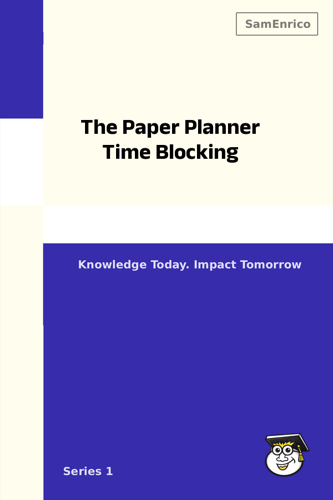
Non-FictionSelf-HelpAnalog Productivity
The Paper Planner Time Blocking eBook
Analog method using hour by hour planners.
Analog method using hour by hour planners.
Formats
Free sample
Chapter 1: The Ink Contract--–- You are being robbed. Not by a thief in the night, not by a hacker on a distant server, and not by the corporation whose app you check first thing in the morning. You are being robbed by the very tool that promised to save you time. The digital calendar on your phone, your laptop, your smartwatch—the one you trust to organize your life—is not a neutral tool. It is a slot machine designed by billionaires to pull your attention away from your own priorities and toward their quarterly earnings reports.
Every notification, every red badge, every gentle ping is a tiny pickpocket reaching into the pocket of your day and stealing another minute you will never get back.This chapter makes a radical claim that will either infuriate you or set you free: Your digital calendar is making you dumber, more distracted, and less productive than you would be with a twenty-cent piece of paper and a pen you stole from a bank. But unlike most radical claims, this one comes with receipts. We will walk through the neuroscience of attention, the psychology of commitment, the economics of interruption, and the surprising physics of ink on paper. By the end of this chapter, you will understand why the most productive writers, surgeons, architects, and CEOs are quietly abandoning their apps and returning to the one technology that has never been hacked, never crashed, and never sold their data: the paper planner.But let us be clear from the start. This is not a Luddite manifesto.
You will not be asked to burn your i Phone or delete your Google Calendar. Digital tools have their place, but that place is tiny, specific, and strictly subordinate to your analog system. Think of it this way: a hammer is an excellent tool for driving nails. It is a terrible tool for performing surgery. The problem is not that digital calendars are evil.
The problem is that we are using them for everything, including the jobs they were never designed to do. By the final page of this book, you will have demoted your phone from "life manager" to "glorified wristwatch with alarms." And you will be happier, calmer, and more productive for it.The Attention Residue Epidemic Let us begin with a simple experiment you can perform right now, without leaving your chair. Think about the last time you switched from your email inbox to your calendar to your messaging app to your task manager and back to your email inbox. How long did that sequence take? Five seconds?
Ten? Now ask yourself a harder question: how long did it take for your brain to fully re-engage with the original task after that switching sequence?The answer, according to decades of cognitive psychology research, is somewhere between fifteen and twenty-three minutes. This phenomenon has a name: attention residue. When you stop working on Task A to glance at Task B, a piece of your attention remains stuck to Task A like gum on a shoe. You are not fully present for Task B, and you cannot fully return to Task A until the residue dissolves.
Each switch costs you not only the seconds of the switch itself but also the cognitive drag of reorienting. If you check your digital calendar twenty times a day—and most knowledge workers check their calendars far more often than that—you are losing nearly four hours of productive focus to attention residue alone. Four hours. Every day. That is twenty hours a week.
That is a thousand hours a year. That is forty-one full days of your life, vanished into the gap between tabs.Digital calendars are uniquely terrible in this regard because they are designed to be checked constantly. They live on your home screen. They send you push notifications. They display red badges that scream for attention.
Every time you unlock your phone to check the time, you see your calendar icon. Every time you open your laptop, your calendar greets you like a needy friend demanding to know what you are doing next. The digital calendar is not a tool you use. It is a tool that uses you. It fragments your day into a thousand tiny shards, each one too small to hold a single deep thought.Paper, by contrast, lives in one place.
You open your planner when you plan. You close it when you work. There are no notifications, no badges, no pings. When your paper planner is closed, it is silent. It does not demand your attention.
It waits patiently, like a well-trained servant, until you call upon it. This absence of interruption is not a bug. It is the single most important feature of the analog system.Consider the research of Professor Sophie Leroy, who coined the term "attention residue" in her 2009 study published in the Academy of Management Journal. Leroy found that participants who were interrupted mid-task and forced to switch to a new task performed significantly worse on both tasks than participants who completed the first task before moving to the second. The residue effect was so powerful that even a three-second interruption—the time it takes to glance at a calendar notification—was enough to degrade performance.
Now multiply that three-second interruption by the fifty or sixty times you glance at your digital calendar each day. The cumulative effect is not addition. It is multiplication. Each interruption costs more than the last because your brain grows increasingly fatigued.The solution is not to try harder. You cannot willpower your way out of a neurological fact.
The solution is to change the environment. You remove the source of interruption. You close the digital calendar. You open a paper planner. And suddenly, for the first time all day, your brain is allowed to work on one thing at a time—the way evolution designed it.Cognitive Offloading: Why Your Brain Hates Remembering The second argument for paper is even more powerful than the first, because it speaks not to what you lose when you use digital tools but to what you gain when you use analog ones.
This is the concept of cognitive offloading.Your working memory is tiny. Psychologists estimate that the average human can hold only four to seven discrete pieces of information in conscious awareness at any given moment. That is it. Four to seven. Everything else—your grocery list, your meeting time, your child's pediatrician appointment, your boss's deadline, your car's oil change schedule—must be stored somewhere else or it will be forgotten.
Most people try to store this information in their own heads. This is a catastrophic error. Your brain is not a hard drive. It is a processor. When you use your brain to remember things, you are stealing processing power from the work of thinking, creating, and solving problems.Digital calendars appear to solve this problem.
You enter the appointment, you set the reminder, and your brain can relax. The information is stored externally. Cognitive offloading achieved. Right?Not quite. Digital calendars offload the memory, yes, but they do so at a cost that most users never consider.
When you type an appointment into a digital calendar, you are engaging in a shallow, low-commitment act. Your fingers move.…
This is the end of the free sample. Get the eBook to keep going. Buy now
About this book
Details
- Author
- Boudreaux Virgil
- Publisher
- SamEnrico
- Language
- English
- Genre
- Non-Fiction, Self-Help, Analog Productivity
- Released
- 2026-06-07
- Pages (approx.)
- 149
- Available as
- eBook, Audiobook

Read better in the ZLOADR app
Your eBooks on your phone or tablet. Sign in with your SamEnrico account and start reading.
More by Boudreaux Virgil
 Nobel Physics TodayBoudreaux Virgil$11.99
 Blame Shifting Anger Management HandbookBoudreaux Virgil$11.99
 Financial Stress Survival GuideBoudreaux Virgil$11.99
 Jonathan Ross Big Beard JourneyBoudreaux Virgil$11.99
 The Architects of the Sky: The Nubian Pyramids of MeroëBoudreaux Virgil$11.99
 How to Start a Pens (retail) Business (Beginners Guide)Boudreaux Virgil$11.99
 Epic Games GuideBoudreaux Virgil$12.99
 Ethereum for African ExportersBoudreaux Virgil$12.99
 Understanding PyropoikilocytosisBoudreaux Virgil$17.99
 Fund AccountantBoudreaux Virgil$11.99
You may also like
 Hong Kong Handover 1997Dunn Johnnie$11.99
 Zumba For Postnatal Recovery CourseNeal Christian$11.99
 Zumba for BeginnersLadner Nikia$11.99
 YouTube Comment Mining GuideHumes Pandora$12.99
 Worry Box MeditationCarlin Rudy$11.99
 Workplace Stress MeditationNguyen Lynn$11.99
 Workplace Stress and Sleep RepairHawley Ivory$11.99
 Workplace Perfectionism CureDelaney Jeffry$11.99
 Workplace Injustice Anger GuideWallen Isabelle$11.99
 Work Addiction and Burnout LinkGreenwood Ester$11.99
 Women in Yoga and WellnessBeattie Galina$11.99
 Women in Stand Up ComedyChun Evangeline$11.99