
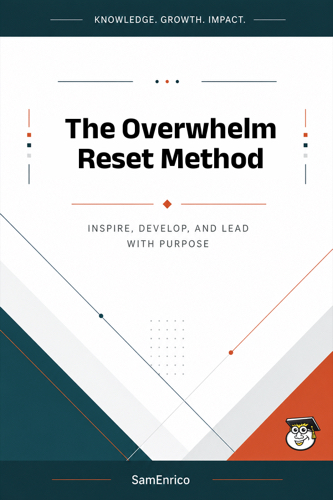
The Overwhelm Reset Method eBook
Use five minute resets during chaotic workdays to
Use five minute resets during chaotic workdays to prevent stress accumulation.
Formats
Free sample
Chapter 1: The 2 PM Crash--It happens every day, and you have started to believe it is your fault.You arrive at work in the morning feeling capable, perhaps even optimistic. You have coffee. You glance at your calendar. You make a mental promise: Today will be different. Today, I will stay on top of things.
Then, somewhere between 1:30 and 3:00 in the afternoon, something shifts. It is not dramatic. There is no single catastrophe. But suddenly, the email that should have taken ninety seconds to write becomes a five-minute ordeal. A colleague asks a simple question, and you feel an irrational spike of irritation.
Your eyes glaze over as you stare at a paragraph you have now read four times without understanding a single word. The afternoon stretches ahead of you like a desert, and you are already exhausted.You tell yourself you are lazy. You tell yourself you lack discipline. You tell yourself that if you just tried harder, ate a better lunch, slept more, or cared less, you would not feel this way.You are wrong.What you are experiencing is not a character flaw. It is not a lack of willpower.
It is not a moral failing. It is a neurological flood, and it has a name: accumulated overwhelm. This chapter will show you why you crash at 2 PM, why sleep alone cannot fix it, and why the solution is not more time or more vacation days—but better interrupts.The Tired-Overwhelmed Distinction Let us begin with a distinction that will change how you understand every bad afternoon you have ever had.Tired is a physical state. You feel tired when you have not slept enough, when you have exerted physical energy, or when you have been awake for too many hours. Tired responds to rest.
A good night of sleep, a nap, or even a quiet evening on the couch can fix tired. Tired is uncomfortable, but it is linear. You know the solution. You simply may not have time to apply it.Overwhelmed is something else entirely. Overwhelmed is a neurological state.
It is the result of your nervous system becoming saturated with stress hormones, unresolved mental loops, and accumulated micro-frustrations. You can be perfectly rested—eight hours of sleep, a green smoothie, a morning run—and still feel overwhelmed by 2 PM. In fact, many people who report feeling "burned out" are not exhausted in the physical sense. They are flooded in the neurological sense.Here is the cruel irony: when you are overwhelmed, you often cannot rest. Your mind races.
You lie in bed replaying the conversation you had at 11 AM. You wake up at 3 AM thinking about the email you should not have sent. Sleep does not fix overwhelm because overwhelm is not a deficit of rest. It is a surplus of activation.Think of it this way. A tired person needs a mattress.
An overwhelmed person needs an interrupt.The Stress Bucket: A Mental Model for Your Nervous System To understand why you crash at 2 PM, you need a simple mental model. Imagine you have a bucket inside your nervous system. This bucket is not infinite. It has a fixed capacity, and once it overflows, you stop functioning well.Every single stressor of your day drops a pebble into that bucket. Some pebbles are small.
A notification ping while you are trying to focus. A typo you have to correct. A meeting that runs five minutes late. A lukewarm cup of coffee. A passive-aggressive email from a coworker.
Each of these events, by itself, is trivial. You barely notice them. But they are pebbles, and they add up.Other pebbles are larger. A tense conversation with your boss. A deadline that just moved up.
A mistake you made that you now have to fix. A project that got rejected. These are heavier. They displace more water in the bucket. But here is what most people get wrong: they believe that only the large pebbles matter.
They think, I can handle small things. It is the big crises that wear me down.The research suggests the opposite.Multiple studies in occupational health psychology have found that the accumulation of micro-stressors—dozens of small frustrations, interruptions, and annoyances—predicts end-of-day exhaustion more accurately than the presence of one or two major stressors. A single difficult conversation at 9 AM might sting, but you recover. Thirty small interruptions between 9 AM and 2 PM do not give you time to recover between them. They pile up.
They sediment.By mid-afternoon, your bucket is full. The next pebble—any pebble—causes an overflow. And overflow looks like this: you snap at someone for no reason. You cry in the bathroom. You stare at your screen for ten minutes unable to remember what you were doing.
You feel a wave of despair that seems completely disproportionate to whatever just happened.That is not weakness. That is physics. Your bucket overflowed.Work-Related Rumination: The Loop That Eats Your Afternoon The stress bucket alone does not fully explain the 2 PM crash. There is a second mechanism at work, and it is even more insidious. Psychologists call it work-related rumination, but you probably know it as "that thing your brain does when it will not shut up about what happened earlier."Rumination is the tendency to repeatedly think about a stressful event long after the event itself is over.
It is not problem-solving. Problem-solving moves toward a solution. Rumination circles the same drain endlessly. It sounds like this: I cannot believe I said that in the meeting. Why did I say that?
Everyone must think I am incompetent. But maybe they did not notice. No, they definitely noticed. I should apologize. But apologizing would draw more attention to it.
I am so stupid.Notice what just happened. The event (saying something awkward in a meeting) lasted five seconds. The rumination lasted five minutes, then twenty minutes, then two hours. The actual stressor was tiny. The rumination magnified it by a factor of a hundred.Here is what the research shows about rumination.
A study published in the Journal of Occupational Health Psychology found that employees who ruminate on workplace stressors during their commute home have elevated cortisol levels (a key stress hormone) well into the evening. Another study found that just five minutes of rumination after a morning conflict reduces creative problem-solving ability by over thirty percent in the afternoon. Thirty percent. That is the difference between a good idea and no idea.Rumination does not just make you feel bad. It actively degrades your cognitive performance.
It occupies your working memory, leaving less space for the task in front of you. It keeps your nervous system in a state of low-grade activation, meaning your bucket never empties. It is the lid on the bucket that prevents water from evaporating.And here is the cruelest part: rumination feels like productivity. Your brain tricks you into believing that if you just keep thinking about the problem, you will eventually solve it. But rumination is not analysis.
Analysis asks, What can I do differently next time? Rumination asks, Why am I so terrible? One leads to learning. The other leads to a spiral.Why Sleep, Vacations, and Weekends…
This is the end of the free sample. Get the eBook to keep going. Buy now
About this book
Details
- Author
- Earle Aleisha
- Publisher
- SamEnrico
- Language
- English
- Genre
- Non-Fiction, Self-Help, Productivity
- Released
- 2026-06-08
- Pages (approx.)
- 145
- Available as
- eBook, Audiobook

Read better in the ZLOADR app
Your eBooks on your phone or tablet. Sign in with your SamEnrico account and start reading.
More by Earle Aleisha
 Values And Mission Alignment Hiring And Onboarding GuideEarle Aleisha$11.99
 Social Proof Influence TacticsEarle Aleisha$11.99
 Boss Anger Trigger WorkbookEarle Aleisha$11.99
 The Menopause Sleep Hygiene GuideEarle Aleisha$11.99
 The Plastic Whisperer: How a Teen Girl Turned Trash into TreasureEarle Aleisha$11.99
 Understanding TrapsEarle Aleisha$17.99
 Business Plan for ExportersEarle Aleisha$12.99
 Buttercup Replaces 1Password GuideEarle Aleisha$12.99
 Wti Crude Oil TradingEarle Aleisha$11.99
 How to Start a Downproof Cloth Weaving Business (Beginners Guide)Earle Aleisha$11.99
You may also like
 Productivity Habit SystemWinter Cameron$11.99
 Five AM Club Morning RoutineLarue Alva$11.99
 Workload Prioritization Stress HandbookToney Dolly$11.99
 The Prevention PlanPepper Veta$11.99
 SMART Goals Action Planning GuideSouza Charlyn$11.99
 Memory Palace for Daily TasksBlair Ida$11.99
 Deep Work Interruption Shield GuideKasper Myriam$11.99
 Chunking Grocery ShoppingSmalls Carolyne$11.99
 Time Management Pattern GuideRollins Sherell$11.99
 The Remote Work Time TrackerAbney Vonda$11.99
 The Distraction Proof Morning RoutineGray Marsha$11.99
 The Deep Work Interruption Shield ManualParks Ian$11.99