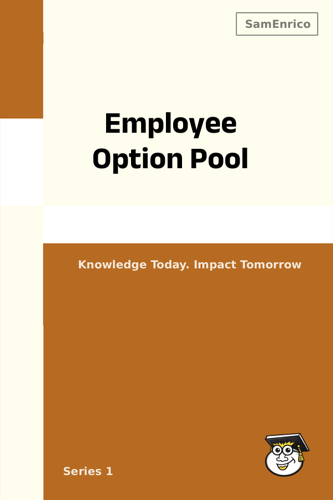
The Option Pool Guide eBook
ESOP size and refresh patterns in real VC deals.
ESOP size and refresh patterns in real VC deals.
Formats
Free sample
Chapter 1: The Equity Trap--The first time someone hands you a percentage of a company, it feels like a miracle. You have built nothing yet—maybe a slide deck, maybe a prototype, maybe just a promise—and suddenly a piece of paper says you own 10% of something that could be worth a fortune. That feeling is dangerous. Not because it is false hope, but because it blinds you to the question you should be asking: 10% of what exactly?I have sat across from more than two hundred founders over the past decade. Some were first-time entrepreneurs, trembling as they signed their first term sheet.
Others were serial founders, cocky and caffeinated, convinced they had seen every trick in the book. Almost all of them made the same mistake. They negotiated the valuation. They fought over the board seat. They high-fived over the liquidation preference.
And then they signed a document that quietly, legally, and permanently transferred millions of dollars of future wealth from their pockets to their investors' pockets—all because they did not understand the seven words buried on page fourteen.Those seven words are: "The option pool shall be created prior to the investment."By the time you finish this chapter, you will understand exactly why those words matter more than the valuation itself. You will also understand why the very acronym ESOP has been weaponized to confuse you, why your lawyer probably will not explain this to you, and why most founders learn this lesson only after they have already lost the money.But first, we need to talk about what an option pool actually is—because the name itself is a lie.The Two Meanings of ESOP (And Why One Will Cost You)In the public markets, ESOP stands for Employee Stock Ownership Plan. It is a retirement trust. Employees contribute a portion of their salary, the company matches it, and the money buys company stock. It is boring.
It is regulated. It has nothing to do with startups.In the venture capital world, the same four letters refer to something completely different: the option pool. This is a bucket of shares reserved for future employee grants. It sits on the cap table like a dark star—invisible until you look closely, but its gravitational pull determines the fate of everyone else's ownership.Here is what your term sheet actually says, translated from legalese into English: *"Before we invest, we want you to create a pool of shares equal to 10-15% of the company. Those shares will be set aside for employees you have not hired yet.
They will not be owned by anyone. They will just exist. And we, the investors, will calculate our ownership percentage after those shares have been created."*That last part is the trap. Most founders read the term sheet and see a valuation: $10 million pre-money, $2 million investment, post-money valuation of $12 million. They think they own 60% (if there are two founders), the investor owns 16.7%, and the option pool is just a line item.
But if the pool is created before the investment—the "pre-money" pool—the math changes entirely.Let me show you the math that no one will show you.The Seven Words That Cost Founders $14 Million Imagine you are raising a Seed round. You have two co-founders. You have a product, some traction, and a VC who loves you. The term sheet arrives:Pre-money valuation: $10 million Investment: $2 million Post-money valuation: $12 million Option pool: 15%, created pre-money You do the simple math in your head. You and your co-founder own 50% each of the pre-money company.
After the investment, you will own roughly 41.7% each ($5 million divided by $12 million). The investor owns 16.7%. The pool sits at 15%. Everyone is happy.You are wrong.Here is what actually happens when the pool is created pre-money:Step 1: The company is valued at $10 million pre-money. But that $10 million now must accommodate a 15% option pool.
That means the pool alone consumes $1.5 million of the pre-money valuation.Step 2: The founders' shares are squeezed into the remaining $8.5 million. You and your co-founder now own 42.5% each of the pre-money company, not 50%.Step 3: The investor puts in $2 million, buying 16.7% of the post-money company. But because the founders already gave up 15% to the pool, your ownership has been hit twice.Step 4: The final ownership: Founders combined, approximately 68%. Investor, 16.7%. Option pool, 15%.Wait—68% plus 16.7% plus 15% equals 99.7%, not 100%.
That is because the pre-money pool math is not linear. The actual numbers: each founder ends up with roughly 34% (68% total), the investor with 16.7%, and the pool with 15%. Compared to the "simple math" version where founders had 83.4% combined, each founder just lost 9.7% of the company.Now multiply that by a realistic exit. Say the company sells for $100 million. Your "simple math" version would have given you $41.7 million.
The "pre-money pool" version gives you $34 million. That is a $7.7 million difference for one founder. For two founders, nearly $15 million gone—because of seven words.I have watched this happen more times than I can count. One founder, whom I will call Sarah, built a machine learning company in Boston. She raised a $5 million Series A at a $20 million pre-money valuation.
The term sheet had a 12% pre-money pool. She thought she was giving up 12%. She was actually giving up nearly 20% of her effective ownership. When her company sold four years later for $180 million, Sarah's share was $4.2 million less than she had modeled. She asked me afterward: "Where did the money go?"It went to the pool.
The pool that she created before the investor calculated their ownership. The pool that she thought was free.Why "ESOP" Is a Perfectly Confusing Acronym The confusion is not accidental. The venture capital industry has a vocabulary problem, and nowhere is that more visible than with the word "ESOP."In India and many other markets, "ESOP" is the standard term for any employee option plan. In the US, it means two different things depending on context. In Europe, the term varies by country.
The result is that founders spend their first year of fundraising learning a language that seems designed to keep them in the dark.Here is the truth that no one tells you: an option pool is not a cost. It is a budget.Think about it this way. When you raise money, you do not create a "cash pool" that sits on the balance sheet labeled "future salaries." You simply raise cash and then spend it. The option pool is the same thing, except instead of cash, you are raising equity. You set aside a percentage of the company—say 10%—and then you "spend" that equity over the next 18-24 months by granting options to employees.Every time you grant an option, you are not losing ownership.
You are simply moving a piece of the pool from "unallocated" to "allocated." The pool itself remains exactly the same size. The only person who loses ownership is the pool itself—and the pool does not vote, does not get dividends, and does not care.This is the single most important mental shift you will make as a founder. Once you understand that the pool is a budget, not a cost, you stop fearing option grants. You start planning them. You stop fighting with investors over whether the pool…
This is the end of the free sample. Get the eBook to keep going. Buy now
About this book
Details
- Author
- Harring Fabian
- Publisher
- SamEnrico
- Language
- English
- Genre
- Non-Fiction, Capital & Valuation Register, ESOP
- Released
- 2026-06-05
- Pages (approx.)
- 138
- Available as
- eBook, Audiobook

Read better in the ZLOADR app
Your eBooks on your phone or tablet. Sign in with your SamEnrico account and start reading.
More by Harring Fabian
 Wine At 5 Sardinian Habit GuideHarring Fabian$11.99
 Celebrity Charity Scams GuideHarring Fabian$11.99
 Neurodivergent Relationship StressHarring Fabian$11.99
 Depression and Food AddictionHarring Fabian$11.99
 Quetzalcoatl’s Celestial Serpent: The Feathered God’s DescentHarring Fabian$11.99
 Understanding Welander Distal Myopathy, Swedish TypeHarring Fabian$17.99
 Ultimate Handbook Guide to Bhopal : (India) Travel GuideHarring Fabian$11.99
 Ghana Bank Account GuideHarring Fabian$12.99
 ARIPO Assignment RulesHarring Fabian$12.99
 Subscription Box Business LaunchHarring Fabian$11.99