
Non-FictionBusiness BriefStrategy
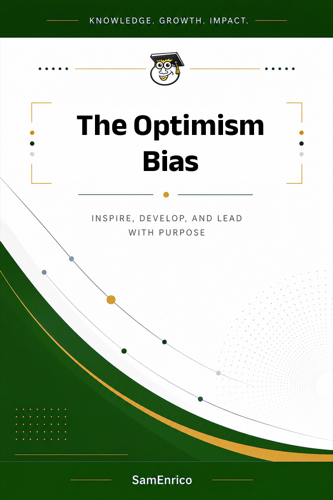
The Optimism Bias Audiobook
Balance positive outlook with realistic risk asses
Balance positive outlook with realistic risk assessment in planning.
Formats
Free sample
Chapter 1: The Rose-Tinted Cortex--Every morning, when you wake up, your brain has already decided how to feel about the day ahead before you have even opened your eyes. This is not a metaphor or a self-help cliché. It is a measurable neurological fact. The human brain does not neutrally observe the future like a camera recording reality. Instead, it actively constructs a version of tomorrow that is systematically, predictably, and often dramatically more positive than any rational assessment would justify.This is the optimism bias, and it lives in your neuroanatomy.For decades, psychologists assumed that optimism was a personality trait—some people had it, others did not, and you could supposedly learn it by repeating affirmations or visualizing success.
That view is now obsolete. Functional magnetic resonance imaging (f MRI) and other neuroscientific tools have revealed that the optimism bias is not a choice, not a moral failing, and not merely a cultural construct. It is a fundamental feature of how the human brain processes information about the future. Your brain is literally wired to hope.The Anatomy of Hope Deep inside your skull, tucked between the frontal lobes and the limbic system, lies a small but extraordinarily important region called the rostral anterior cingulate cortex, or r ACC for short. This strip of neural tissue, about the size of a grape, serves as a bridge between emotion and cognition.
When you think about your future, the r ACC becomes active. When you imagine a positive outcome—a promotion, a successful project, a happy relationship—the r ACC lights up like a Christmas tree. When you imagine a negative outcome, its activity drops.This asymmetry is the biological bedrock of the optimism bias.Consider a landmark study conducted by Tali Sharot and her colleagues at University College London. Participants were placed inside f MRI scanners and asked to imagine various future events—some positive (winning an award, going on a fantastic vacation), some negative (ending a relationship, being diagnosed with an illness). As they imagined each scenario, the researchers measured their brain activity.
The results were striking: when participants imagined positive events, the r ACC and the amygdala (the brain's emotional alarm system) showed strong, coordinated activation. When they imagined negative events, these regions were comparatively quiet.But the most telling finding came from a second phase of the study. After the scanning session, participants were given statistical information about…
This is the end of the free sample. Get the Audiobook to keep going. Buy now
About this book
Details
- Author
- Mobley Williemae
- Publisher
- SamEnrico
- Language
- English
- Genre
- Non-Fiction, Business Brief, Strategy
- Released
- 2026-06-06
- Pages (approx.)
- 146
- Available as
- eBook, Audiobook

Listen in the VoxFlicks app
Audiobooks and audio dramas wherever you go. Sign in with your SamEnrico account and press play.
More by Mobley Williemae
 Social Media Emotion GuideMobley Williemae$11.99
 Financial Stress for SeniorsMobley Williemae$11.99
 The Last Samurai Generals: Japan's Forgotten Warriors of the Great WarMobley Williemae$11.99
 How to Start a Non-ferrous Metal Ore Quarrying Business (Beginners Guide)Mobley Williemae$11.99
 Financial Close Checklist AIMobley Williemae$12.99
 How to Produce Atv and Utv Bar PadsMobley Williemae$11.99
 Collecting Musical Works Like Cd's or AlbumsMobley Williemae$11.99
You may also like
 Hong Kong Handover 1997Dunn Johnnie$11.99
 Zumba For Postnatal Recovery CourseNeal Christian$11.99
 Zumba for BeginnersLadner Nikia$11.99
 YouTube Comment Mining GuideHumes Pandora$12.99
 Worry Box MeditationCarlin Rudy$11.99
 Workplace Stress MeditationNguyen Lynn$11.99
 Workplace Stress and Sleep RepairHawley Ivory$11.99
 Workplace Perfectionism CureDelaney Jeffry$11.99
 Workplace Injustice Anger GuideWallen Isabelle$11.99
 Work Addiction and Burnout LinkGreenwood Ester$11.99
 Women in Yoga and WellnessBeattie Galina$11.99
 Women in Stand Up ComedyChun Evangeline$11.99