
Non-FictionHealth & WellnessOpioid Side Effects
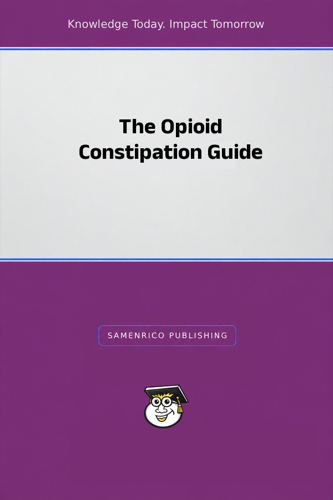
The Opioid Constipation Guide eBook
Laxatives, stool softeners, and peripherally actin
Laxatives, stool softeners, and peripherally acting blockers.
Formats
Free sample
Chapter 1: The Paralysis Within--–- The first time Margaret realized her opioids had stopped working—not for pain, but for something far more basic—she was sitting on a toilet in a highway rest stop, two hundred miles from home, crying. She had taken her morning dose of oxycodone at 6 AM, as prescribed for her degenerative disc disease. By 2 PM, she felt the familiar pressure in her rectum. But when she sat down, nothing happened. She pushed.
She strained. She sweated. Forty-five minutes later, she emerged with nothing but a hemorrhoid and a sense of humiliation she could not name. Her husband asked if she was okay. She said yes.
She lied.Margaret’s story is not unusual. It is, in fact, the most common side effect of opioid therapy—more common than nausea, more common than drowsiness, more common than the fear of addiction that dominates public discourse. Opioid-induced constipation, or OIC, affects between 40 and 90 percent of all patients taking prescription opioids for chronic pain, cancer-related pain, or post-surgical recovery. That range exists because different opioids, different doses, and different patient populations produce different rates. But the direction is always the same: opioids slow the gut.
And for a substantial fraction of patients, they slow it to a near standstill.This chapter is about why that happens. Not the superficial explanation you might have heard from a hurried primary care doctor—“opioids cause constipation, drink more water, take some fiber”—but the real, cellular, neurological mechanism that turns a functioning digestive tract into a paralyzed tube. Understanding this mechanism is the first step toward fixing it. Because if you do not understand what is broken, you cannot choose the right tool to repair it.The Enteric Nervous System: Your Second Brain To understand OIC, you must first understand that your gut has its own brain. It is called the enteric nervous system (ENS), and it contains approximately 500 million neurons—roughly the same number as the spinal cord.
This network of nerves lines the entire gastrointestinal tract, from esophagus to anus, and operates largely independently of your central brain. You do not consciously tell your stomach to churn or your colon to contract. The ENS handles those tasks automatically, using a complex orchestra of neurotransmitters, hormones, and mechanical sensors.The most important neurotransmitter for gut movement is acetylcholine. When the ENS releases acetylcholine, it triggers smooth muscle contraction—a wave of squeezing and relaxing that we call peristalsis. Peristalsis moves food, liquid, and stool through the digestive tract at a carefully calibrated speed.
In a healthy person, total gut transit time—from mouth to toilet—is about 24 to 48 hours. That timeline allows for proper nutrient absorption in the small intestine and proper water reabsorption in the colon.The ENS also regulates several other critical functions. It controls the release of digestive enzymes. It senses the chemical composition of gut contents. It communicates bidirectionally with the central brain via the vagus nerve (which is why anxiety can cause diarrhea and why a big meal can make you sleepy).
And it maintains something called the anal sphincter tone—the resting tension of the muscles that keep the anus closed until you decide to open it.All of these functions are vulnerable to opioids.The μ-Opioid Receptor: The Lock That Slows Everything Opioids work by binding to specific receptors on nerve cells. There are three main types of opioid receptors—mu (μ), delta (δ), and kappa (κ)—but the mu receptor is the most important for both pain relief and constipation. When an opioid molecule (morphine, oxycodone, hydrocodone, fentanyl, methadone, or any other) binds to a mu receptor, it triggers a cascade of intracellular events that ultimately reduce the release of neurotransmitters. In the brain, that reduction produces analgesia by dampening pain signals. In the gut, that same reduction produces constipation by dampening the signals that tell the gut to move.Here is the precise sequence: when an opioid binds to a mu receptor on an enteric nerve cell, it inhibits the enzyme adenylate cyclase.
This reduces the production of cyclic AMP, which in turn reduces the opening of calcium channels. With less calcium entering the nerve cell, less acetylcholine is released into the synapse. Less acetylcholine means less smooth muscle contraction. Peristalsis slows. Stool spends more time in the colon.
And the colon, being a water-absorbing organ, continues to do its job: it pulls water out of the stool, making it progressively harder, drier, and more difficult to pass.But the slowing does not stop there. Opioids also increase resting anal sphincter tone. That means the door at the end of the digestive tract is clamped tighter than normal, requiring more effort to open. Patients describe this as a sensation of incomplete evacuation—the feeling that there is more stool waiting just inside, even after a successful bowel movement. In many cases, there is more stool.
The combination of slowed transit and increased sphincter tone creates a functional obstruction: the gut is trying to push, but the exit is too tight, and the stool is too dry.The Tolerance Myth: Why Constipation Is Different One of the most dangerous misconceptions about OIC is the belief that the body will “get used to” the constipation over time, just as it gets used to the sedation and nausea that often accompany initial opioid therapy. This is false. And understanding why it is false requires a brief lesson in pharmacology tolerance.Tolerance occurs when a drug’s effect diminishes with repeated use, requiring higher doses to achieve the same response. For most opioid side effects—nausea, sedation, respiratory depression—tolerance develops relatively quickly, over days to weeks. The body upregulates counter-regulatory mechanisms.
The brain adapts. A patient who felt nauseated on day one of morphine may feel fine on day thirty, even at the same dose.But the enteric nervous system does not adapt in the same way. Why? Because mu receptors in the gut are not subject to the same degree of downregulation or desensitization as mu receptors in the central nervous system. The exact molecular reasons are still being studied, but the clinical observation is unambiguous: constipation does not improve with continued opioid use.
In fact, it often worsens, as stool becomes more impacted and the colon becomes more distended.Consider the data. A 2016 systematic review in the journal Pain followed 1,200 patients on stable opioid therapy for chronic non-cancer pain. At baseline, 42 percent met criteria for OIC. At 12 months, despite no increase in opioid dose, 47 percent met criteria. The difference was not statistically significant—meaning constipation did not improve.
Other studies have shown that patients on opioids for five years or longer have the same constipation rates as patients on opioids for five weeks.This has profound implications for treatment. If you are waiting for your body to “adjust” to opioids, you will be waiting forever. The constipation will not resolve on its own. It requires active, ongoing management. And the management strategies that work for routine constipation—more water, more fiber, occasional laxatives—are often insufficient for OIC because they do not address the root cause.The Rome IV Criteria: How Doctors Define OICIn clinical practice, OIC is not just “constipation while taking opioids.” It has a specific definition…
This is the end of the free sample. Get the eBook to keep going. Buy now
About this book
Details
- Author
- Olvera Yolande
- Publisher
- SamEnrico
- Language
- English
- Genre
- Non-Fiction, Health & Wellness, Opioid Side Effects
- Released
- 2026-06-09
- Pages (approx.)
- 142
- Available as
- eBook, Audiobook

Read better in the ZLOADR app
Your eBooks on your phone or tablet. Sign in with your SamEnrico account and start reading.
More by Olvera Yolande
 Customer Service First Contact ResolutionOlvera Yolande$11.99
 Mindfulness 101 WorkbookOlvera Yolande$11.99
 Loneliness After Moving CitiesOlvera Yolande$11.99
 Francis San Francesco ImageOlvera Yolande$11.99
 The Silent Plague: The Forgotten Epidemic That Shaped CivilizationOlvera Yolande$11.99
 Analcite MiningOlvera Yolande$11.99
 Waitlist Building StrategiesOlvera Yolande$12.99
 Digital Marketing MOOC GuideOlvera Yolande$12.99
 Learn to Play the Timpani (Kettledrum)Olvera Yolande$11.99
 How to Start a Pharmaceutical Goods Importer (wholesale) Business (Beginners Guide)Olvera Yolande$11.99
You may also like
 Hong Kong Handover 1997Dunn Johnnie$11.99
 Zumba For Postnatal Recovery CourseNeal Christian$11.99
 Zumba for BeginnersLadner Nikia$11.99
 YouTube Comment Mining GuideHumes Pandora$12.99
 Worry Box MeditationCarlin Rudy$11.99
 Workplace Stress MeditationNguyen Lynn$11.99
 Workplace Stress and Sleep RepairHawley Ivory$11.99
 Workplace Perfectionism CureDelaney Jeffry$11.99
 Workplace Injustice Anger GuideWallen Isabelle$11.99
 Work Addiction and Burnout LinkGreenwood Ester$11.99
 Women in Yoga and WellnessBeattie Galina$11.99
 Women in Stand Up ComedyChun Evangeline$11.99