
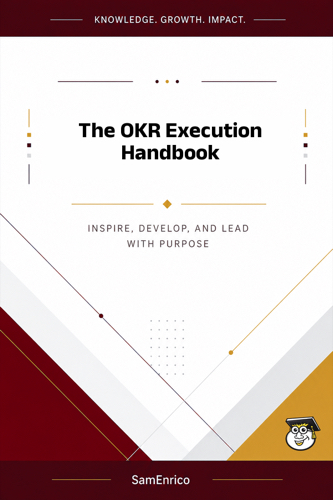
The OKR Execution Handbook eBook
Track progress, score results, and cascade objecti
Track progress, score results, and cascade objectives through your organization.
Formats
Free sample
Chapter 1: The Execution Gap--–- On a Tuesday morning in March, the leadership team of a $200 million software company gathered in a glass-walled conference room. They had spent the previous quarter crafting what they believed were perfect OKRs. The objectives were ambitious but achievable. The key results were specific and measurable. Every employee had received a beautifully formatted PDF.
The CEO had given a rousing kickoff speech. Pizza was served. High-fives were exchanged.Six weeks later, no one had opened the document.Not once.The CEO assumed the VP of Product was tracking progress. The VP assumed the managers were running weekly check-ins. The managers assumed the individual contributors were updating their statuses.
The individual contributors assumed someone else would notice if things went off track. By week ten, when the quarter was nearly over, someone finally looked at the OKR document. The results were catastrophic. Three of the five key results had made zero progress. Two had actually gone backward.
The CEO called an emergency meeting and asked a simple question that no one could answer: "What happened?"The answer, as this chapter will reveal, was not a failure of planning. It was not a failure of strategy. It was not even a failure of effort. It was a failure of execution – the silent killer of good intentions and the single greatest predictor of whether your OKRs will live or die.The Great Misunderstanding Most leaders believe that success with OKRs begins and ends with writing them well. They pour hours into crafting the perfect objective, debating the ideal key result, and arguing over whether a metric should be 87% or 92%.
They treat the quarterly kickoff as the finish line – a moment to celebrate before returning to "real work."This is a catastrophic error.John Doerr, who introduced OKRs to Google in 1999 and chronicled the methodology in his bestseller Measure What Matters, has observed this pattern across thousands of organizations. "The写好 OKR is table stakes," he has said in numerous interviews. "The real game is the weekly discipline of tracking, updating, and course-correcting." Yet study after study confirms that the vast majority of OKR failures happen not in the drafting phase, but in the silent weeks between the quarterly kickoff and the final review.Consider the data. A 2022 survey of 500 organizations using OKRs found that 73% reported significant execution problems. Among those, the most common issues were:No regular tracking (42%): Teams set OKRs and then forgot about them until the quarter ended.Stale data (38%): OKR documents were updated sporadically, often weeks out of date.No accountability (35%): No one was explicitly responsible for monitoring progress or escalating problems.Meeting bloat (29%): Teams held long, unfocused check-ins that everyone dreaded.The pattern is unmistakable: organizations are suffering not from a planning problem, but from an execution problem.
They know what to do. They just cannot seem to do it consistently, week after week, until the goal is achieved.Introducing the Execution Gap This chapter introduces a concept that will serve as the foundation for the entire book: the Execution Gap.The Execution Gap is the chasm between a plan and its realization. It is the space where good intentions go to die. It is the distance between "we committed to this goal" and "we actually achieved this goal." And for most organizations, that distance is vast.Here is what the Execution Gap looks like in practice:Week 1 (The Kickoff): Energy is high. The team is excited.
The OKRs feel challenging but possible. Everyone leaves the meeting motivated.Week 2: The first weekly check-in happens. A few people have not updated their statuses. The meeting runs long. Some key results are already yellow.
The team agrees to "circle back next week."Week 3: The check-in is canceled because of a scheduling conflict. The OKR document sits untouched.Week 4: Half the team forgets to update their statuses before the check-in. The Champion spends 20 minutes just getting everyone up to speed. The meeting runs 45 minutes. People start checking their phones.Week 5: A key result turns red.
No one escalates it because "we will figure it out."Week 6: The OKR document has not been opened in two weeks. The Zombie OKR has risen.Week 7-10: Silence. The team focuses on "real work." The OKRs are somewhere in the back of everyone's mind, but no one looks at them.Week 11: Someone finally looks at the OKR document. Panic ensues. Four of the six key results are off track.
The team scrambles to salvage what they can.Week 12 (The Review): The quarter ends. The team scores a 0.4. The CEO is disappointed. Everyone shrugs and says, "We will do better next quarter."Then the cycle repeats.This is the Execution Gap in action. And it is the reason 70% of OKR initiatives fail within the first two quarters.The Anatomy of the Execution Gap The Execution Gap has three distinct components.
Understanding each one is essential to closing it.Component 1: The Visibility Gap You cannot execute what you cannot see. Yet most teams store their OKRs in places that are invisible to daily work – a shared drive, a project management tool that no one checks, a spreadsheet that lives on the CEO's laptop. When OKRs are not front and center, they are easily forgotten.The Visibility Gap manifests in several ways:OKRs are not displayed prominently in team spaces (physical or digital).OKRs are not integrated into daily workflows or tools.There is no single source of truth for current status.Team members cannot recite their top three key results without looking them up.In the software company example that opened this chapter, the OKR document lived on a shared drive. No one had it bookmarked. No one saw it unless they went looking for it.
Unsurprisingly, no one looked.Component 2: The Accountability Gap When everyone is responsible, no one is responsible. This is the tragedy of the commons applied to goal execution. The Accountability Gap appears when:Key Results have multiple owners (or no owner at all).No one is explicitly tasked with monitoring progress.There is no clear escalation path for blockers.Team members assume someone else will notice if things go wrong.In the software company, every key result was owned by "the team." When the team failed to make progress, each member assumed someone else would pick up the slack. No one did.Component 3: The Discipline Gap Execution requires discipline. Not the discipline of heroic effort or late nights, but the discipline of small, consistent actions repeated week after week.
The Discipline Gap appears when:Weekly check-ins are irregular or canceled.Updates are inconsistent or incomplete.There is no standard format for status reporting.Blockers are discussed but never resolved.The software company's weekly check-ins were scheduled for 60 minutes, but they often ran long or were canceled. There was no standard agenda. People came unprepared. The meetings became dreaded obligations rather than valuable rituals.Why Most Teams Fail to Close the Gap If the Execution Gap is so well understood, why do most teams fail to close it? The answer lies in three psychological and structural barriers.Barrier 1: The Myth of "Set It and Forget It"Humans are terrible at maintaining focus over long periods.
This is not a character flaw; it is a feature of how our brains work. The Zeigarnik effect – our…
This is the end of the free sample. Get the eBook to keep going. Buy now
About this book
Details
- Author
- Carney Filomena
- Publisher
- SamEnrico
- Language
- English
- Genre
- Non-Fiction, Self-Help, Management
- Released
- 2026-06-12
- Pages (approx.)
- 139
- Available as
- eBook, Audiobook

Read better in the ZLOADR app
Your eBooks on your phone or tablet. Sign in with your SamEnrico account and start reading.
More by Carney Filomena
 Creative Warm Up ActivitiesCarney Filomena$11.99
 Gambling Disorder SignsCarney Filomena$11.99
 Embracing Failure For GrowthCarney Filomena$11.99
 Breath Release TechniqueCarney Filomena$11.99
 Foreclosure Stress SurvivalCarney Filomena$11.99
 Delegation for Healthcare LeadersCarney Filomena$11.99
 Flow for Artists GuideCarney Filomena$11.99
 The Celestial Architects of Meroë: How Kushite Astronomers Mastered the SkyCarney Filomena$11.99
 The Great Irish Auction: When Europe’s Banks Betrayed a NationCarney Filomena$11.99
 Redtop: BentgrassCarney Filomena$11.99
 How to Produce Electronic Musical InstrumentsCarney Filomena$11.99
 Digital Sabbath Implementation GuideCarney Filomena$12.99
You may also like
 Manager Confidence GuideRains Millie$11.99Manager Confidence GuideRains Millie$11.99
 Time Blocking For Managers GuideClement Enedina$11.99
 Manager Employee Empathy GuideHerrick Ashley$11.99
 Group Creative Playbook For Managers ManualLowell Drew$11.99
 Call Center Manager Stress GuideMcafee Jamison$11.99
 Layoff Conversations GuideWhaley Cherly$11.99
 Difficult Conversations with EmployeesTeal Hermine$11.99
 Weekly Review for ManagersBrunner Hunter$11.99
 SMART Goals for ManagersRicks Sidney$11.99
 Relationship Building for ManagersCreamer Corrie$11.99
 NVC For Managers GuideBrink Sharmaine$11.99