
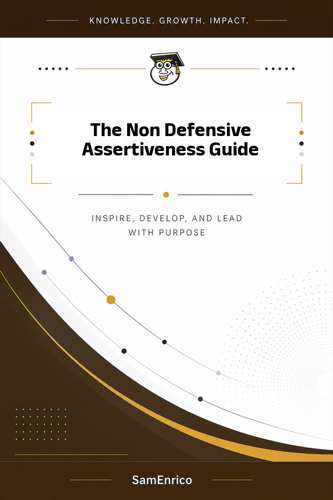
The Non Defensive Assertiveness Guide eBook
Responds to criticism without explaining, justifyi
Responds to criticism without explaining, justifying, or apologizing excessively.
Formats
Free sample
Chapter 1: The Explanation Trap--You are standing in the kitchen. Your partner, your parent, or your boss has just said something mild. Something like, “You’re late again,” or “You forgot to call,” or “Why didn’t you do it my way?”And before you can stop yourself, you are explaining.The traffic was terrible. Your phone died. Your child was sick.
Your printer broke. You meant to. You were just about to. You feel terrible. You know you should have.
Here’s the timeline. Here are the receipts. Here is your alibi, presented with the desperate hope that if you just offer enough evidence, the other person will nod, soften, and say, “Oh, I see. You’re not a bad person. You had a good reason.”That nod never comes.Instead, the more you explain, the more the critic leans in.
They ask follow-up questions. They poke holes in your timeline. They say, “But why didn’t you leave earlier?” And now you are trapped in a conversation you never wanted, defending choices you should never have had to justify, feeling like a defendant in a trial where you are both the accused and the lawyer.This is the Explanation Trap.And it is the single most common reason that kind, competent, thoughtful people lose respect, lose energy, and lose control of their own lives.The Urge That Feels Like Safety Let us be clear about what we are not saying. We are not saying that you should never clarify a misunderstanding. We are not saying that information is the enemy.
If your boss asks, “Did you send that email?” and you say, “No, I was waiting for the final approval from legal,” that is not the problem. That is a simple exchange of data.The problem is something else entirely.The problem is the involuntary, panicked, often lengthy explanation that you offer when no one asked for one. It is the difference between answering a question and preemptively building a legal defense. It is the moment when you shift from providing information to begging for permission.Here is how you know you have fallen into the Explanation Trap: you feel relief when you finish speaking. Not because the conversation went well, but because you survived.
You said your piece. You laid out your evidence. You did not get convicted. And yet, somehow, you still feel smaller than you did before the conversation started.That feeling is your first clue.Every time you over-explain, you are broadcasting a hidden message. That message is not about the traffic or the printer or the childcare.
That message is: “I need you to approve of me. I cannot tolerate your disappointment. Please validate my existence by agreeing that my reasons are good enough.”And the person listening? They may not be able to name what just happened. But they felt it.
And they now hold slightly more power over you than they did sixty seconds ago.The JADE Reflex Psychologists and assertiveness trainers have a useful acronym for what happens in these moments. It is called JADE. It stands for four behaviors that defensive people engage in when they feel criticized: Justifying, Arguing, Defending, and Explaining.These four behaviors feel different from the inside. Justifying feels like providing evidence. Arguing feels like standing up for yourself.
Defending feels like protecting your reputation. Explaining feels like being helpful and transparent. But from the outside, they all look the same. They all look like insecurity.Here is the hard truth that this entire book will ask you to accept: JADE is never a winning strategy.Not once. Not in any relationship.
Not in any workplace. Not on any social media platform. When you justify, you imply that your actions require permission. When you argue, you signal that you are uncertain enough to need a debate. When you defend, you remind everyone that you feel accused.
And when you explain unprompted, you announce that you believe the critic has the right to judge your reasons.Let us test this.Think of the most confident person you know. Not the loudest. Not the most aggressive. The person who walks into a room and seems quietly certain of who they are. Now imagine someone criticizes them.
Imagine someone says, “You handled that poorly.” What does that confident person do?They do not pull out a Power Point presentation about their thought process. They do not list the seventeen reasons they made the choice they made. They do not argue. They might say, “I see it differently,” or “Noted,” or simply nothing at all. They do not JADE.And here is the insulting part: we admire that person.
We wish we were that person. But when criticism comes for us, we JADE immediately. Not because we are weak. Because we have been trained to believe that explaining is polite, that justifying is responsible, and that defending is standing up for ourselves. That training is wrong.The Compliance Cycle There is a predictable pattern that unfolds every time you JADE.
This book calls it the Compliance Cycle, and it has four stages.Stage one: You receive a criticism. It might be direct (“You messed up”) or indirect (a sigh, a raised eyebrow, a pointed silence). Your nervous system detects a threat. You feel the urge to restore safety by proving your goodness.Stage two: You explain. You offer reasons, context, or an apology that includes a “but.” You believe you are clarifying.
The critic hears something else entirely. They hear that you are willing to hand over power in exchange for approval.Stage three: The critic leans in. They ask another question. They offer a counter-argument. They say, “That’s not a good enough reason.” They are not being cruel.
They are simply responding to the invitation you just extended. You invited them to judge your reasons, and now they are judging.Stage four: You explain more. You offer more details. You escalate your JADE. The critic feels increasingly entitled to scrutinize you.
The conversation grows longer, more exhausting, and more humiliating. By the end, you have revealed far too much about your insecurities, your schedule, and your desperate need for approval. And the original criticism? It was never the point. The point became the dance.The Compliance Cycle is insidious because each stage feels like progress.
You think, “If I just explain a little more clearly, they will finally understand.” But clarity was never the problem. The problem is that you entered the courtroom at all.A Story of Two Responses Consider two versions of the same moment.Maria is a project manager. Her boss, David, stops by her desk and says, “I noticed the client report went out an hour late.”Version one is the Explanation Trap. Maria says, “Oh my god, I know, I am so sorry. My internet went down right when I was about to hit send, and then IT took forever to respond, and then I had to re-enter all the data, and I know I should have started earlier, but I had back-to-back meetings all morning, and I feel terrible, and I promise it won’t happen again.”What happens next?
David says, “Well, why didn’t you just use your phone hotspot?” Or he says, “Maybe you should plan ahead next…
This is the end of the free sample. Get the eBook to keep going. Buy now
About this book
Details
- Author
- Rudolph Nereida
- Publisher
- SamEnrico
- Language
- English
- Genre
- Non-Fiction, Self-Help, Emotional Regulation
- Released
- 2026-06-06
- Pages (approx.)
- 123
- Available as
- eBook, Audiobook

Read better in the ZLOADR app
Your eBooks on your phone or tablet. Sign in with your SamEnrico account and start reading.
More by Rudolph Nereida
 Three Step Walking MeditationRudolph Nereida$11.99
 Self Talk For College StudentsRudolph Nereida$11.99
 Cooperative Profit DistributionRudolph Nereida$11.99
 Walking Meditation for Yoga TeachersRudolph Nereida$11.99
 The Ripper Copycats: London’s Shadow of Jack the RipperRudolph Nereida$11.99
 Understanding OnychogryphosisRudolph Nereida$17.99
 Hospital ChaplainRudolph Nereida$11.99
 A Beginners Guide to Futsal (Volume 1)Rudolph Nereida$11.99
 Twitch Remote Internship GuideRudolph Nereida$12.99
 Shrinkflation and Package DownsizingRudolph Nereida$12.99
You may also like
 The Stress Reactivity WorkbookHutchens Cicely$11.99
 Imposter Syndrome Calming GuideCartwright Darell$11.99
 Emotional Sobriety Training ManualRiggs Lahoma$11.99
 The RAIN Technique HandbookOkeefe Pei$11.99
 The Interruption Resilience PrimerRicketts Louie$11.99
 Partner Criticism Overreaction GuidePaxton Ashanti$11.99
 Emotional Eating Recovery HandbookMullis Tory$11.99
 The Jealousy Management WorkbookMeeker Marya$11.99
 Self Hypnosis For Jealousy Relief GuideParis Cheyenne$11.99
 Self Esteem And Emotional DependencyHargrove Elvis$11.99
 Parent Emotional Regulation GuidePrewitt Sammie$11.99
 Natural Disaster Recurring DreamsCoker Arline$11.99