
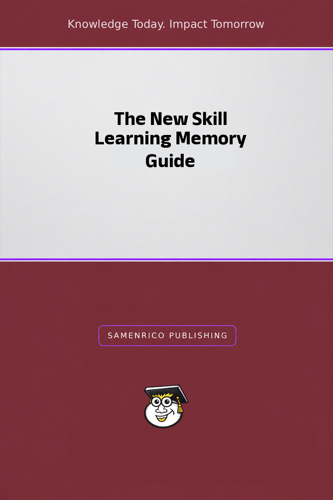
The New Skill Learning Memory Guide eBook
Learning instruments or languages builds cognitive
Learning instruments or languages builds cognitive reserve.
Formats
Free sample
Chapter 1: The Cognitive Bank...--The first time I saw a brain scan that looked like a topographical map of a younger person's neural territory, I assumed the patient was in their thirties. She was seventy-two. Her name was Margaret, a retired schoolteacher who had done two things differently from her identical twin sister: she had taken up the violin at sixty, and she had started learning Japanese at sixty-five. Her twin, who spent her retirement doing crossword puzzles and watching game shows, showed the typical white matter degradation expected at her age—thinning, fragmentation, and a hippocampus that had shrunk by nearly fifteen percent.Margaret's brain looked five to eight years younger by every measurable metric.This is not an anomaly. It is not luck, superior genetics, or the result of expensive supplements.
It is the visible, physical manifestation of something neuroscientists call cognitive reserve—and it is the single most important concept in brain health that almost no one has heard of.Let me say this plainly: the vast majority of what you have been told about brain aging is wrong. You have been told that memory decline is inevitable, that learning slows down after twenty-five, that picking up a new language or instrument in adulthood is an uphill battle not worth fighting. These are comforting myths for a society that has convinced itself that cognitive decline is a matter of fate, not choice. They are also, one by one, being demolished by a growing body of research that points to a radically different conclusion: the brain you have at eighty is largely the brain you built, starting today.This book exists because of that research. And it exists because of a question that nagged at me for years: if we know that certain activities build cognitive reserve more effectively than others, why is no one teaching people how to do them?The answer, I discovered, is that most books on learning focus on speed or productivity—how to memorize faster, how to learn more in less time, how to pass tests.
These are worthy goals. But they miss the deeper purpose. The reason you should learn a new language or instrument is not to impress people at parties or pass a certification exam. It is to build a biological firewall between your brain and the ravages of time. It is to ensure that when your friends in their seventies start forgetting names and losing their keys, you are still traveling, still playing, still thinking clearly.This chapter introduces the foundational concept that drives everything else in this book: cognitive reserve.
By the time you finish reading, you will understand why a violinist's brain looks younger than a bridge player's, why bilingualism delays Alzheimer's by four to six years, and why the distinction between "cognitive junk food" and genuine neural exercise may be the most important health decision you ever make.The Two Seventies Let me tell you about two women. I will call them Eleanor and Irene, though those are not their real names. They were participants in the Nun Study, one of the most important longitudinal investigations of aging and cognition ever conducted. Starting in 1986, researchers followed over six hundred Catholic sisters, all of whom lived similar lifestyles—same diet, same physical activity levels, same access to healthcare, no smoking, minimal alcohol. The only major variable was what they did with their minds.Eleanor taught elementary school for forty years.
In retirement, she took up crossword puzzles, watched television, and occasionally played bridge with friends. These activities were familiar, comfortable, and required no real struggle. By the time she reached her mid-seventies, she began showing signs of mild cognitive impairment. By eighty, she had difficulty remembering the names of her nieces and nephews. An autopsy after her death revealed significant neurofibrillary tangles and amyloid plaques—the pathological hallmarks of Alzheimer's disease.Irene also taught elementary school for forty years.
But in retirement, she did something different. She had always loved music but never had time to learn an instrument. At sixty-eight, she bought a violin and hired a teacher. She described the first six months as "excruciating"—the sounds she produced were awful, her fingers fumbled, and she frequently wanted to quit. But she persisted.
She also decided, at seventy-one, to learn Italian, the language of her grandparents, which she had never spoken fluently. She struggled with pronunciation, forgot vocabulary constantly, and felt embarrassed when she tried to speak with native speakers.Irene lived to ninety-three. At eighty-five, she was still playing the violin—badly, by professional standards, but competently enough to enjoy it. She could hold a simple conversation in Italian. She remembered the names of all her great-nieces and great-nephews.
She traveled to Rome at eighty-nine. Her autopsy revealed something remarkable: she had the same amount of amyloid plaques and neurofibrillary tangles as Eleanor. Neuropathologically, she had Alzheimer's disease. But cognitively, she had never shown a single symptom.This is the power of cognitive reserve. Irene's brain had Alzheimer's pathology but not Alzheimer's symptoms because her brain had built alternative neural pathways—detours around the damaged areas.
Eleanor's brain, lacking those detours, had no way to route around the damage. The pathology was identical. The outcome was dramatically different.What Is Cognitive Reserve, Exactly?Cognitive reserve is the brain's ability to improvise and find alternate ways of completing a task when its usual pathways are damaged or blocked. Think of it as a detour system. If your usual route to work is closed due to construction, you can still get there if you know the side streets.
If you only know one route, you are stuck.In the brain, every time you learn something new—especially something that requires combinatorial complexity, which we will discuss shortly—you are building alternative neural circuits. You are creating side streets. Later in life, when some of those circuits are damaged by age, disease, or injury, you still have other ways to access the same information or perform the same function.This is not a metaphor. It is a physical reality observable in brain scans. A 2018 study from the University of California, Irvine compared the brains of older adults who had engaged in lifelong learning of complex skills (musical instruments, foreign languages) against those who had engaged in passive or repetitive activities (crosswords, puzzles, watching educational television).
The lifelong learners had significantly greater white matter integrity, larger hippocampal volumes, and more robust connectivity between brain regions—even when controlling for education, income, and baseline cognitive ability.The most stunning finding came from a 2020 meta-analysis of fourteen longitudinal studies involving over 18,000 participants. Researchers found that lifelong bilingualism delayed the onset of Alzheimer's symptoms by an average of 4.6 years—significantly outperforming any pharmaceutical intervention ever approved for the disease. The best drug on the market, at enormous cost and with significant side effects, delays symptoms by approximately six months.Let that sink in. Learning a second language is nearly ten times more effective at delaying Alzheimer's symptoms than the most expensive, high-tech medication available. And it has no side effects except knowing another language.Why Music and Language?
The Combinatorial Complexity Advantage You might be wondering: why focus on music and language? Why not chess, or learning to…
This is the end of the free sample. Get the eBook to keep going. Buy now
About this book
Details
- Author
- Muhammad Nolan
- Publisher
- SamEnrico
- Language
- English
- Genre
- Non-Fiction, Self-Help, Lifelong Learning
- Released
- 2026-06-05
- Pages (approx.)
- 150
- Available as
- eBook, Audiobook

Read better in the ZLOADR app
Your eBooks on your phone or tablet. Sign in with your SamEnrico account and start reading.
More by Muhammad Nolan
 Remote Company Retreats For Creative TeamsMuhammad Nolan$11.99
 Amazon Review Comparison GuideMuhammad Nolan$11.99
 Burnout Prevention Work AutonomyMuhammad Nolan$11.99
 The Arthritis Surgery GuideMuhammad Nolan$11.99
 The Golden Quill of Timbuktu: The Scholars Who Lit the WorldMuhammad Nolan$11.99
 Understanding ShigellosisMuhammad Nolan$17.99
 Korean Scholarship Document PrepMuhammad Nolan$12.99
 Shea Climate Adaptation GuideMuhammad Nolan$12.99
 Security Guard LicensingMuhammad Nolan$11.99
 How to Become a Library AssistantMuhammad Nolan$11.99
You may also like
 Staying Relevant At Any AgeConn Charity$11.99
 Legacy Of Lifelong Learning HandbookLunsford Makeda$11.99
 Senior Learning New SkillsMclemore Johnsie$11.99
 Senior Late Life Learning ConfidenceMcnamara Sung$11.99
 Learning Habit FormationCarey Joline$11.99
 Learning Weekly ReviewMansfield Trula$11.99
 Cultivating A Learner IdentityDunlap Lenna$11.99
 Joyful Learning Gratitude GuideRichey Lynwood$11.99
 Learning Legacy GuideMcafee Ingrid$11.99
 Learning Daily Review GuideLemons Merrilee$11.99
 The Senior New Skill Confidence CourseJean Johanne$11.99
 Learning New Skills SeniorsDill Heriberto$11.99