
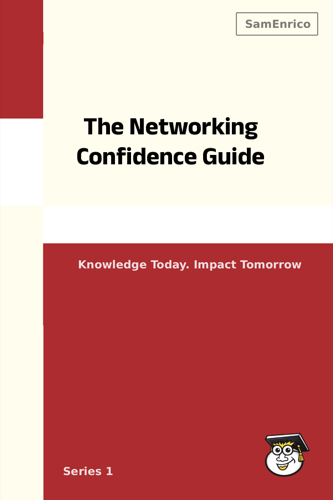
Non-FictionSelf-HelpNetworking
The Networking Confidence Guide eBook
Builds self esteem for industry events, cold outre
Builds self esteem for industry events, cold outreach, and LinkedIn.
Formats
Free sample
Chapter 1: The Silence That Stings--–- The email sat in your sent folder for forty-seven minutes now. You have checked it fourteen times. No reply. No "got it, thanks." No "out of office." Nothing. Your brain, which was calm forty-seven minutes ago, is now constructing a detailed horror film starring you as the rejected, forgettable, annoying fool who should have known better than to reach out.This is not about that email.
This is about what happens inside your head between sending a message and receiving a response. That gap—the silent, open space where nothing happens—is where self-esteem goes to die.Most people believe they fear rejection. They are wrong. What they actually fear is not a clear "no." A clear "no" is a gift. It provides data, closure, and permission to move on.
What people truly fear is the ambiguity of being ignored. Ghosted. Left on read. Avoided at a mixer. That silent gap triggers a self-esteem crash unlike anything a simple "no" could ever produce, because your brain, desperate for an explanation, fills the void with the worst possible stories.
"They hate me." "I'm boring." "My message was worthless." "Everyone can see I don't belong here."This chapter introduces the Rejection Paradox: a clear "no" is less damaging to your self-worth than a vague silence. And it gives you the first tool in your confidence architecture—cognitive reframing—to dismantle the stories your brain tells itself while waiting for a reply that may never come.The Weight of an Empty Inbox Let us be precise about what happens psychologically when you are ignored. Researchers studying social rejection have found that the brain processes ambiguous social silence in the same neural regions that process physical pain. The anterior cingulate cortex—the part of your brain that lights up when you stub your toe or burn your hand—also activates when you send a message and receive nothing back. Your body does not know the difference between a sprained ankle and a ghosted email.
It registers threat either way.But here is the crucial distinction: physical pain has a clear cause. You stubbed your toe on the coffee table. You know what happened. Ambiguous silence has no clear cause. The person on the other end could be busy, distracted, traveling, overwhelmed, ill, or simply forgetful.
Or they could be actively ignoring you because they find you worthless. Your brain, unable to tolerate the uncertainty, defaults to the worst possible explanation. This is called negative attribution bias, and it evolved to keep you safe from tribal expulsion thousands of years ago. Today, it keeps you from sending a follow-up email.Consider two scenarios. In the first, you send a cold message to a senior executive, and they reply within an hour: "Not interested, but best of luck." That stings for about ninety seconds.
Then you move on. You have data. You close the loop. In the second scenario, you send the same message, and you never hear anything. Days pass.
Weeks. You check your sent folder. You wonder if you wrote something offensive. You re-read the message fourteen times, finding new flaws each time. You decide never to reach out to anyone again.
The clear "no" caused less damage than the silence.This is the Rejection Paradox. Understanding it changes everything.Why "No" Is a Gift Let me tell you about a writer named Sarah. Sarah was a mid-level marketing manager who wanted to move into product management. She identified ten people at her target company and sent each a thoughtful, personalized message asking for a fifteen-minute informational interview. Five never replied.
Three said "not right now." One said "I'm too busy." One scheduled a call and then canceled.For two weeks, Sarah obsessed over the five who never replied. She re-read her messages. She wondered if her grammar was wrong. She checked if she had misspelled their names. She lost sleep.
The three who said "no" directly? She barely thought about them. "At least they responded," she told herself. "At least they respected me enough to say no."Sarah's experience is universal. In a study of over two thousand professionals who regularly send cold outreach, researchers found that respondents rated a direct "no" as 73 percent less emotionally damaging than being ghosted.
A direct "no" provides closure, respect, and efficiency. Being ghosted provides nothing except an open loop that your brain spins on endlessly.The paradox extends beyond email. Consider the industry mixer where you approach someone, introduce yourself, and they say "Nice to meet you" before turning away to talk to someone else. That is a clear "no"—it stings, but you know where you stand. Compare that to the person who makes eye contact, smiles, says "let me just grab a drink," and never returns.
The ghosting in the physical room is worse than the polite rejection because you are left waiting. Should you stay? Should you follow them to the bar? Should you pretend it never happened? The ambiguity is the poison.A clear "no" is a gift because it returns your time and attention to you.
Silence steals both and gives nothing back.Introducing Cognitive Reframing: Your First Tool The Rejection Paradox is not just an interesting observation. It is the foundation of a skill called cognitive reframing—the conscious act of choosing a different interpretation of the same event. Cognitive reframing is the most important psychological tool in this entire book. You will use it in Chapter 2 to dismantle imposter syndrome at industry events. You will use it in Chapter 11 to recover from moments when you freeze or say the wrong thing.
And you will use it right now to change how you experience silence.Here is how cognitive reframing works in practice. When you are ghosted, your brain automatically offers one interpretation: "They are ignoring me because I am not valuable." That interpretation triggers shame, withdrawal, and self-criticism. Cognitive reframing asks you to pause and generate at least three alternative interpretations that are equally plausible. For example:"They received my message during a chaotic day and intended to reply but forgot.""Their inbox currently has five thousand unread messages, and mine got buried.""They are traveling, overwhelmed, or dealing with a personal issue that has nothing to do with me."Notice that none of these interpretations requires you to know the truth. You do not need certainty.
You only need to recognize that your automatic negative interpretation is not the only possible explanation. Once you have three alternatives, the grip of the negative story loosens. You are no longer trapped in a single narrative. You have options.A client named James, a software engineer who struggled to get responses from recruiters, tried this exercise for one week. Every time he sent a message and received silence, he wrote down three neutral explanations before allowing himself to feel rejected.
By day five, he noticed that his anxiety had dropped by more than half. "I realized I was treating every silence as a verdict on my soul," he told me. "Once I gave myself permission to imagine other explanations, I stopped panicking. And ironically, people started replying more. I think I was less desperate."James was…
This is the end of the free sample. Get the eBook to keep going. Buy now
About this book
Details
- Author
- Minton Mafalda
- Publisher
- SamEnrico
- Language
- English
- Genre
- Non-Fiction, Self-Help, Networking
- Released
- 2026-06-09
- Pages (approx.)
- 137
- Available as
- eBook, Audiobook

Read better in the ZLOADR app
Your eBooks on your phone or tablet. Sign in with your SamEnrico account and start reading.
More by Minton Mafalda
 Mindful Stress Reduction for TherapistsMinton Mafalda$11.99
 Wholesaling Skip Tracing GuideMinton Mafalda$11.99
 Road Rage Triggers IdentificationMinton Mafalda$11.99
 Creative Block AssessmentMinton Mafalda$11.99
 The Birthday YellMinton Mafalda$11.99The Birthday YellMinton Mafalda$11.99
 Baseball Arm Care ProgramMinton Mafalda$11.99
 High Sensitivity Child WorthMinton Mafalda$11.99
 Redgrave Dynasty - Lynn RedgraveMinton Mafalda$11.99
 The Long White Cloud: New Zealand's Pioneers of Discovery and InnovationMinton Mafalda$11.99
 The Last Broadcast: When Radio Saved the WorldMinton Mafalda$11.99
 The Timbuktu Renaissance: When Africa's Scholars Lit the World's TorchMinton Mafalda$11.99
You may also like
 Hong Kong Handover 1997Dunn Johnnie$11.99
 Zumba For Postnatal Recovery CourseNeal Christian$11.99
 Zumba for BeginnersLadner Nikia$11.99
 YouTube Comment Mining GuideHumes Pandora$12.99
 Worry Box MeditationCarlin Rudy$11.99
 Workplace Stress MeditationNguyen Lynn$11.99
 Workplace Stress and Sleep RepairHawley Ivory$11.99
 Workplace Perfectionism CureDelaney Jeffry$11.99
 Workplace Injustice Anger GuideWallen Isabelle$11.99
 Work Addiction and Burnout LinkGreenwood Ester$11.99
 Women in Yoga and WellnessBeattie Galina$11.99
 Women in Stand Up ComedyChun Evangeline$11.99