
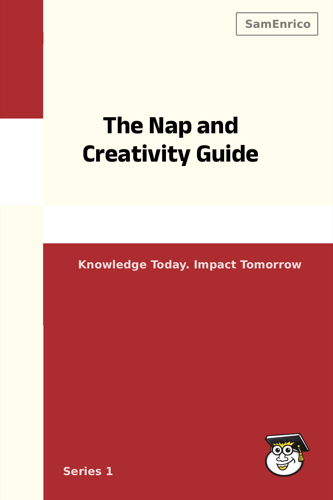
Non-FictionHealth & WellnessNeuroscience
The Nap and Creativity Guide eBook
How naps boost problem solving and insight.
How naps boost problem solving and insight.
Formats
Free sample
Chapter 1: The 4PM Graveyard--–- The cursor blinks. You have been staring at it for forty-seven seconds. The screen is the same screen you have been staring at for the past three hours. The problem is the same problem. The sentence you just deleted for the fifth time is the same sentence.
The code that will not compile is the same code. The spreadsheet cell that refuses to balance is the same cell. And yet, you cannot look away. Because somewhere, buried in the deep architecture of modern work culture, you have been taught that looking away is failure. That leaving your desk is quitting.
That closing your laptop means you do not care enough.This is the 4 PM Graveyard. It is not a physical place. It is a cognitive state. And if you are reading this book, you have lived there more times than you can count.The 4 PM Graveyard is that specific hour of the late afternoon when your brain has exhausted its executive function, your willpower is running on fumes, your third coffee has stopped working, and yet you remain glued to your chair because the meeting is at 4:30 and then there is the follow-up and then you just need to push through. So you push.
You stare harder. You type slower. You delete. You retype. You refresh your email for the thirtieth time.
You open a new tab and close it immediately because you forgot why you opened it. You are, by every reasonable measure, no longer working. You are performing the ritual of working. And the cruelest part is that you believe this ritual will eventually produce a breakthrough.It will not.The Paradox of Effort Let us name the enemy. It is not laziness.
It is not distraction. It is not your phone or your notifications or your open-plan office. The enemy is something far more insidious: the belief that more effort always produces better results.This belief is so deeply embedded in modern work culture that questioning it feels like heresy. We have been raised on a diet of bootstrap narratives and hustle culture manifestos. We have internalized the idea that success is a linear function of hours logged and sweat equity earned.
We have built entire industries around the premise that if you are not grinding, you are not trying. And yet, the data tells a very different story.In 2025, a landmark study from Stanford's Department of Cognitive Neuroscience tracked the problem-solving performance of 1,200 knowledge workers across six industries. The participants were given a series of complex analytical puzzles and told to solve them. Half were told to work continuously until they either solved the puzzle or hit a four-hour time limit. The other half were instructed to take a twenty-minute break whenever they felt cognitively stuck.
The results were not close. The break-takers solved the puzzles 43 percent faster and made 62 percent fewer errors. But here is the finding that should stop you cold: among the continuous workers, the ones who spent the most time staring at the puzzle before making progress were the ones who performed the worst overall. In other words, effort alone did not help. Effort without strategic disengagement actively harmed performance.This is the Paradox of Effort.
It states that for complex, non-routine problems, the relationship between time spent and creative output is not linear but inverted U-shaped. Early effort is productive. Moderate effort is very productive. But beyond a certain threshold, additional effort becomes not just useless but counterproductive. You do not stay flat.
You actively get worse.The Cognitive Fixation Trap Why does this happen? The answer lies in a phenomenon called cognitive fixation.Your brain, for all its wonder, is a pattern-matching machine. It evolved to recognize threats, predict outcomes, and automate routine decisions. When you encounter a problem, your brain immediately searches its memory for similar problems you have solved before. If it finds a match, it retrieves the solution and applies it.
This is efficient. This is how you manage to drive a car without consciously thinking about every turn of the steering wheel. This is how you type without looking at the keyboard.But this same efficiency becomes a liability when the problem is genuinely novel. Your brain retrieves the nearest solution it knows, even if that solution is wrong. And then, because your brain prefers efficiency over accuracy, it locks onto that wrong solution.
It refuses to let go. The more time you spend staring at the problem, the more deeply entrenched that wrong solution becomes. You are not getting closer to the answer. You are digging a hole and calling it progress.Consider the programmer in our opening scene. She is debugging a recursive function that keeps overflowing the stack.
She has tried moving the base case. She has tried inverting the conditional. She has tried rewriting the loop as a while statement. Nothing works. But here is the problem: every failed attempt is a piece of data that her brain is using to reinforce the existing incorrect mental model.
She is not generating new possibilities. She is generating new evidence for why her wrong approach is actually right if only she tweaks one more variable. She has entered the Fixation Trap—a cognitive dead-end where increased effort only tightens the grip of the wrong solution.The 2025 workplace burnout studies from the University of Melbourne quantified this effect with alarming precision. Researchers gave participants a classic insight problem: the nine-dot puzzle, where you must connect all nine dots using four straight lines without lifting your pen. Participants who were given unlimited time and told to "keep trying" took an average of eighteen minutes to solve it, and 31 percent never solved it at all.
Participants who were forced to take a five-minute break every ten minutes solved it in an average of seven minutes, and only 6 percent failed. The break-forced group did not work harder. They worked smarter—because they interrupted the fixation cycle before it could lock in.Effort Traps: A Typology Not all effort traps look the same. Over three years of clinical observation and self-experimentation, I have identified four distinct patterns of cognitive fixation. Recognizing which trap you are in is the first step to escaping it.The Treadmill Trap.
This is the most common trap in knowledge work. You are making progress, but it is the wrong kind of progress. You are answering emails, organizing files, reformatting slides, moving tasks from one column to another in your project management software. You feel productive. Your brain releases little bursts of dopamine with every completed micro-task.
But the core problem remains untouched. The Treadmill Trap is dangerous because it feels like work. You can spend an entire day on the treadmill and go to bed feeling exhausted and accomplished, having solved absolutely nothing of importance. The fix is simple but brutal: ask yourself at the start of every hour, "Am I working on the problem or around it?"The Spiral Trap. This trap occurs when you have a partial solution that is almost right but not quite.
Your brain, desperate for closure, begins making increasingly small and desperate adjustments to force the partial solution to work. You change a…
This is the end of the free sample. Get the eBook to keep going. Buy now
About this book
Details
- Author
- Weyand Crystal
- Publisher
- SamEnrico
- Language
- English
- Genre
- Non-Fiction, Health & Wellness, Neuroscience
- Released
- 2026-06-05
- Pages (approx.)
- 142
- Available as
- eBook, Audiobook

Read better in the ZLOADR app
Your eBooks on your phone or tablet. Sign in with your SamEnrico account and start reading.
More by Weyand Crystal
 Anger At Partner SpouseWeyand Crystal$11.99
 The Weather Report ClueWeyand Crystal$11.99
 Homework Hassle Reduction PlanWeyand Crystal$11.99
 Hungarian Business GuideWeyand Crystal$11.99
 The Siege of La Modelo: Colombia's Deadliest Prison UprisingWeyand Crystal$11.99
 Legal AdministratorWeyand Crystal$11.99
 Bubble Email NotificationsWeyand Crystal$12.99
 Creative Role Promotion CaseWeyand Crystal$12.99
 Ultimate Handbook Guide to Boston : (United States) Travel GuideWeyand Crystal$11.99
 Understanding Vascular Malformations of The BrainWeyand Crystal$17.99
You may also like
 Hong Kong Handover 1997Dunn Johnnie$11.99
 Zumba For Postnatal Recovery CourseNeal Christian$11.99
 Zumba for BeginnersLadner Nikia$11.99
 YouTube Comment Mining GuideHumes Pandora$12.99
 Worry Box MeditationCarlin Rudy$11.99
 Workplace Stress MeditationNguyen Lynn$11.99
 Workplace Stress and Sleep RepairHawley Ivory$11.99
 Workplace Perfectionism CureDelaney Jeffry$11.99
 Workplace Injustice Anger GuideWallen Isabelle$11.99
 Work Addiction and Burnout LinkGreenwood Ester$11.99
 Women in Yoga and WellnessBeattie Galina$11.99
 Women in Stand Up ComedyChun Evangeline$11.99