
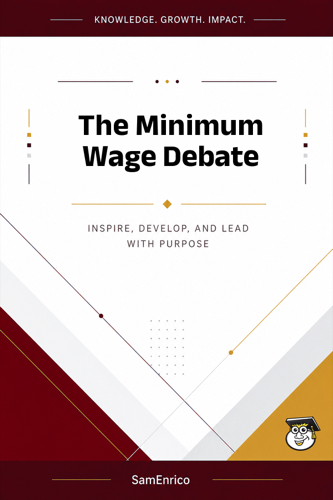
Non-FictionBusiness BriefLabor Economics
The Minimum Wage Debate eBook
Analyze employment effects, poverty impacts, and m
Analyze employment effects, poverty impacts, and market outcomes of wage floors.
Formats
Free sample
Chapter 1: The $7.25 Question--–- In 1968, a worker earning the federal minimum wage of $1.60 per hour could lift a family of three out of poverty while working forty hours a week. Fifty-six years later, that same worker earning $7.25 per hour falls nearly $5,000 short of the federal poverty line for that same family. The minimum wage has lost 40 percent of its purchasing power since Richard Nixon was in the White House, and yet the debate over raising it has never been more furious, more polarized, or more detached from the evidence.This is the puzzle at the heart of American economic policy. A tool designed to ensure that work provides a path out of poverty has become a battlefield in the culture wars. On one side, activists with bullhorns chant “Fight for $15” outside fast-food restaurants.
On the other side, economists warn darkly about teenagers priced out of their first jobs and automation swallowing the remaining entry-level positions. Both sides cite studies. Both sides claim science on their side. Both sides cannot be right.The truth, as this book will demonstrate across twelve chapters, is that the minimum wage is neither a magic wand for ending poverty nor a job-killing monster. It is a policy tool that produces radically different outcomes depending on where it is applied, how high it is set, and what other policies surround it.
The $7.25 question is not “should we raise the minimum wage?” The question is “for whom, where, and by how much?”The Human Face of the Floor Before diving into economic models and regression analyses, consider Latisha. She is thirty-four years old, a single mother of two children aged seven and nine, living in Cleveland, Ohio. She works forty hours per week at a national fast-food chain, arriving at 6:00 AM to open the restaurant and leaving at 2:00 PM just in time to meet her youngest at the school bus. Her wage: $7.25 per hour. Her weekly take-home pay after taxes: approximately $260.
Her monthly rent for a two-bedroom apartment in a safe neighborhood: $950. She qualifies for food stamps, Medicaid, and the Earned Income Tax Credit. She does not want to be on any of these programs. She wants her wage to cover her bills.Now consider Jason. He is sixteen years old, lives in an affluent suburb of Seattle, and works fifteen hours per week at a local coffee shop while his parents earn a combined household income of $180,000 per year.
His wage after Seattle’s $15 minimum wage ordinance: $15 per hour. He uses the money to buy sneakers, video games, and gas for the car his parents gave him. He is a nice kid. He does not need a raise.The minimum wage debate is not a debate about abstract principles. It is a debate about whether Latisha and Jason should receive the same policy intervention, and whether the benefits to Latisha outweigh the costs that economists warn about.
To answer that question, we must first understand who actually earns the minimum wage, how the policy has changed over time, and why the moral case for a higher floor is both powerful and incomplete.Who Earns the Minimum Wage? A Statistical Portrait The Bureau of Labor Statistics publishes an annual report on minimum wage workers, and the findings often surprise both supporters and opponents of wage hikes. In 2023, approximately 1.1 million American workers earned exactly the federal minimum wage or less (the latter group consisting primarily of tipped workers whose base wage falls below $7.25). Another 1.5 million earned just above the minimum—typically within a dollar. Together, these 2.6 million workers represent about 1.9 percent of all hourly paid workers in the United States.This number is smaller than most people believe.
Polling consistently shows that Americans estimate the proportion of minimum wage workers at around 10 to 15 percent of the workforce. The actual figure is closer to 2 percent. However, this statistic can be misleading. A much larger number of workers earn wages that are affected by the minimum wage through what economists call “spillover effects.” When the floor rises, employers often raise wages slightly above the floor to maintain internal pay hierarchies. A $7.25 minimum wage increase to $10 might push wages for workers currently earning $10.50 up to $11 or $12.
The ripple effects extend to perhaps 15 to 20 percent of the workforce.Who are these 2.6 million workers at the very bottom? They are disproportionately young. More than half—52 percent—are under the age of twenty-five. Workers under twenty make up roughly 30 percent of minimum wage earners despite being only 8 percent of the total workforce. They are disproportionately female: 56 percent of minimum wage workers are women, compared to 47 percent of the overall workforce.
They are disproportionately employed in service occupations: food preparation and serving (35 percent), sales and related occupations (17 percent), and personal care (9 percent). They are disproportionately part-time: 64 percent of minimum wage workers work fewer than thirty-five hours per week.Perhaps the most politically significant statistic, however, concerns household income. Contrary to the image of the single mother struggling to feed her children, a substantial share of minimum wage earners live in households that are not poor. According to an analysis by the Congressional Budget Office, approximately 40 percent of minimum wage workers live in households with incomes above twice the federal poverty line. Many are teenagers living with parents, secondary earners in middle-class households, or young adults living with roommates.
This does not mean that Latisha does not exist—she absolutely does. But it means that a $15 minimum wage would give Latisha a desperately needed raise and give Jason a raise he does not need.This distributional reality is the first complication that ideologues on both sides prefer to ignore. For progressive advocates, acknowledging that many minimum wage workers are not poor complicates the moral narrative. For conservative opponents, acknowledging that some minimum wage workers are desperately poor complicates the economic narrative. The evidence requires us to hold both truths simultaneously: the minimum wage is a poorly targeted anti-poverty tool, but it is the only tool that directly raises wages for the working poor without requiring a government check.The Eroding Floor: How $7.25 Became Worthless To understand why the minimum wage debate has become so heated, we must understand how the federal minimum wage has eroded over time.
The Fair Labor Standards Act of 1938 established the first federal minimum wage at $0.25 per hour—equivalent to about $5.00 in today’s dollars. For the next three decades, Congress raised the minimum wage regularly, often keeping pace with or exceeding inflation. By 1968, the minimum wage had reached its historical peak in real terms: $1.60 per hour, or approximately $12.00 in 2023 dollars.Then the erosion began. The 1970s brought high inflation and only sporadic increases. The 1980s saw the minimum wage frozen at $3.35 for an entire decade while prices rose.
The 1990s brought modest increases to $4.25 and then $5.15. The 2000s saw another long freeze from 1997 to 2007. The most recent federal increase came in 2009, when the minimum wage rose from $6.55 to $7.25. It has not moved since.The result is catastrophic for low-wage workers. Adjusting for inflation, the federal minimum wage is now worth 40 percent less than it was in 1968.
If the minimum wage had simply kept pace with productivity growth over the past five decades—meaning that workers received raises commensurate with their increasing output—it…
This is the end of the free sample. Get the eBook to keep going. Buy now
About this book
Details
- Author
- Norfleet Bette
- Publisher
- SamEnrico
- Language
- English
- Genre
- Non-Fiction, Business Brief, Labor Economics
- Released
- 2026-06-08
- Pages (approx.)
- 141
- Available as
- eBook, Audiobook

Read better in the ZLOADR app
Your eBooks on your phone or tablet. Sign in with your SamEnrico account and start reading.
More by Norfleet Bette
 Research Proposal Revision ChecklistNorfleet Bette$11.99
 Formula One Pit Crew StressNorfleet Bette$11.99
 Diversity in SectorsNorfleet Bette$11.99
 Clown Fear CoulrophobiaNorfleet Bette$11.99
 Cannabis and Psychosis GuideNorfleet Bette$11.99
 Focus and Concentration HypnosisNorfleet Bette$11.99
 Emotional Neglect RecoveryNorfleet Bette$11.99
 The Vanishing Billionaire: The Untold Story of the Panama PapersNorfleet Bette$11.99
 The Silk Road Swindle: Marco Polo’s Phantom FortuneNorfleet Bette$11.99
 Cyber Risk and ComplianceNorfleet Bette$11.99
 UK Business Credit Fast Track GuideNorfleet Bette$12.99
 Growing Dierama (African Harebell, Angel's Fishing Rod, Wand Flower)Norfleet Bette$11.99
You may also like
 Hong Kong Handover 1997Dunn Johnnie$11.99
 Zumba For Postnatal Recovery CourseNeal Christian$11.99
 Zumba for BeginnersLadner Nikia$11.99
 YouTube Comment Mining GuideHumes Pandora$12.99
 Worry Box MeditationCarlin Rudy$11.99
 Workplace Stress MeditationNguyen Lynn$11.99
 Workplace Stress and Sleep RepairHawley Ivory$11.99
 Workplace Perfectionism CureDelaney Jeffry$11.99
 Workplace Injustice Anger GuideWallen Isabelle$11.99
 Work Addiction and Burnout LinkGreenwood Ester$11.99
 Women in Yoga and WellnessBeattie Galina$11.99
 Women in Stand Up ComedyChun Evangeline$11.99