
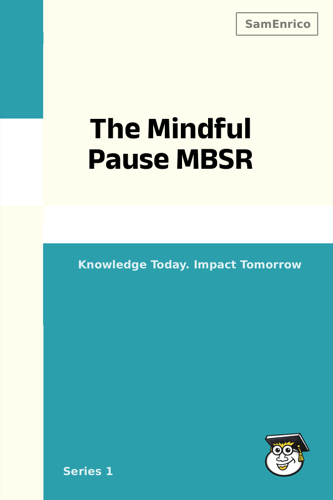
Non-FictionSelf-HelpMicro Practices
The Mindful Pause MBSR eBook
Teaches brief micro-practices for high-stress mome
Teaches brief micro-practices for high-stress moments.
Formats
Free sample
Chapter 1: The 3-Second Theft...--You have already lost something valuable today. Not your keys, not your phone, not the password you swear you just reset. You have lost something far more precious: the gap between what happened and how you responded to it. And you did not even notice it was gone.Consider the last time someone said something that stung. A critical comment from a colleague.
A dismissive tone from a partner. A passive-aggressive email that landed in your inbox at 4:47 PM on a Friday. What happened in the space between the words entering your ears and the words leaving your mouth? For most people, the honest answer is nothing. No space.
No gap. No pause. Just stimulus, then response, welded together so tightly that they feel like a single event. The comment happened, and then you happened back. It felt inevitable.
It felt like gravity.But here is the truth that changes everything, the truth that the entire field of Mindfulness-Based Stress Reduction rests upon: that feeling of inevitability is an illusion. A very convincing illusion, yes. A neurologically expensive illusion, absolutely. But an illusion nonetheless.Between the moment a stress trigger arrives and the moment you react, there is a window. It is not a large window.
It is not a comfortable window. It is approximately three seconds long, sometimes less, sometimes a breath more. But it exists. And in that window lives every choice you will ever make about who you want to be under pressure. The tragedy is not that the window is small.
The tragedy is that most people do not even know it is there.This book is about finding that window, prying it open, and learning to live inside it.The Autopilot That Runs Your Life Let us name the enemy, because a nameless enemy cannot be fought. Call it Autopilot. Autopilot is not a demon or a character flaw. It is a neurological survival mechanism, a feature not a bug, and it has kept your ancestors alive for millions of years. Here is how it works.Your brain processes approximately eleven million bits of sensory information per second.
Your conscious mind can handle roughly fifty of those bits. The rest is handled by neural circuits that run beneath awareness, processing, predicting, and preparing responses before you have any conscious say in the matter. This is efficient. This is necessary. Without Autopilot, you could not walk, drive, or brush your teeth without intense concentration.But Autopilot has a dark side.
The same neural efficiency that allows you to drive home without remembering the trip also allows you to react to your boss's tone before you have registered what she actually said. The same predictive processing that helps you catch a falling glass also helps you launch a defensive remark at your partner before you have fully heard their concern. Autopilot does not care about your relationships, your career, or your self-respect. Autopilot cares about survival, and survival, in the ancient wiring of your brain, means reacting fast.The problem is that the modern world is not the savanna. The threat is not a predator in the tall grass.
The threat is an email, a tone of voice, a traffic jam, a passive-aggressive text, a performance review, a child's tantrum, a spouse's sigh. These are not life-threatening events, but your nervous system does not know the difference. It processes social threats using the same ancient hardware it uses for physical threats. Cortisol does not care why it is being released. Adrenaline does not ask whether the danger is real or imagined.
The chemistry of stress is blind to context.And so you react. Not because you are weak. Not because you lack willpower. Not because you have not tried hard enough to be calm. You react because your Autopilot is doing exactly what evolution designed it to do.
The tragedy is that evolution has not caught up with the twenty-first century.The 3-Second Window No One Told You About Here is where the science of MBSR offers a radical intervention. Researchers studying the timing of emotional responses have identified a critical gap in the stress cascade. When a stimulus arrives, there is a brief period—approximately three seconds—during which the prefrontal cortex (the thinking, choosing part of your brain) can still influence the amygdala (the alarm system of your brain). After those three seconds, the stress response is fully launched, and the prefrontal cortex loses influence. You are no longer choosing your response.
You are riding a wave that has already left the shore.This is not philosophy. This is milliseconds on an f MRI scan.Dr. Jill Bolte Taylor, the neuroanatomist who famously studied her own stroke, describes it this way: from the moment the amygdala sounds the alarm, a chemical cascade floods the body. That cascade takes approximately ninety seconds to clear from the bloodstream—provided you stop adding new fuel. But the critical decision point, the moment when you can still choose rather than react, is not the ninety-second mark.
It is the three-second mark. The ninety seconds is for chemistry to dissipate. The three seconds is for you to decide whether to add more fuel.Most people live their entire lives in the space after the three seconds. They experience the trigger and the reaction as a single, seamless event. "She made me angry." "He pushed my buttons." "I couldn't help it." These are not accurate descriptions of reality.
They are post-hoc explanations for what happened after the window closed.The cost of this Autopilot living is not abstract. It shows up in ruined relationships, because you say things you do not mean. It shows up in chronic health problems, because your body is flooded with cortisol dozens of times per day. It shows up in decision fatigue, because every reactive choice creates a new problem that requires another reactive solution. It shows up in insomnia, because your nervous system never fully learns that the threat has passed.
It shows up in the quiet, accumulating weight of shame: the sense that you are not the person you want to be, that you keep falling short, that your reactions own you rather than the other way around.This chapter is not here to shame you for your reactivity. Shame is just another stress trigger, and you have enough of those already. This chapter is here to show you the window, because once you see it, you cannot unsee it. And once you cannot unsee it, you have a choice that you did not have before.The Sound That Changes Everything Before we go any further, you need a practice. Not a long one.
Not a complicated one. A micro-practice. The entire philosophy of this book is that you do not need thirty minutes of meditation to change your stress baseline. You need thirty moments of mindfulness scattered through your day, each one lasting seconds, not minutes. This is the first of those moments.Choose a sound that already exists in your environment.
Not a new sound you will add—a sound that is already there, one you hear several times a day. A phone notification. A car horn outside your…
This is the end of the free sample. Get the eBook to keep going. Buy now
About this book
Details
- Author
- Sipes Stefania
- Publisher
- SamEnrico
- Language
- English
- Genre
- Non-Fiction, Self-Help, Micro Practices
- Released
- 2026-06-09
- Pages (approx.)
- 137
- Available as
- eBook, Audiobook

Read better in the ZLOADR app
Your eBooks on your phone or tablet. Sign in with your SamEnrico account and start reading.
More by Sipes Stefania
 Lactose Free Calcium Sources GuideSipes Stefania$11.99
 Five Minute Breath PracticeSipes Stefania$11.99
 Elderly Power Training WorkoutSipes Stefania$11.99
 Postpartum Hemorrhoid Relief GuideSipes Stefania$11.99
 TM and ConsciousnessSipes Stefania$11.99
 War Correspondent StressSipes Stefania$11.99
 Bipolar Therapy GuideSipes Stefania$11.99
 Rheumatoid Arthritis Flare TriggersSipes Stefania$11.99
 The Mamluk Blitz: Egypt’s Slave Warriors Conquer the Holy LandSipes Stefania$11.99
 The Last Gold Rush: How a Single Bank Collapse Triggered a Global PanicSipes Stefania$11.99
 How to Become a Aquatic PerformerSipes Stefania$11.99
 Innovation Leadership in PracticeSipes Stefania$11.99
You may also like
 Hong Kong Handover 1997Dunn Johnnie$11.99
 Zumba For Postnatal Recovery CourseNeal Christian$11.99
 Zumba for BeginnersLadner Nikia$11.99
 YouTube Comment Mining GuideHumes Pandora$12.99
 Worry Box MeditationCarlin Rudy$11.99
 Workplace Stress MeditationNguyen Lynn$11.99
 Workplace Stress and Sleep RepairHawley Ivory$11.99
 Workplace Perfectionism CureDelaney Jeffry$11.99
 Workplace Injustice Anger GuideWallen Isabelle$11.99
 Work Addiction and Burnout LinkGreenwood Ester$11.99
 Women in Yoga and WellnessBeattie Galina$11.99
 Women in Stand Up ComedyChun Evangeline$11.99