
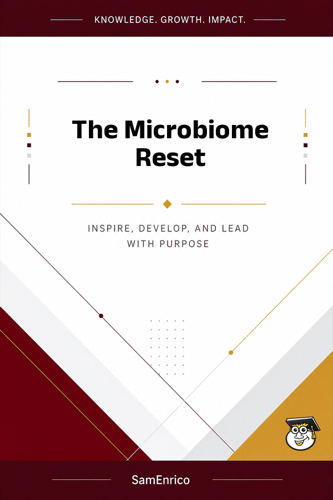
Non-FictionHealth & WellnessDigestive Health
The Microbiome Reset eBook
Rebalance your gut bacteria through targeted diet
by Simms Isaiah
Rebalance your gut bacteria through targeted diet and lifestyle changes.
Formats
Free sample
Chapter 1: You Are Outnumbered–- Let us begin with a number that will unsettle you: thirty-eight trillion. That is the approximate number of bacterial cells living in your body right now. Not on your body—though there are plenty there too—but inside your digestive tract, woven into your intestinal lining, clinging to the mucus that protects your gut wall. If you gathered every human cell from your skin, organs, bones, and blood, you would have roughly thirty trillion of them. This means you are, by cell count, only about forty-four percent human.
The majority of what you call "you" is not you at all. It is them.This is not a metaphor. It is not spiritual philosophy dressed in scientific clothing. It is a literal, measurable, biological fact. You are a superorganism—a walking, talking, breathing ecosystem—and the creatures that outnumber you ten to one are bacteria.
They have been with you since the moment of your birth, when you passed through your mother’s birth canal and received your first inoculation of microbes. They have evolved alongside you for hundreds of thousands of years, co-writing your genetic destiny. And they are, right now, making decisions that you believe you are making for yourself.Do you crave sugar at three in the afternoon? That is not necessarily a failure of willpower. It may be your gut bacteria sending signals up your vagus nerve to your brain, requesting their favorite meal.
Do you feel inexplicably anxious before a work presentation? That may not be a psychological flaw. It may be the absence of specific bacterial strains that produce the neurotransmitters that calm your nervous system. Do you struggle to lose weight despite eating the same number of calories as your friend who stays effortlessly thin? That may not be metabolic injustice.
It may be that your microbes are extracting more energy from your food than hers are.The ninety-ten rule captures this颠倒 of priorities. Ninety percent of the cells in your body are bacterial, yet ninety percent of medical research, dietary guidelines, and public health spending focuses on the ten percent that are human. We have spent billions of dollars mapping the human genome, searching for the genes that cause cancer, Alzheimer’s, and heart disease. And those genes matter. But the microbiome—the collective genome of your trillions of bacterial passengers—contains over one hundred times more genes than your human DNA.
From a genetic perspective, you are only one percent human. The rest is microbial.This chapter will introduce you to the radical premise of The Microbiome Reset: most modern diseases—obesity, anxiety, depression, autoimmune conditions, chronic fatigue, brain fog, irritable bowel syndrome, and even some neurodegenerative disorders—are not primarily caused by defective human genes or random bad luck. They are caused by a broken relationship between you and your microbes. Your ancestors carried a diverse, resilient rainforest of bacteria. You carry a depleted, inflamed lawn of weeds.
And the gap between rainforest and weed patch explains more about your health than any other single factor.The good news is that this relationship can be repaired. The better news is that repair does not require expensive drugs, complicated surgeries, or genetic engineering. It requires food, timing, and targeted lifestyle changes—things you control starting today. But before we discuss solutions, you must understand how your microbial rainforest was destroyed. And that destruction came from two catastrophic punches, delivered in rapid succession over the past century.The First Punch: The Industrialization of Food Imagine a healthy human gut circa 1850.
Your great-great-great-grandmother, whether she lived in Italy, Ireland, China, or West Africa, ate a diet that was seasonal, regional, and minimally processed. She consumed large amounts of fiber—from tubers, whole grains, legumes, and wild greens—because fiber was what food came with. She ate fermented foods: sourdough bread, sauerkraut, kimchi, miso, yogurt, or kefir, depending on her culture. These ferments were not trendy health foods; they were preservation methods, the only way to keep vegetables and dairy edible through winter. She rarely ate refined sugar; it was expensive and scarce.
She never touched a seed oil; those required industrial extraction methods that did not yet exist. And she certainly never consumed an emulsifier, a preservative, or an artificial sweetener.Her gut microbiome looked nothing like yours. It was a rainforest: thousands of bacterial species, living in complex interdependence, with keystone species that performed essential functions. Akkermansia muciniphila thickened her gut lining. Faecalibacterium praenitzii produced massive quantities of butyrate, the short-chain fatty acid that fuels her colon cells.
Bifidobacterium longum synthesized B vitamins and trained her immune system to tolerate harmless antigens. Lactobacillus reuteri produced oxytocin, the bonding and calming hormone. The ecosystem was stable, resilient, and diverse.Then came the industrial revolution, and everything changed. Between 1900 and 1950, the Western diet transformed more radically than in the previous ten thousand years. Refined flour replaced whole grains, stripping away the fiber that bacteria needed to survive.
Sugar consumption increased by over six thousand percent per capita. Seed oils—soybean, canola, sunflower, corn—displaced animal fats and olive oil, introducing an overload of omega-6 fatty acids that drive inflammation. Emulsifiers like polysorbate 80 and carboxymethylcellulose were added to processed foods to improve texture; they also dismantle the mucous layer protecting your intestinal lining, allowing bacteria to get closer to your epithelial cells than they ever should.What did this do to the microbial rainforest? Let us look at the data. Researchers have compared the microbiomes of hunter-gatherer populations like the Hadza of Tanzania to those of Westerners living in Italy, the United States, and the United Kingdom.
The differences are not subtle. The Hadza gut contains bacterial species that simply do not exist in Western guts—species of Treponema that break down resistant starches from wild tubers, strains of Prevotella that thrive on baobab fruit and fibrous roots. Their microbial diversity is roughly double that of the average Italian. And crucially, they have no detectable levels of many pathobionts—disease-causing bacteria like Clostridium difficile and Klebsiella pneumoniae—that lie dormant in Western guts, waiting for an opportunity to bloom.When the researchers sequenced the Hadza microbiome and compared it to the Italian microbiome, the difference was not a gradient. It was a collapse.
The Italian gut resembled a lawn treated with herbicide: a few hardy grass species—mostly Bacteroides and Firmicutes in ratios that correlate with obesity and inflammation—where a rainforest once stood. Diversity, the single best predictor of gut health, had crashed by over forty percent.You did not choose this. You inherited a gut shaped by your mother’s diet, her exposure to antibiotics, and the standard American diet served in school cafeterias. But the first punch set the stage for the second, far more devastating blow.The Second Punch: The Antibiotic Bomb Alexander Fleming discovered penicillin in 1928, and by the 1950s, antibiotics were being celebrated as miracle drugs. And they were—for acute bacterial infections.
A course of penicillin in 1945 could pull a soldier back from the brink of septic death. But somewhere between the battlefield and the pediatrician’s office, antibiotics became something else: a crutch, a precaution, a routine. We began using them for viral…
This is the end of the free sample. Get the eBook to keep going. Buy now
About this book
Details
- Author
- Simms Isaiah
- Publisher
- SamEnrico
- Language
- English
- Genre
- Non-Fiction, Health & Wellness, Digestive Health
- Released
- 2026-06-09
- Pages (approx.)
- 143
- Available as
- eBook, Audiobook

Read better in the ZLOADR app
Your eBooks on your phone or tablet. Sign in with your SamEnrico account and start reading.
More by Simms Isaiah
 Vendor Data Leak NotificationSimms Isaiah$11.99
 Nikki HaleySimms Isaiah$11.99
 Low Libido Self Esteem GuideSimms Isaiah$11.99
 TM for Kids and TeensSimms Isaiah$11.99
 Counter Reformation Index Librorum GuideSimms Isaiah$11.99Counter Reformation Index Librorum GuideSimms Isaiah$11.99
 Acupuncture For Hearing LossSimms Isaiah$11.99
 Nightmare Cheat SheetSimms Isaiah$11.99
 Support Team Burnout FixSimms Isaiah$11.99
 The Phantom Fleet: The Unsinkable Ghost Ships of WWIISimms Isaiah$11.99
 The Night the Strip Stood Still: How Las Vegas United After ChaosSimms Isaiah$11.99
 The Last Trade: How a 19th-Century Coffee Baron Built an Empire on a Single DealSimms Isaiah$11.99
You may also like
 Hong Kong Handover 1997Dunn Johnnie$11.99
 Zumba For Postnatal Recovery CourseNeal Christian$11.99
 Zumba for BeginnersLadner Nikia$11.99
 YouTube Comment Mining GuideHumes Pandora$12.99
 Worry Box MeditationCarlin Rudy$11.99
 Workplace Stress MeditationNguyen Lynn$11.99
 Workplace Stress and Sleep RepairHawley Ivory$11.99
 Workplace Perfectionism CureDelaney Jeffry$11.99
 Workplace Injustice Anger GuideWallen Isabelle$11.99
 Work Addiction and Burnout LinkGreenwood Ester$11.99
 Women in Yoga and WellnessBeattie Galina$11.99
 Women in Stand Up ComedyChun Evangeline$11.99