
Non-FictionSelf-HelpCognitive Fitness
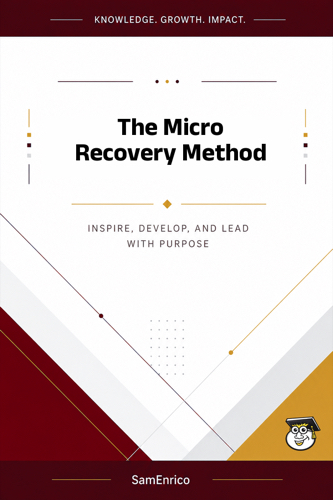
The Micro Recovery Method eBook
Teaches one to five minute recovery rituals throug
Teaches one to five minute recovery rituals throughout the workday to prevent cumulative fatigue.
Formats
Free sample
Chapter 1: The Death by a Thousand Clicks--You are not tired because you work too hard.Let that land for a moment. The dominant narrative of burnout—the one sold to you by hustle culture memes, overworked martyrs, and well-meaning but misguided influencers—is that exhaustion is the natural price of ambition. Work harder, sleep less, push through, and the success you deserve will eventually catch up to you. The fact that you feel drained by 2:00 PM is simply evidence that you aren't trying hard enough.This narrative is not only wrong. It is dangerous.The truth is far more insidious, and far more liberating.
You are not exhausted because of the big things—the quarterly report, the client presentation, the product launch. You are exhausted because of the small things. The thousand tiny, invisible, almost laughably minor interruptions, decisions, and physical discomforts that accumulate over the course of a single morning like a stealth tax on your nervous system.This chapter introduces the problem that the rest of this book exists to solve. We call it the Micro-Stress Spiral. Understanding it is not optional; it is the prerequisite for every recovery ritual that follows.
If you do not understand what is draining you, no breathing exercise or five-minute break will ever be enough.The 89% Phenomenon In 2019, the American Institute of Stress published a staggering finding that largely went unnoticed outside of occupational health circles. When researchers asked workers to identify the primary sources of their daily mental fatigue and burnout, only 11 percent pointed to major traumatic events—a layoff, a public failure, a toxic confrontation, a missed promotion. The remaining 89 percent identified something else entirely: the accumulation of low-grade, repetitive, seemingly minor stressors.A buzzing phone during deep work. A Slack notification that breaks a train of thought. A poorly timed email from a colleague who could have just walked over to your desk.
A stiff neck from a chair that was never designed for a human spine. A forgotten password that requires a reset, which requires checking your personal email, which leads to a news headline that spikes your blood pressure. A meeting that could have been an email. An email that should have been a meeting. A Zoom call where someone's audio cuts out and you spend ninety seconds saying "Can you hear me now?"None of these events, taken alone, would send a reasonable person to the brink.
That is precisely the problem. Because each one is so small, so mundane, so laughably trivial, you do not notice them. You do not count them. You do not build recovery time for them. You simply absorb them, one after another, like a sponge quietly soaking up dishwater until it becomes too heavy to lift.By 10:00 AM on a typical Tuesday, the average knowledge worker has experienced somewhere between thirty and fifty of these micro-stressors.
And because each one triggers a tiny but measurable spike in cortisol—the body's primary stress hormone—your nervous system has been in a state of low-grade activation for three straight hours. You are not tired because you worked hard. You are tired because your fight-or-flight response has been idling in neutral since you opened your laptop.The Context Switch Tax To understand how micro-stressors accumulate, you must first understand the single most expensive cognitive cost of modern work: the context switch.In 2008, researchers Gloria Mark, Daniela Gudith, and Ulrich Klocke at the University of California, Irvine conducted a landmark study on interruptions in the workplace. They followed knowledge workers through their days, tracking every time they switched from one task to another—whether by choice or because of an external interruption. The results were devastating.When a worker was interrupted—by an email, a chat message, a colleague stopping by—it took an average of twenty-five minutes to fully return to the original task at the same level of focus and cognitive depth.
Not two minutes. Not ten. Twenty-five minutes. In some cases, workers never fully returned; they abandoned the original task entirely and moved on to something else, leaving a trail of half-finished work behind them.Here is what that means in practice. Imagine you begin your day with a clear intention: you will spend the first hour writing a project proposal.
At 9:05 AM, a Slack message arrives. It is not urgent, but it is mildly interesting. You glance at it. You reply. That glance cost you twenty-five minutes of proposal focus.
At 9:30 AM, your phone buzzes with a news alert. You do not even open it, but the glance breaks your flow. Another twenty-five minutes. At 9:45 AM, a colleague stops by your desk to ask a question that could have been an email. You answer politely.
Another twenty-five minutes.By 10:00 AM, you have spent zero minutes in deep focus on the proposal, even though you have been "working" for an hour. Your brain has been context-switching continuously, bleeding cognitive efficiency with every interruption. And because you never noticed the cost—it is invisible, after all—you blame yourself for being lazy, unfocused, or undisciplined.You are none of those things. You are simply being asked to perform a task that the human brain was never designed to do: continuous, uninterrupted attention in an environment engineered for continuous, uninterrupted interruption.The Anatomy of a Micro-Stressor Micro-stressors come in four primary categories. Learning to recognize them is the first step toward recovering from them.Cognitive Micro-Stressors are the most familiar.
These are interruptions that demand mental processing: a confusing email, a request for information you do not have, a decision that requires research, a meeting agenda that arrives five minutes late. Each cognitive micro-stressor forces your brain to load a new context, evaluate its urgency, and either act or defer. The act of deferring—deciding not to act—is itself a cognitive cost. You cannot simply ignore an email; you must first decide to ignore it.Physical Micro-Stressors are the ones you have learned to tolerate. A chair that does not support your lower back.
A screen at the wrong height. A keyboard that requires slightly too much force. A room that is two degrees too cold. Your jaw clenched. Your shoulders raised.
Your brow furrowed. Each of these physical states sends a signal to your nervous system: Threat. Be ready. Your body does not know the difference between a furrowed brow caused by deep concentration and a furrowed brow caused by fear. It simply receives the signal and releases cortisol accordingly.Emotional Micro-Stressors are the sharpest.
A passive-aggressive comment in a team meeting. A client who sounds disappointed. A piece of feedback that lands like a paper cut—small, but stinging. An email from your boss that ends with a period instead of an exclamation point, and you spend ten minutes decoding what that means. These micro-stressors trigger the amygdala, the brain's threat-detection center, which responds to social rejection the same way it responds to physical danger.
The rude comment is not actually dangerous. But your nervous system does not know that.Environmental Micro-Stressors are the ones you have stopped noticing. The overhead fluorescent light that flickers every few minutes. The office refrigerator that hums at an annoying frequency. The open-plan desk where…
This is the end of the free sample. Get the eBook to keep going. Buy now
About this book
Details
- Author
- Shumate Lakia
- Publisher
- SamEnrico
- Language
- English
- Genre
- Non-Fiction, Self-Help, Cognitive Fitness
- Released
- 2026-06-09
- Pages (approx.)
- 147
- Available as
- eBook, Audiobook

Read better in the ZLOADR app
Your eBooks on your phone or tablet. Sign in with your SamEnrico account and start reading.
More by Shumate Lakia
 Emotional Trading GuideShumate Lakia$11.99
 Resentment About MoveShumate Lakia$11.99
 Caregiver Burnout for Kidney DiseaseShumate Lakia$11.99
 Excalibur’s Shadow: The Lost Knights of the LabyrinthShumate Lakia$11.99
 How to Become a Lumite InjectorShumate Lakia$11.99
 UN Career Gateway Vacancy GuideShumate Lakia$12.99
 Olfactory Signature AnalyzerShumate Lakia$11.99
 How to Produce Baby and Toddler ClothingShumate Lakia$11.99
You may also like
 Hong Kong Handover 1997Dunn Johnnie$11.99
 Zumba For Postnatal Recovery CourseNeal Christian$11.99
 Zumba for BeginnersLadner Nikia$11.99
 YouTube Comment Mining GuideHumes Pandora$12.99
 Worry Box MeditationCarlin Rudy$11.99
 Workplace Stress MeditationNguyen Lynn$11.99
 Workplace Stress and Sleep RepairHawley Ivory$11.99
 Workplace Perfectionism CureDelaney Jeffry$11.99
 Workplace Injustice Anger GuideWallen Isabelle$11.99
 Work Addiction and Burnout LinkGreenwood Ester$11.99
 Women in Yoga and WellnessBeattie Galina$11.99
 Women in Stand Up ComedyChun Evangeline$11.99